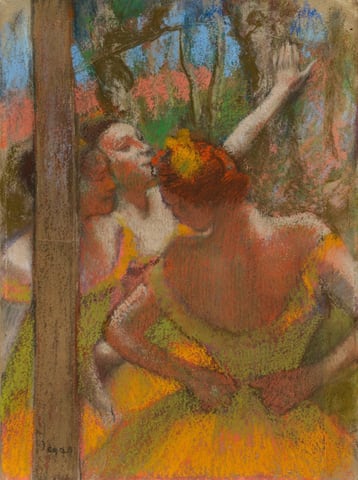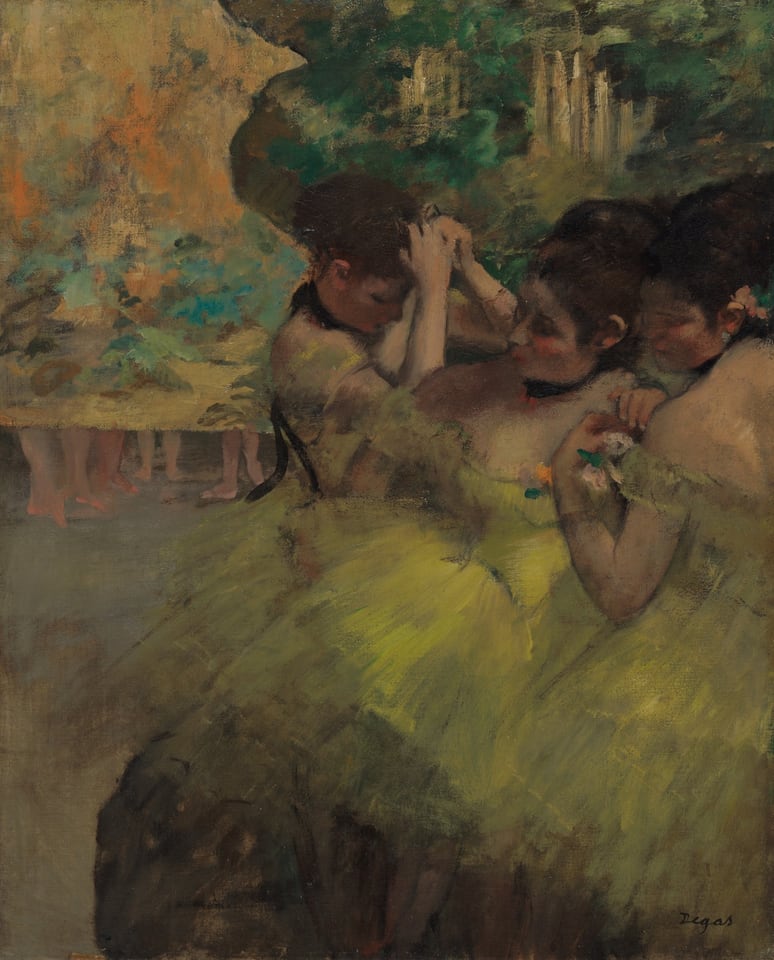
Yellow Dancers (In the Wings)1874–76
Edgar Degas first painted dancers as an independent subject in 1871. More about this work
About this work
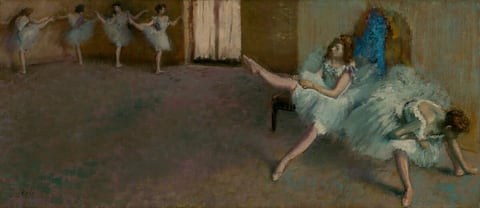
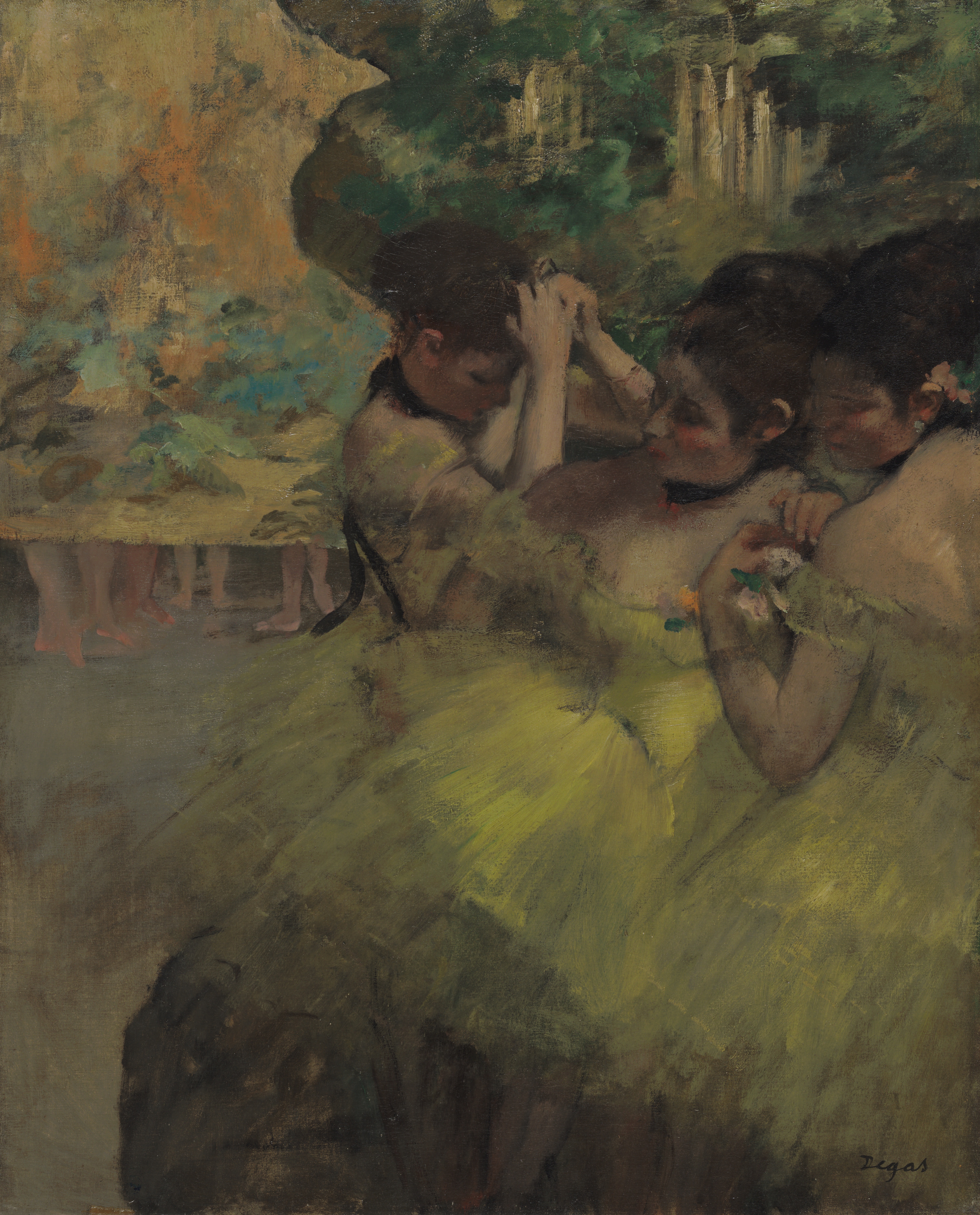
Edgar Degas first painted dancers as an independent subject in 1871. He would go on to devote almost half his output as an artist to this subject, observing countless performances and rehearsals at the Paris Opéra. Here, he placed the viewer in the wings, as if among the elite opera subscribers who paid for the privilege to roam and socialize backstage.
Text from the Art Institute of Chicago.
What you’re looking at
Three light-skinned, dark-haired ballerinas, painted in muted tones, wear off-the-shoulder yellow leotards and tutus as they huddle near each other. One adjusts her costume, while one holds her hands clasped above her head. At left is a painted screen with four pairs of feet visible underneath.
Description from the Art Institute of Chicago.
How it was made
- Oil paint
- Pigment ground in a drying oil, usually linseed. It dries slowly, so painters could blend on the canvas, build up thin translucent glazes, and rework a picture over weeks. Canvas replaced wooden panels in the 1500s because it is lighter and can be rolled.
Edgar Degas
French, 1834–1917 · Born and died in Paris.
Degas trained in the academic tradition, admired Ingres and spent three years in Italy copying earlier art, but turned to modern Paris for his subjects: dancers, racecourses, laundresses, milliners and café singers. He helped organise the Impressionist exhibitions and showed in all but one, yet preferred to call himself a realist. Working from drawing and memory rather than outdoors, he composed with unexpected cropping and viewpoints, and in later years worked mostly in pastel as his eyesight failed.
Written by Ochre Editions.
Impressionism
Painters in 1870s Paris who worked quickly, often outdoors, to catch light as it changed.
Rights and the museum’s record
Public domain. The Art Institute of Chicago has dedicated this image to the public domain under CC0, so anyone may copy, adapt and use it, for any purpose, without asking. Our prints and files are reproductions made from the museum’s image; the museum doesn’t endorse them.
- Object number
- 1963.923
- Credit
- Courtesy of the Art Institute of Chicago
- Type
- Painting
- Department
- Painting and Sculpture of Europe
- Licence
- CC0 1.0 Universal
- Museum record
- See it on the museum’s site
Report this work
More by Edgar Degas
All their works