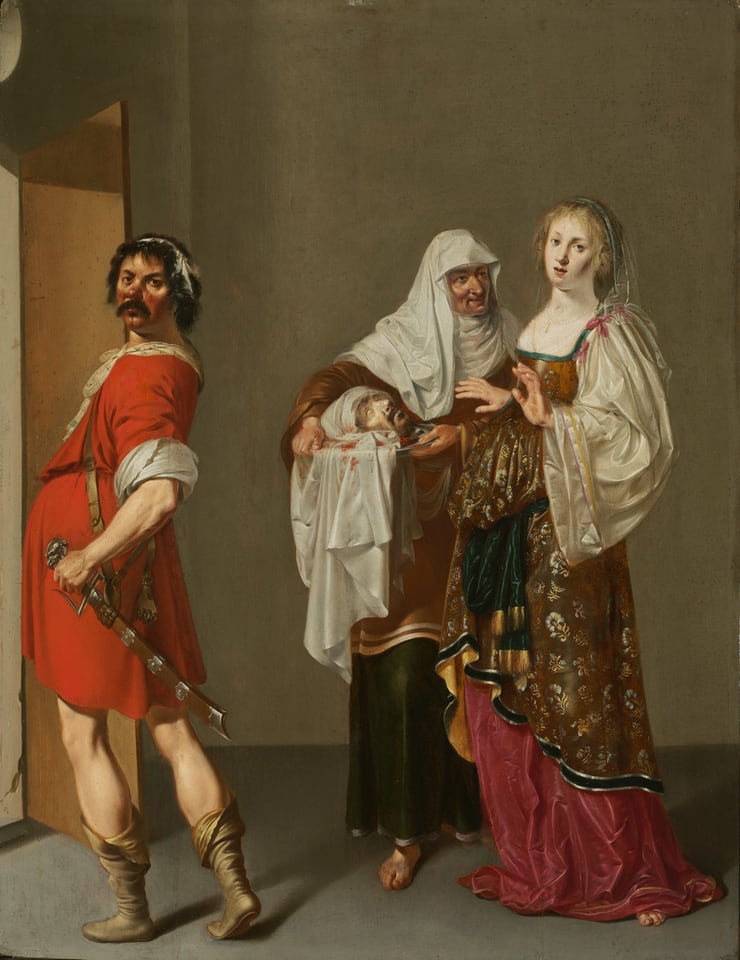
Salome with the Head of Saint John the Baptistmid-1600s
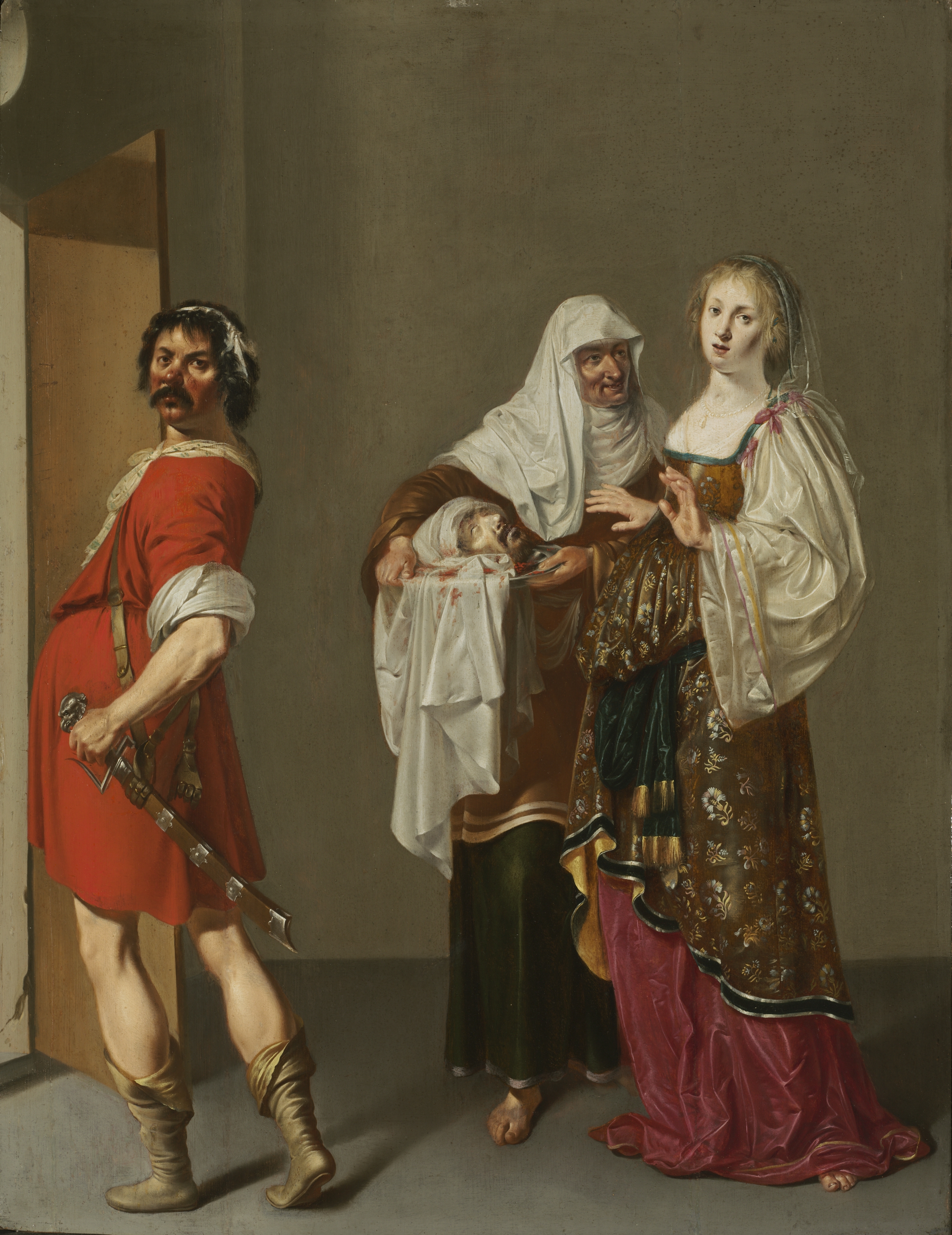
The colorful, exotic garments worn by the woman at the right demonstrate Jacob Duck’s skill in painting luxurious surfaces: she is Salome, daughter of Herodias. More about this work
About this work
The colorful, exotic garments worn by the woman at the right demonstrate Jacob Duck’s skill in painting luxurious surfaces: she is Salome, daughter of Herodias. According to the New Testament, Herodias bore a grudge against John the Baptist, who condemned her marriage to Herod, ruler of Galilee and Perea. At a celebration dinner, Salome so charmed Herod with her dancing that he offered her anything she desired—and Herodias convinced Salome to demand John the Baptist’s head. Rather than depicting the actual execution, Duck focused on the executioner’s muscled physique as he departs the scene, turning to look at the viewer after having presented Salome with John’s severed head.
Text from the Cleveland Museum of Art.
How it was made
- Oil on panel
- Oil paint on prepared wooden boards, usually oak in the north and poplar in Italy. The rigid, smooth surface suits fine detail and thin, glowing glazes.
- Oil paint
- Pigment ground in a drying oil, usually linseed. It dries slowly, so painters could blend on the canvas, build up thin translucent glazes, and rework a picture over weeks. Canvas replaced wooden panels in the 1500s because it is lighter and can be rolled.
Jacob Duck
Dutch, c. 1600–1667
Dutch Golden Age
Seventeenth-century painting from the Dutch Republic: still lifes, interiors, portraits and flat, wide skies.
Rights and the museum’s record
Public domain. The Cleveland Museum of Art has dedicated this image to the public domain under CC0, so anyone may copy, adapt and use it, for any purpose, without asking. Our prints and files are reproductions made from the museum’s image; the museum doesn’t endorse them.
- Object number
- 1975.79
- Credit
- Courtesy of the Cleveland Museum of Art
- Type
- Painting
- Department
- European Painting and Sculpture
- Licence
- CC0 1.0 Universal
- Museum record
- See it on the museum’s site
Report this work
Close in colour