Jean Hey (called Master of Moulins)
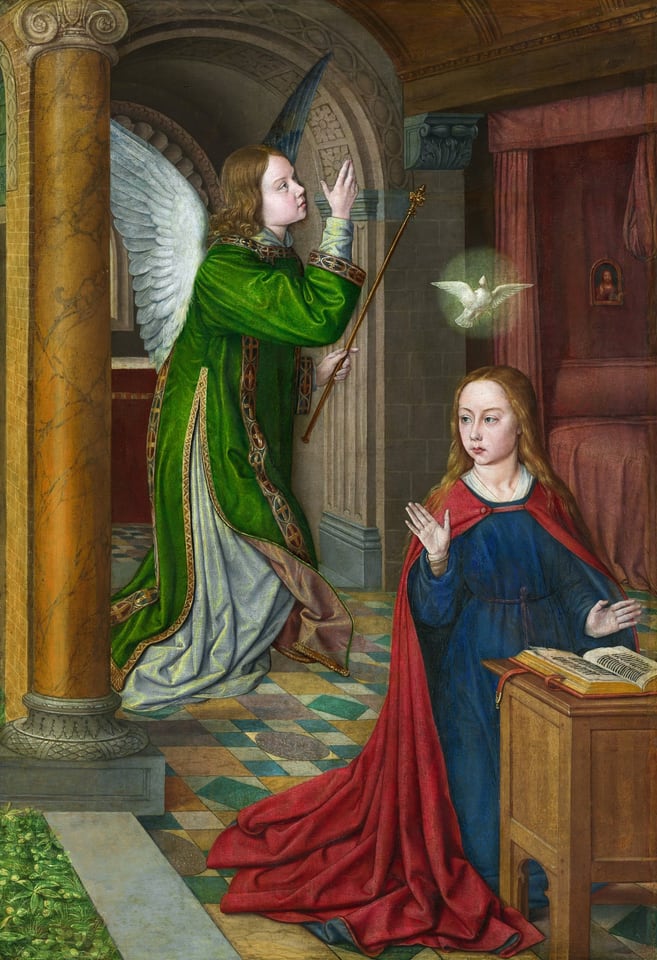
The Annunciation1490–95
Jean Hey, known as the Master of Moulins, was a leading painter in 15th-century France. Here, he captured the moment the archangel Gabriel announced to Mary that she would give birth to a son. More about this work
About this work
Jean Hey, known as the Master of Moulins, was a leading painter in 15th-century France. Here, he captured the moment the archangel Gabriel announced to Mary that she would give birth to a son. The painting once formed the right side of an altarpiece, with the left side depicting Mary’s own Immaculate Conception and a central section, now lost, featuring the enthroned Virgin and Child.
Text from the Art Institute of Chicago.
What you’re looking at
Painting of the Annunciation, dove flying above Mary with angel.
Description from the Art Institute of Chicago.
How it was made
- Oil on panel
- Oil paint on prepared wooden boards, usually oak in the north and poplar in Italy. The rigid, smooth surface suits fine detail and thin, glowing glazes.
- Oil paint
- Pigment ground in a drying oil, usually linseed. It dries slowly, so painters could blend on the canvas, build up thin translucent glazes, and rework a picture over weeks. Canvas replaced wooden panels in the 1500s because it is lighter and can be rolled.
Jean Hey (called Master of Moulins)
Netherlandish, active fourth quarter 15th century
Renaissance
European art from about 1400 to 1600, when painters rediscovered perspective and the classical past.
Rights and the museum’s record
Public domain. The Art Institute of Chicago has dedicated this image to the public domain under CC0, so anyone may copy, adapt and use it, for any purpose, without asking. Our prints and files are reproductions made from the museum’s image; the museum doesn’t endorse them.
- Object number
- 1933.1062
- Credit
- Courtesy of the Art Institute of Chicago
- Type
- Painting
- Department
- Painting and Sculpture of Europe
- Licence
- CC0 1.0 Universal
- Museum record
- See it on the museum’s site
Report this work
More by Jean Hey (called Master of Moulins)
All their works
Close in colour