Before the Ballet1890/1892
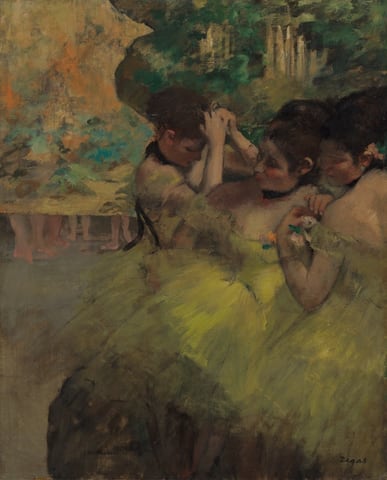
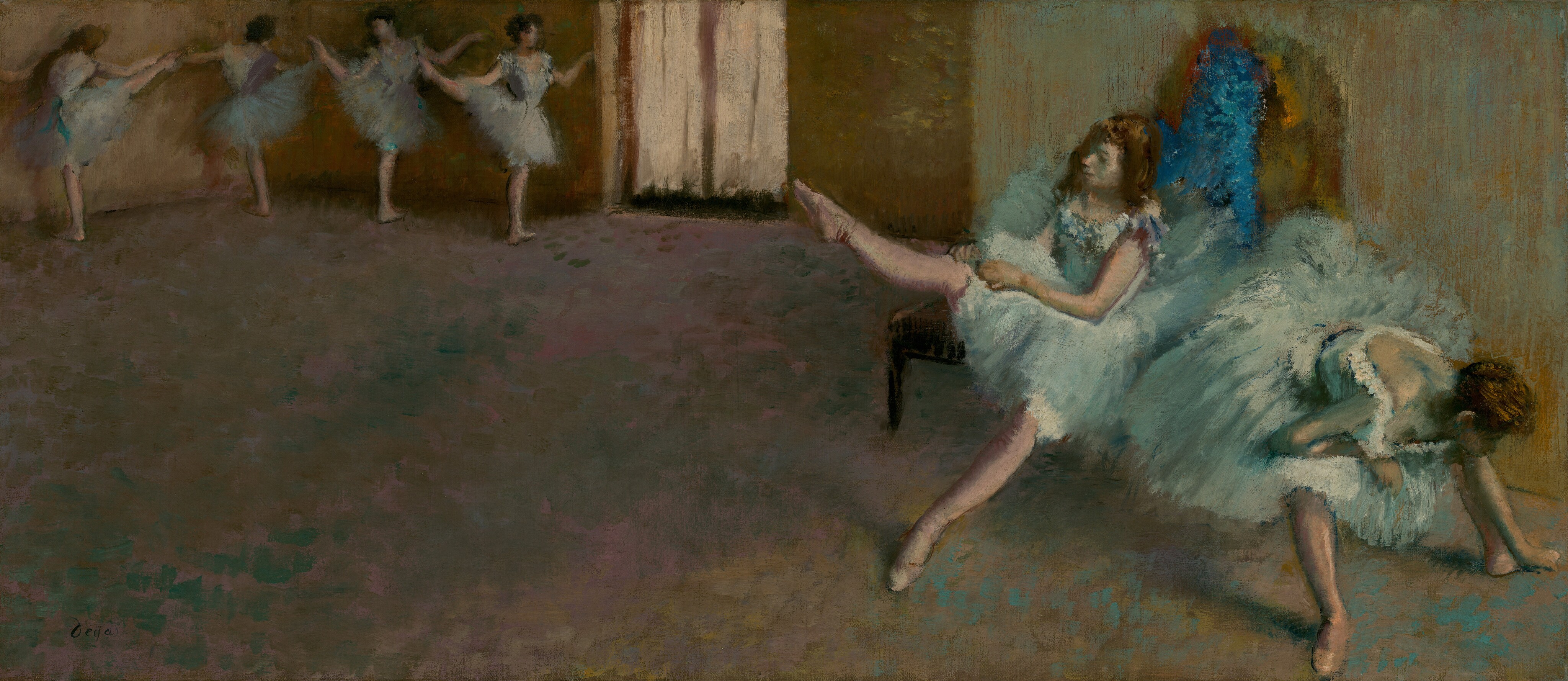
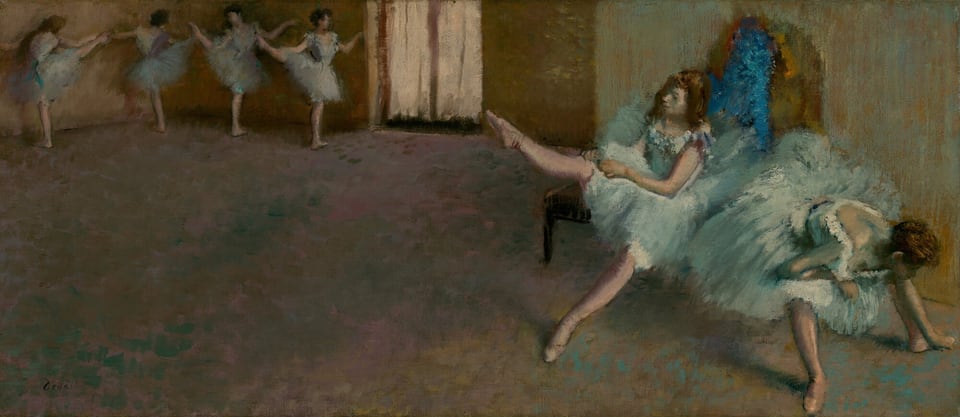
Two dancers in robin’s-egg-blue tutus sit on a bench in the foreground, one bending low to reach her foot, the other pulling on her pink tights, while across a broad expanse of floor four more practise with legs raised high. More about this work
About this work
Two dancers in robin’s-egg-blue tutus sit on a bench in the foreground, one bending low to reach her foot, the other pulling on her pink tights, while across a broad expanse of floor four more practise with legs raised high. Degas painted this long, frieze-like composition late in his career, when his eyesight was failing and his handling had grown broader and softer, with colour laid on in dabs of teal, pink and caramel. The diagonal sweep of the floor and the figures cut off at the edges reflect his lifelong interest in Japanese prints and the unposed moment.
Written by Ochre Editions.
What you’re looking at
In a dance studio, two ballerinas wearing knee-length tutus and ballet slippers sit on a bench and stretch to our right while four more pose at the back of the space, to our left, in this long, horizontal painting. The scene and dancers are loosely painted so many features are indistinct. All the women have light skin and dark brown hair. Each pale, robins’ egg-blue costume has a low-cut, tightly fitting, sleeveless bodice and a full skirt. Dabs of off white, teal, and blue suggest flowers lining the deep U of the neckline at the front and down the back of each bodice. Closest to us and nearly brushing the edges of the lower right corner of the canvas, one dancer sits on the end of a wooden bench and leans down between her legs, her feet widely planted. She rests her torso on an elbow folded onto one knee as she reaches for her left foot, farther from us, with her other hand. Her hair is pulled up and her face, looking downward, is deep in shadow. Sitting behind her on the bench, to our left, a second dancer lifts her right leg, toe pointing, as she pulls on her pale pink tights. Her other leg stretches straight, pointed toe brushing the floor, in front of her. This woman’s hair hangs loose around her shoulders. The pair is brightly lit from a source to our right, and an arched area of electric blue and mustard yellow behind them is difficult to interpret. The floor, which takes up about two-thirds of the composition, is painted with dabs of teal blue, pale fuchsia pink, and caramel brown. It leads us back to the upper left corner of the painting where four more four ballerinas stand in a line. The pair to our left stands with their backs to us, facing the wall with their right legs raised to shoulder height, toes pointed. The pair to our right faces us. They also stand with their right legs raised, creating a wide angle with their standing legs. All four ballerinas bend their arms gently at the elbow, and some tip their heads toward the raised legs. The rightmost dancer is illuminated by a pair of French doors at the back corner, at the top center of the painting. The wall behind the bench is streaked with mint green over honey brown, and the wall at the back of the room is leather brown. The visible, soft brushstrokes give the image a blurred, ethereal appearance in the dimmed studio. The artist signed the painting in the lower left corner, “Degas.”
Description from the National Gallery of Art.
How it was made
- Oil paint
- Pigment ground in a drying oil, usually linseed. It dries slowly, so painters could blend on the canvas, build up thin translucent glazes, and rework a picture over weeks. Canvas replaced wooden panels in the 1500s because it is lighter and can be rolled.
Edgar Degas
French, 1834–1917 · Born and died in Paris.
Degas trained in the academic tradition, admired Ingres and spent three years in Italy copying earlier art, but turned to modern Paris for his subjects: dancers, racecourses, laundresses, milliners and café singers. He helped organise the Impressionist exhibitions and showed in all but one, yet preferred to call himself a realist. Working from drawing and memory rather than outdoors, he composed with unexpected cropping and viewpoints, and in later years worked mostly in pastel as his eyesight failed.
Written by Ochre Editions.
Impressionism
Painters in 1870s Paris who worked quickly, often outdoors, to catch light as it changed.
Rights and the museum’s record
Public domain. The National Gallery of Art has dedicated this image to the public domain under CC0, so anyone may copy, adapt and use it, for any purpose, without asking. Our prints and files are reproductions made from the museum’s image; the museum doesn’t endorse them.
- Object number
- 1942.9.19
- Credit
- Courtesy National Gallery of Art, Washington
- Type
- Painting
- Licence
- CC0 1.0 Universal
- Museum record
- See it on the museum’s site
Report this work
More by Edgar Degas
All their works