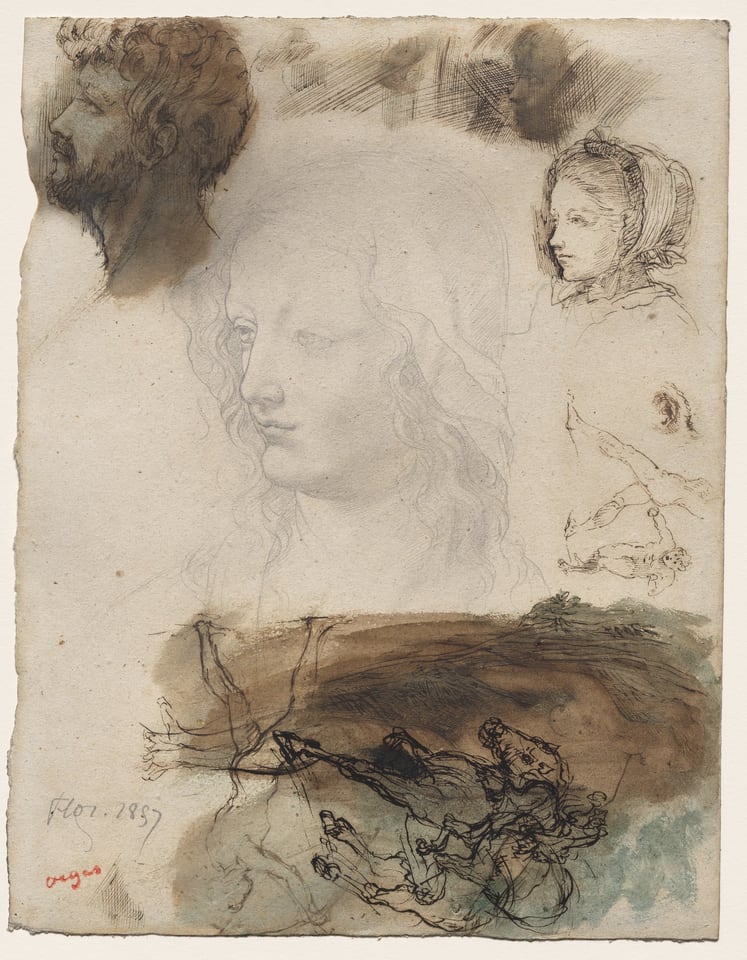
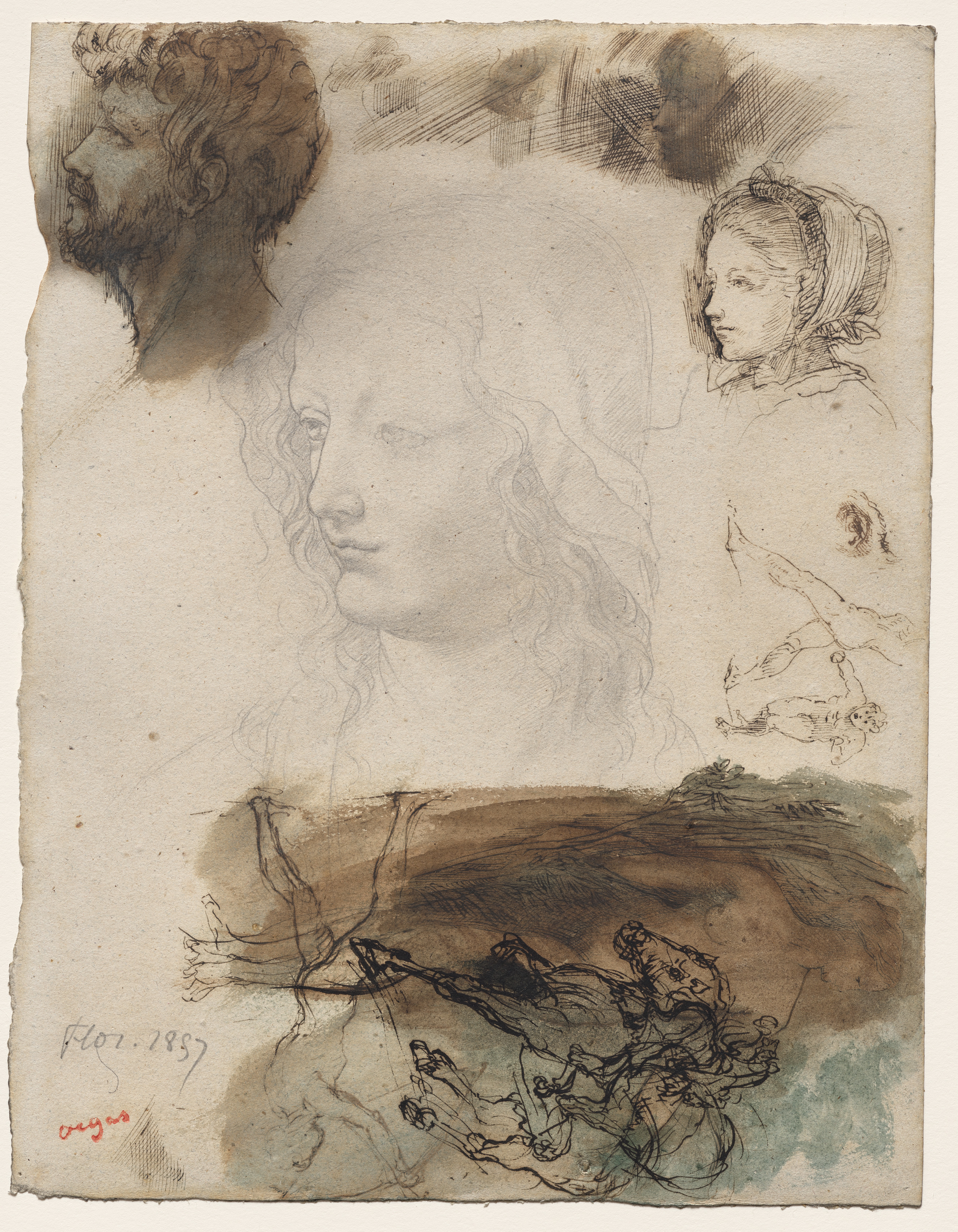
Sheet of Studies and Sketches1858
Degas traveled to Florence, Italy, in July 1858, where he made this sheet of studies. More about this work
About this work
Degas traveled to Florence, Italy, in July 1858, where he made this sheet of studies. The featured imagery is fragmented and dissociated, suggesting the young artist's engagement with art of the past. The refined female head drawn at center in graphite was copied from a drawing then attributed to Leonardo da Vinci in the Uffizi Gallery's collection. Other sketches record Degas's responses to Florentine sculpture. At upper right, he sketched an informal portrait of his cousin Giulia Bellelli, probably from life.
Text from the Cleveland Museum of Art.
How it was made
- Watercolour
- Pigment in gum arabic, thinned with water and laid in transparent washes. Nothing white is painted: the light is the paper showing through.
- Graphite
- Pencil. Graphite has been used for drawing since the 1500s; in 1795 Nicolas-Jacques Conté mixed it with clay, so its hardness could be graded.
- Pen and ink
- Drawn with a quill or reed pen, often with wash added by brush to model light and shadow.
Edgar Degas
French, 1834–1917 · Born and died in Paris.
Degas trained in the academic tradition, admired Ingres and spent three years in Italy copying earlier art, but turned to modern Paris for his subjects: dancers, racecourses, laundresses, milliners and café singers. He helped organise the Impressionist exhibitions and showed in all but one, yet preferred to call himself a realist. Working from drawing and memory rather than outdoors, he composed with unexpected cropping and viewpoints, and in later years worked mostly in pastel as his eyesight failed.
Written by Ochre Editions.
Impressionism
Painters in 1870s Paris who worked quickly, often outdoors, to catch light as it changed.
Rights and the museum’s record
Public domain. The Cleveland Museum of Art has dedicated this image to the public domain under CC0, so anyone may copy, adapt and use it, for any purpose, without asking. Our prints and files are reproductions made from the museum’s image; the museum doesn’t endorse them.
- Object number
- 1951.430
- Credit
- Courtesy of the Cleveland Museum of Art
- Type
- Drawing
- Department
- Drawings
- Licence
- CC0 1.0 Universal
- Museum record
- See it on the museum’s site
Report this work
More by Edgar Degas
All their works
Close in colour