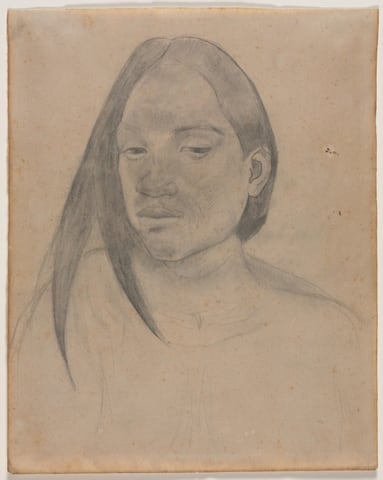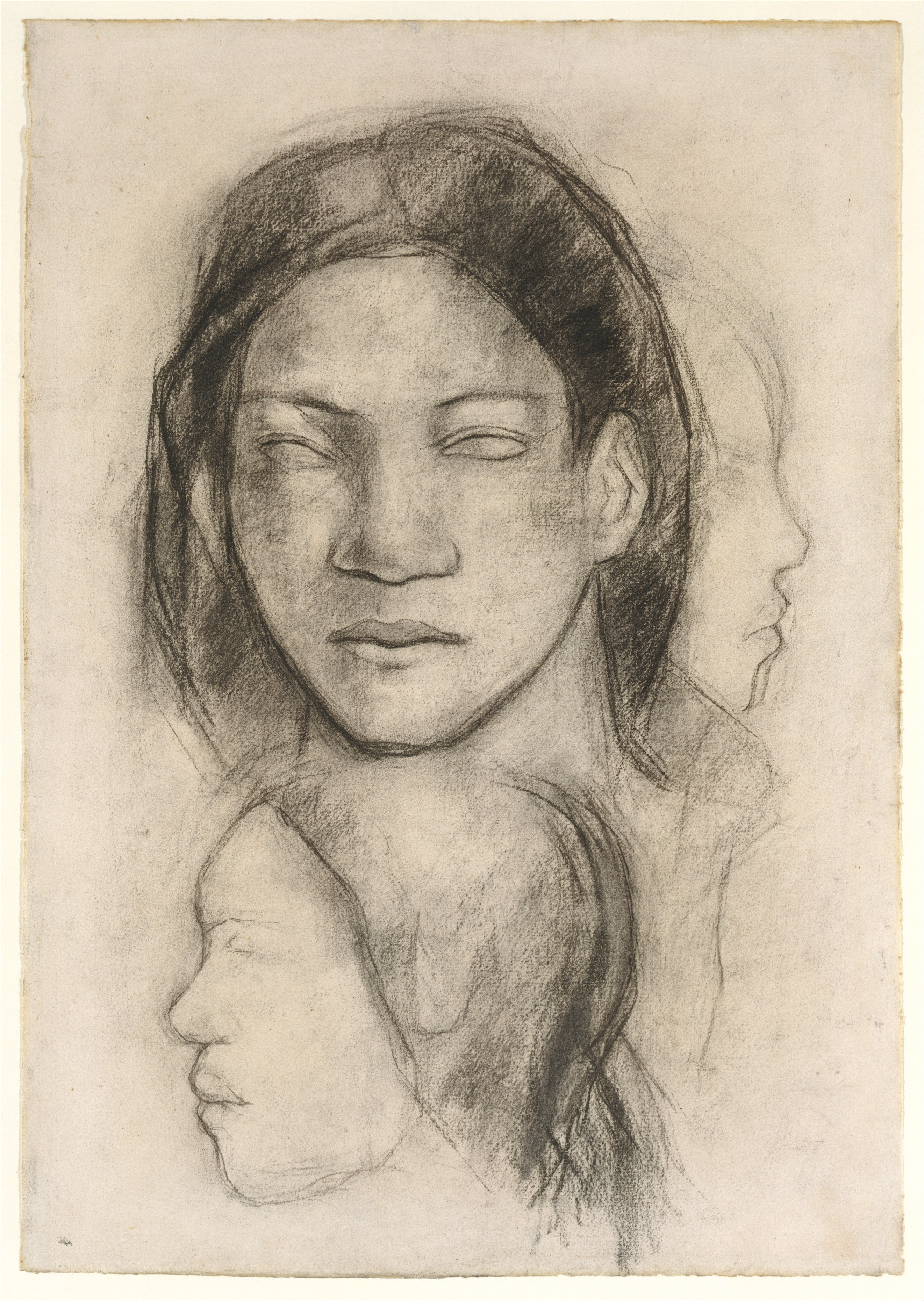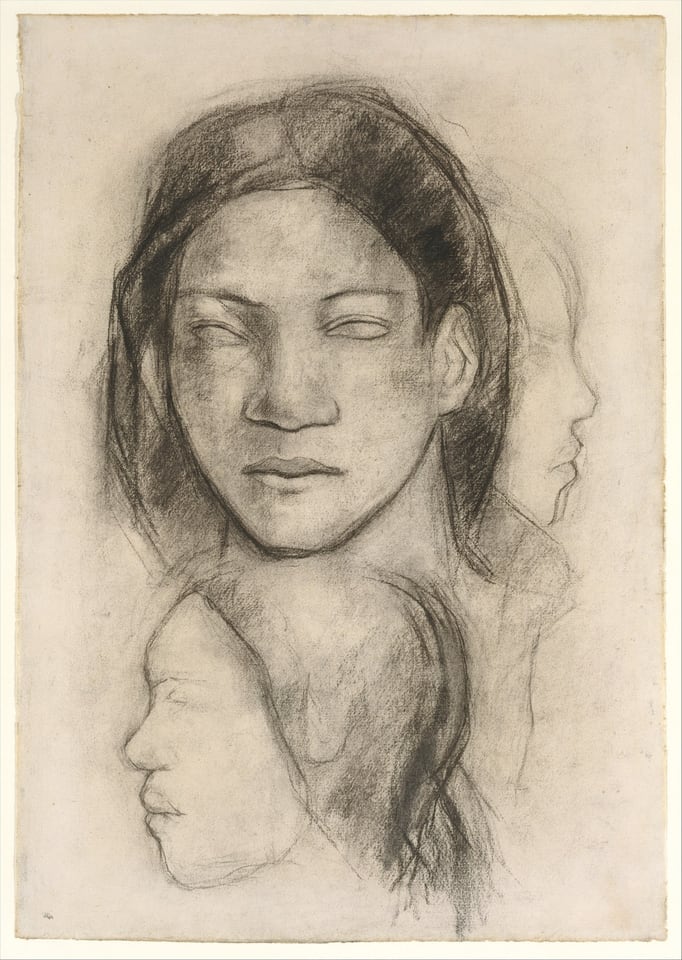
Tahitian Faces (Frontal View and Profiles)ca. 1899
A Tahitian woman’s face is studied from the front and in profile, in soft charcoal on laid paper. More about this work
About this work
A Tahitian woman’s face is studied from the front and in profile, in soft charcoal on laid paper. Gauguin made sheets like this in Tahiti around 1899, recording features and expressions that he could reuse in paintings, and the repeated heads, set side by side, have the solemn, sculptural presence he admired in non-European art. The rich blacks and smudged tones give the faces a quiet monumentality.
Written by Ochre Editions.
How it was made
- Charcoal
- Burnt willow or vine. It smudges and wipes away easily, which made it the natural tool for working out a composition.
- Laid paper
- Handmade on a mould of close-set wires, which leave fine parallel lines you can see when the sheet is held to the light.
Paul Gauguin
French, 1848–1903 · Born in Paris; died in Atuona, Hiva Oa, Marquesas Islands.
Gauguin worked as a Paris stockbroker and collected the Impressionists before taking up painting full time in the 1880s, showing in the last five Impressionist exhibitions. At Pont-Aven in Brittany he developed a style of flat colour and bold outline, and in 1888 he spent nine turbulent weeks with Van Gogh in Arles. Seeking a simpler world, he sailed for Tahiti in 1891 and spent most of his remaining years in French Polynesia, dying in the Marquesas.
Written by Ochre Editions.
Post-Impressionism
Artists who kept Impressionism's colour but pushed towards structure, symbol and feeling.
Rights and the museum’s record
Public domain. The Met has dedicated this image to the public domain under CC0, so anyone may copy, adapt and use it, for any purpose, without asking. Our prints and files are reproductions made from the museum’s image; the museum doesn’t endorse them.
- Object number
- 1996.418
- Credit
- Courtesy of The Metropolitan Museum of Art
- Type
- Drawings
- Department
- Drawings and Prints
- Licence
- CC0 1.0 Universal
- Museum record
- See it on the museum’s site