Trajan1546
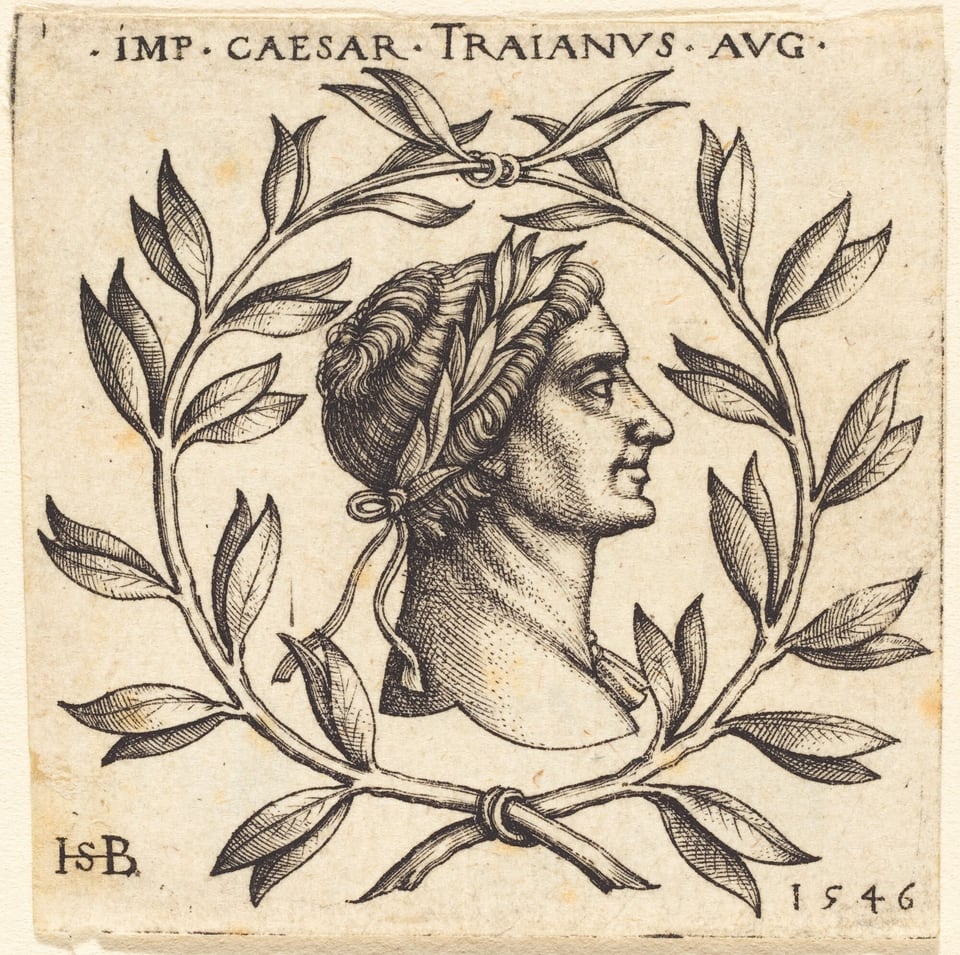
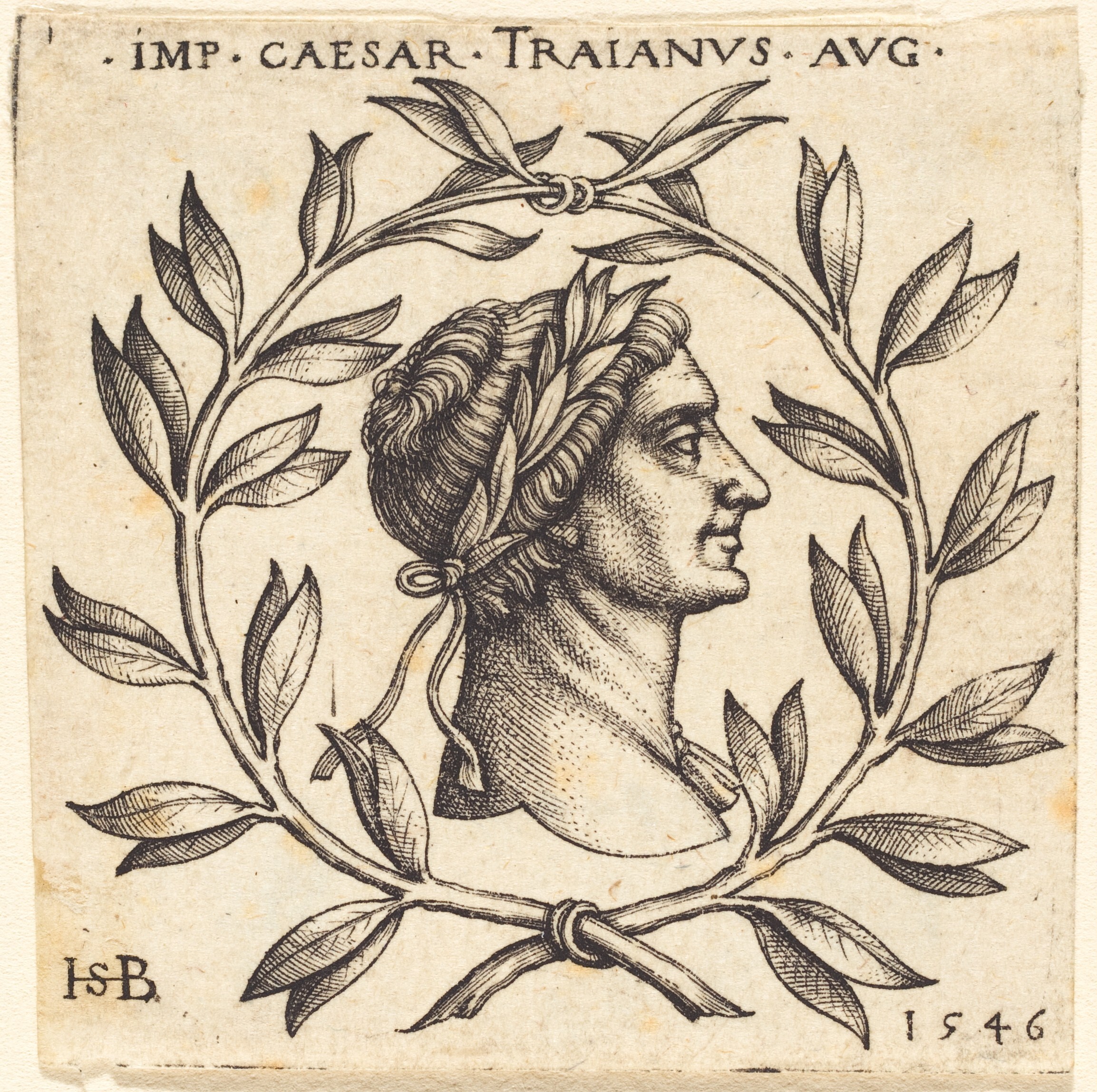
The Roman emperor Trajan appears in profile, crowned with laurel, within a circular wreath and inscribed with his imperial titles in Latin, as if on an ancient coin or medal. More about this work
About this work
The Roman emperor Trajan appears in profile, crowned with laurel, within a circular wreath and inscribed with his imperial titles in Latin, as if on an ancient coin or medal. Sebald Beham, one of the so-called Little Masters of Nuremberg, specialised in tiny, exquisitely detailed engravings, and his images of emperors drew on the Roman coins that Renaissance collectors prized. He dated the plate 1546.
Written by Ochre Editions.
What you’re looking at
The image shows a profile of a person's head and partial neck within a circular laurel wreath. The individual has distinct facial features, including a prominent nose and chin. The hairstyle is tight, wavy locks pulled back, and a laurel wreath crowns the head. The background is plain, with an inscription reading "IMP. CAESAR. TRAIANVS. AVG." Below the portrait are the initials "ISB" and the year "1546". The overall style resembles a classical engraving, featuring detailed line work and traditional iconography.
Description from the National Gallery of Art.
How it was made
- Engraving
- Lines cut directly into a metal plate with a steel burin, which makes them swell and taper. It took years to master, and for centuries it was how paintings travelled as pictures.
Sebald Beham
German, 1500–1550
Sebald Beham trained in Nuremberg in the orbit of Dürer and was one of the “Little Masters”, engravers known for tiny, finely worked plates of biblical, mythological and peasant subjects. In 1525 he, his brother Barthel and Georg Pencz were tried and banished from the city as the “godless painters” for their radical religious views. He later settled in Frankfurt, where he worked prolifically on engravings, woodcuts and book illustrations.
Written by Ochre Editions.
Rights and the museum’s record
Public domain. The National Gallery of Art has dedicated this image to the public domain under CC0, so anyone may copy, adapt and use it, for any purpose, without asking. Our prints and files are reproductions made from the museum’s image; the museum doesn’t endorse them.
- Object number
- 1943.3.1044
- Credit
- Courtesy National Gallery of Art, Washington
- Type
- Licence
- CC0 1.0 Universal
- Museum record
- See it on the museum’s site
Report this work
More by Sebald Beham
All their works
Close in colour