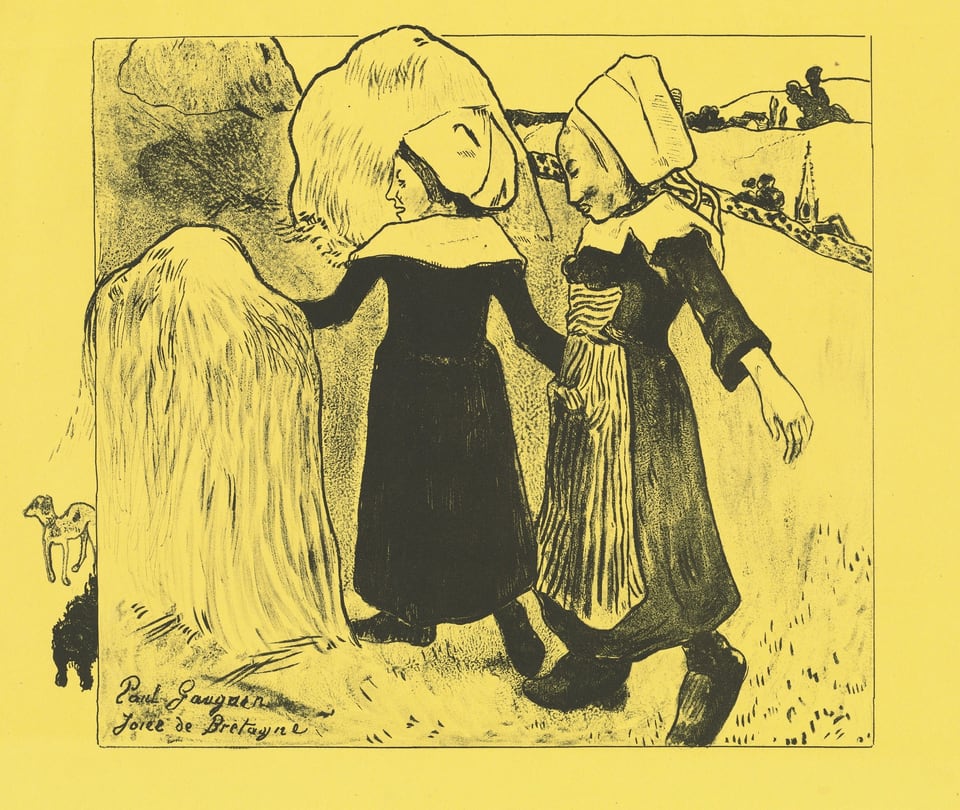
Pleasures of Brittany (Joies de Bretagne)1889
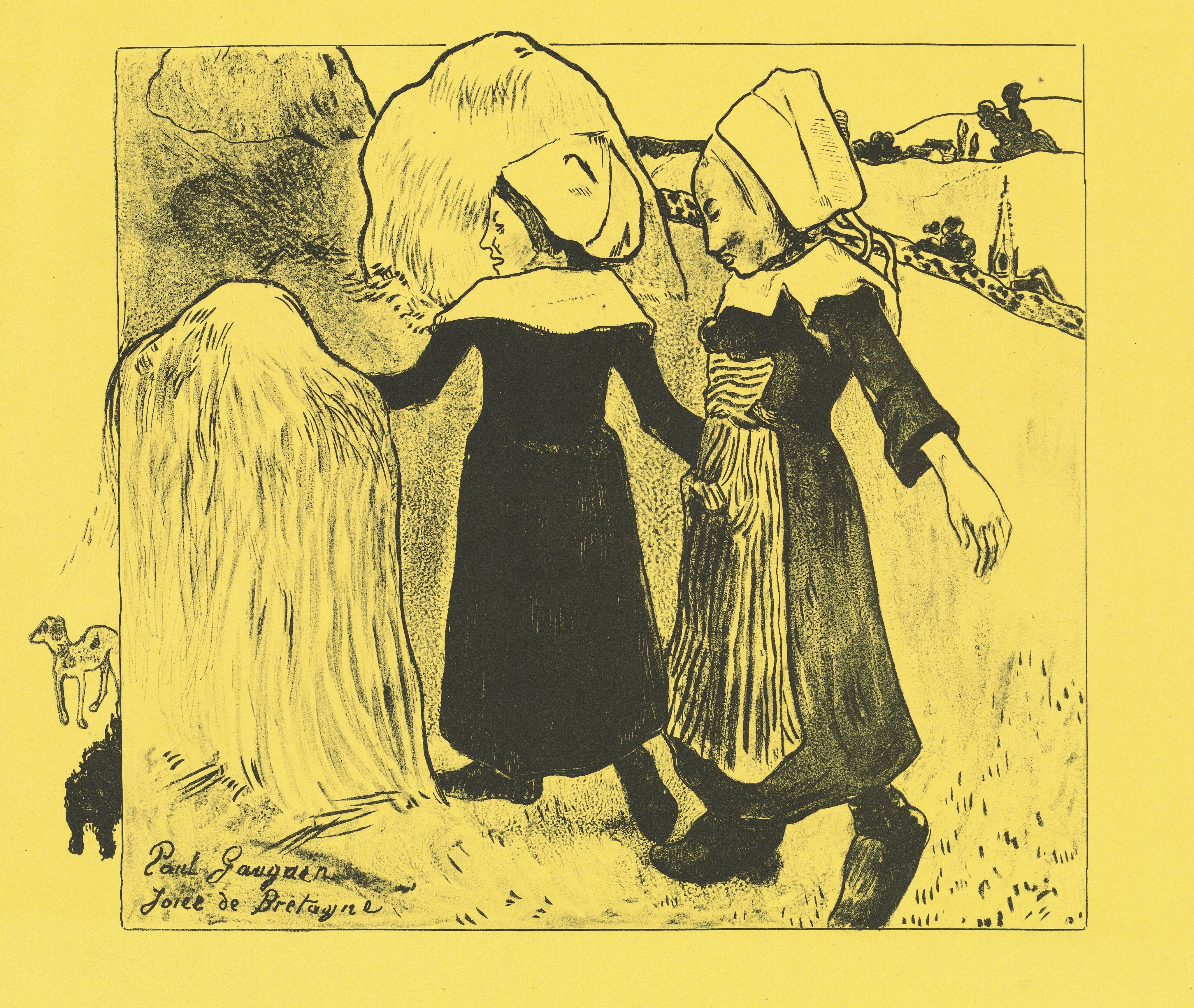
Two Breton women in traditional dress, one in a striped apron, walk arm in arm among haystacks, with a dog nearby and a spire in the distance. More about this work
About this work
Two Breton women in traditional dress, one in a striped apron, walk arm in arm among haystacks, with a dog nearby and a spire in the distance. The print belongs to the Volpini Suite, a set of eleven zincographs on bright yellow paper that Gauguin made in 1889 and showed at the Café des Arts, run by Monsieur Volpini, during the Paris Universal Exposition. Their flat shapes and bold outlines, inspired by Japanese prints and folk imagery, announced the new style Gauguin and his circle were developing in Brittany.
Written by Ochre Editions.
What you’re looking at
The image shows two women walking arm in arm, both in traditional attire. One woman is facing away with a slight profile, while the other is seen from the side. Their faces are stylized and simplistic with covered hair. They wear long dresses with aprons and collars, and one has a striped apron. Haystacks and greenery surround them. Faint figures are in the background, as well as a spire-like structure. A dog is seen near the haystack, with simple lines suggesting a landscape.
Description from the National Gallery of Art.
How it was made
- Lithograph
- Drawn on limestone with a greasy crayon or ink. The stone is kept damp, and the oily printing ink clings only to the drawing. Invented in the 1790s, it let artists print exactly as they drew.
Paul Gauguin
French, 1848–1903 · Born in Paris; died in Atuona, Hiva Oa, Marquesas Islands.
Gauguin worked as a Paris stockbroker and collected the Impressionists before taking up painting full time in the 1880s, showing in the last five Impressionist exhibitions. At Pont-Aven in Brittany he developed a style of flat colour and bold outline, and in 1888 he spent nine turbulent weeks with Van Gogh in Arles. Seeking a simpler world, he sailed for Tahiti in 1891 and spent most of his remaining years in French Polynesia, dying in the Marquesas.
Written by Ochre Editions.
Post-Impressionism
Artists who kept Impressionism's colour but pushed towards structure, symbol and feeling.
Rights and the museum’s record
Public domain. The National Gallery of Art has dedicated this image to the public domain under CC0, so anyone may copy, adapt and use it, for any purpose, without asking. Our prints and files are reproductions made from the museum’s image; the museum doesn’t endorse them.
- Object number
- 1978.54.1
- Credit
- Courtesy National Gallery of Art, Washington
- Type
- Licence
- CC0 1.0 Universal
- Museum record
- See it on the museum’s site
Report this work
More by Paul Gauguin
All their works
Close in colour