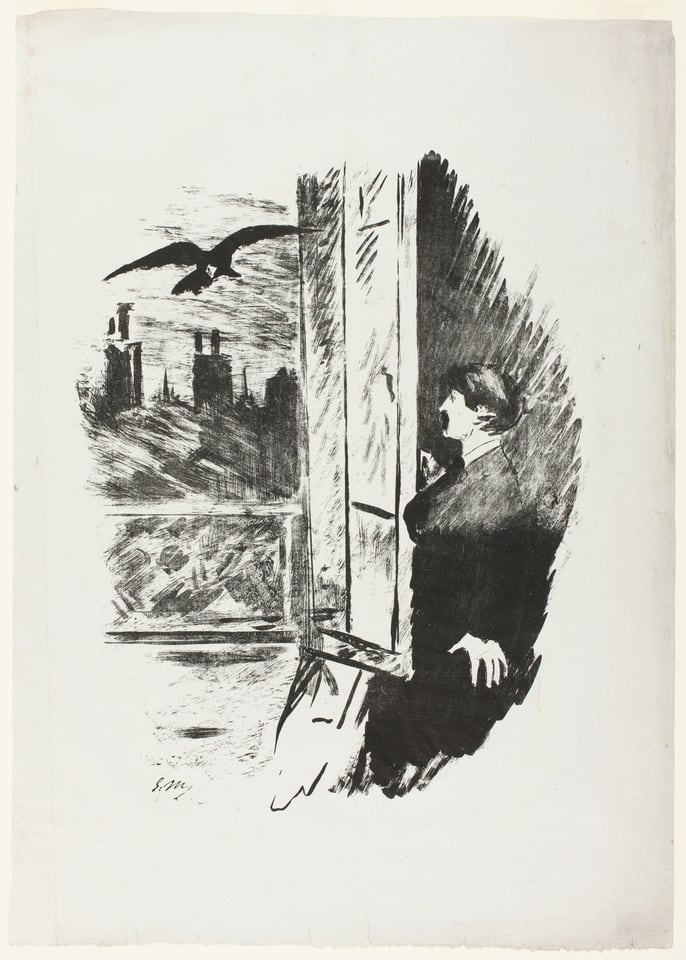
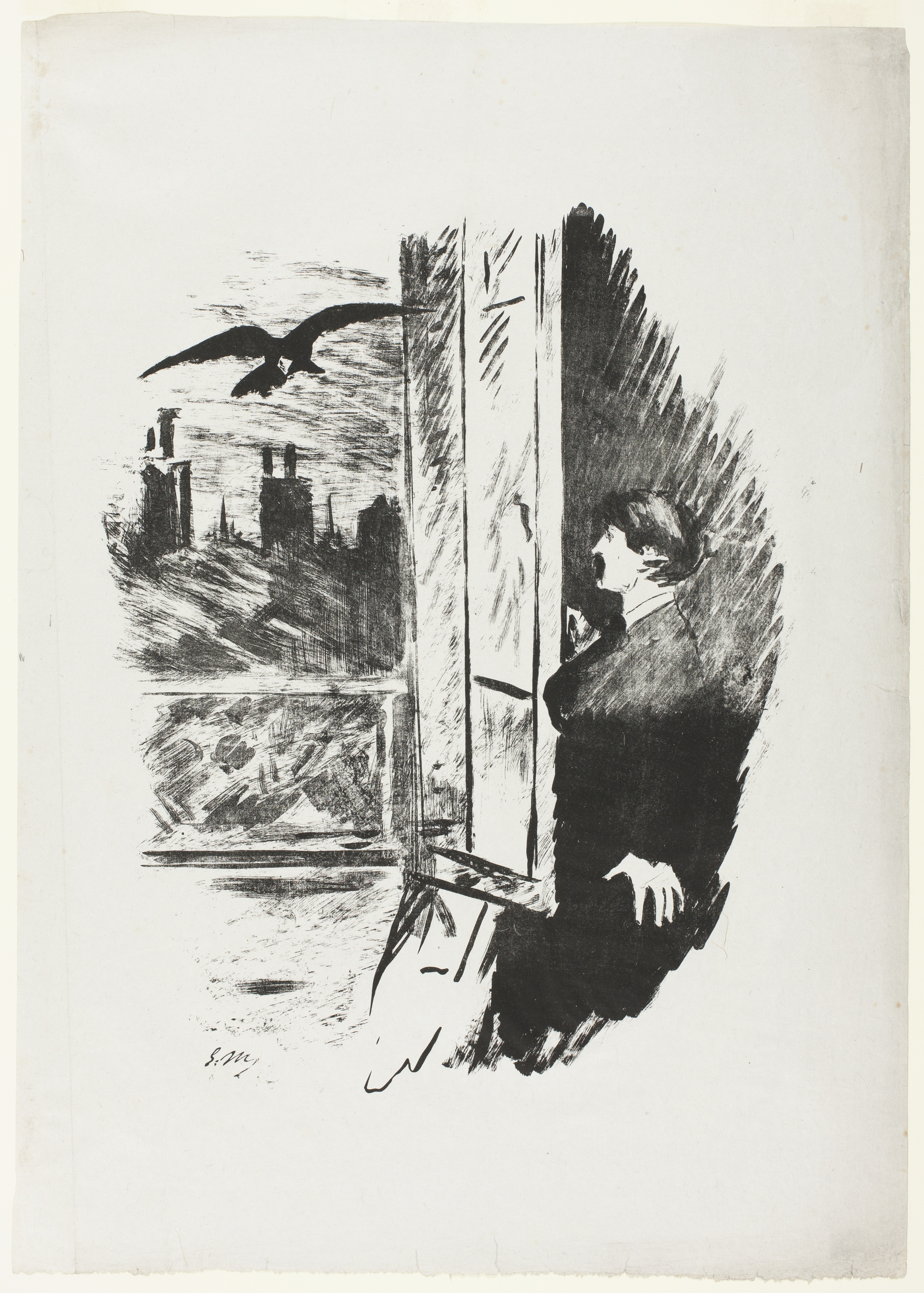
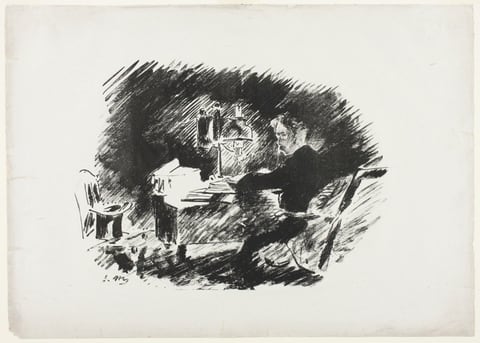
At the window ("Open here I flung the shutter..."), from The Raven (Le Corbeau)1875
“Open here I flung the shutter”: in Poe’s poem the sleepless narrator throws open his window, and in steps the raven, which will perch above his door and answer every question with “Nevermore”. More about this work
About this work
“Open here I flung the shutter”: in Poe’s poem the sleepless narrator throws open his window, and in steps the raven, which will perch above his door and answer every question with “Nevermore”. Manet’s illustration, for Stéphane Mallarmé’s French translation published in 1875, is drawn with a loaded brush in bold, broken strokes of black. The transfer lithograph process allowed him to work on paper and have the drawing printed directly, keeping the immediacy of his hand.
Written by Ochre Editions.
What you’re looking at
A work made of transfer lithograph in black on gray china paper.
Description from the Art Institute of Chicago.
How it was made
- Lithograph
- Drawn on limestone with a greasy crayon or ink. The stone is kept damp, and the oily printing ink clings only to the drawing. Invented in the 1790s, it let artists print exactly as they drew.
Édouard Manet
French, 1832–1883 · Born and died in Paris.
Manet came from a prosperous Parisian family, trained under Thomas Couture and studied the old masters, Velázquez above all. In the 1860s he provoked critics with Le Déjeuner sur l’herbe and Olympia, modern subjects painted in flat, frank colour with little modelling. Though he never showed with the Impressionists, younger painters looked to him as a leader, and in his last years he painted Parisian café life and A Bar at the Folies-Bergère.
Written by Ochre Editions.
Rights and the museum’s record
Public domain. The Art Institute of Chicago has dedicated this image to the public domain under CC0, so anyone may copy, adapt and use it, for any purpose, without asking. Our prints and files are reproductions made from the museum’s image; the museum doesn’t endorse them.
- Object number
- 1945.52.5
- Credit
- Courtesy of the Art Institute of Chicago
- Type
- Department
- Prints and Drawings
- Licence
- CC0 1.0 Universal
- Museum record
- See it on the museum’s site
Report this work
More by Édouard Manet
All their works
Close in colour