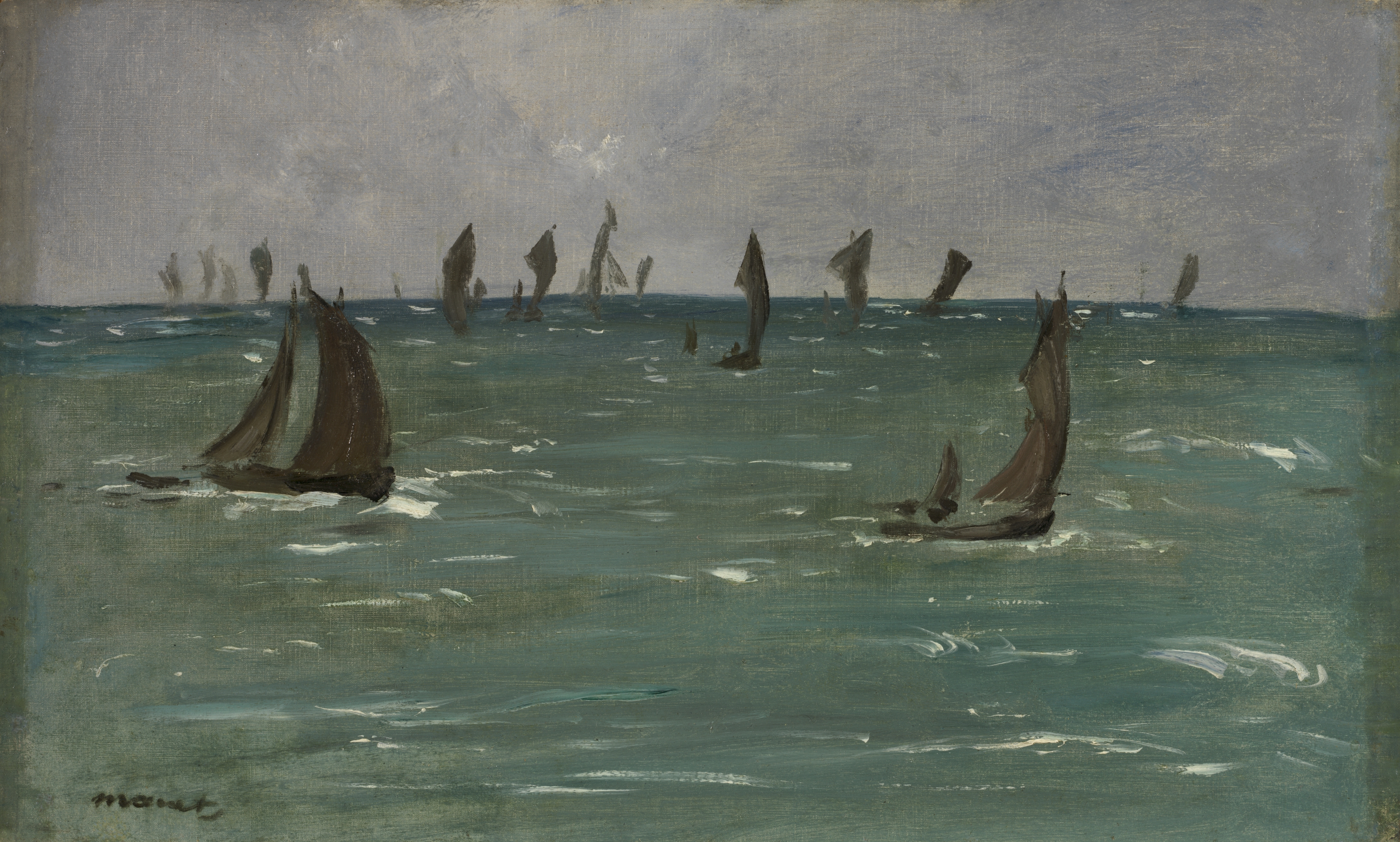
Boats at Berck-sur-Mer1873
Ever since his childhood, Manet spent almost every summer at the seashore. More about this work
About this work
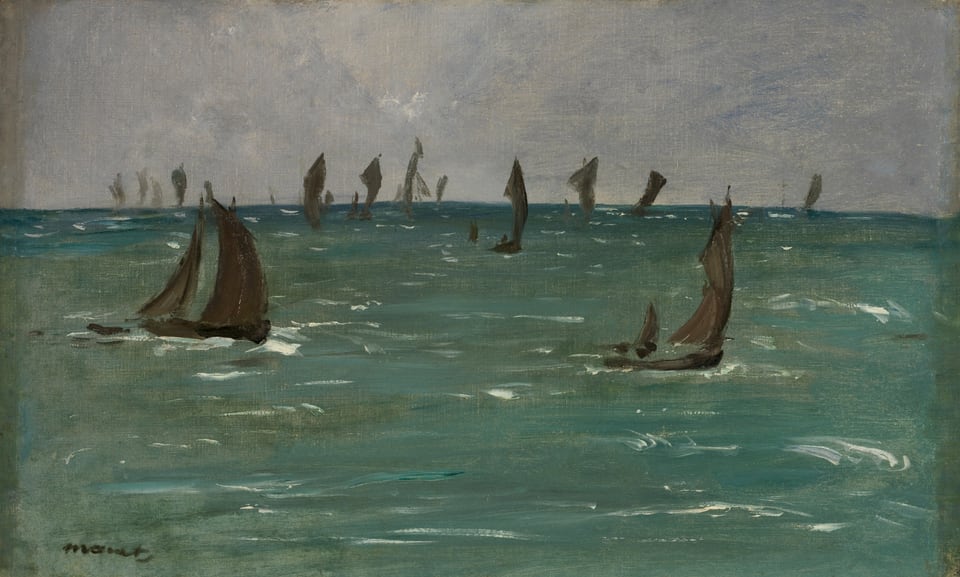
Ever since his childhood, Manet spent almost every summer at the seashore. At age 16, after failing the entrance exam for the naval academy, he embarked as an apprentice on a training ship, traveling as far away as Rio de Janeiro. The sea would always capture his imagination, and in 1864 he painted several seascapes. This painting was made nearly ten years later, while the artist was staying in Berck-sur-Mer, near Boulogne. Exploring light and movement, he rapidly sketched the sails of the countless ships that dance in the wind on blue-green waves highlighted with white. Manet even added a slight curve to the horizon, thus conveying an impression of infinite space, despite the painting's small size.
Text from the Cleveland Museum of Art.
How it was made
- Oil paint
- Pigment ground in a drying oil, usually linseed. It dries slowly, so painters could blend on the canvas, build up thin translucent glazes, and rework a picture over weeks. Canvas replaced wooden panels in the 1500s because it is lighter and can be rolled.
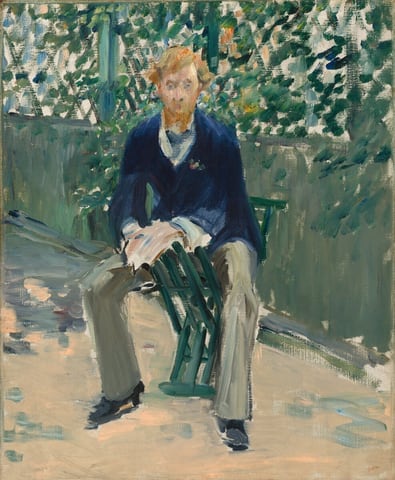
Édouard Manet
French, 1832–1883 · Born and died in Paris.
Manet came from a prosperous Parisian family, trained under Thomas Couture and studied the old masters, Velázquez above all. In the 1860s he provoked critics with Le Déjeuner sur l’herbe and Olympia, modern subjects painted in flat, frank colour with little modelling. Though he never showed with the Impressionists, younger painters looked to him as a leader, and in his last years he painted Parisian café life and A Bar at the Folies-Bergère.
Written by Ochre Editions.
Rights and the museum’s record
Public domain. The Cleveland Museum of Art has dedicated this image to the public domain under CC0, so anyone may copy, adapt and use it, for any purpose, without asking. Our prints and files are reproductions made from the museum’s image; the museum doesn’t endorse them.
- Object number
- 1940.534
- Credit
- Courtesy of the Cleveland Museum of Art
- Type
- Painting
- Department
- Modern European Painting and Sculpture
- Licence
- CC0 1.0 Universal
- Museum record
- See it on the museum’s site
Report this work
More by Édouard Manet
All their works