The Poet's Garden1888
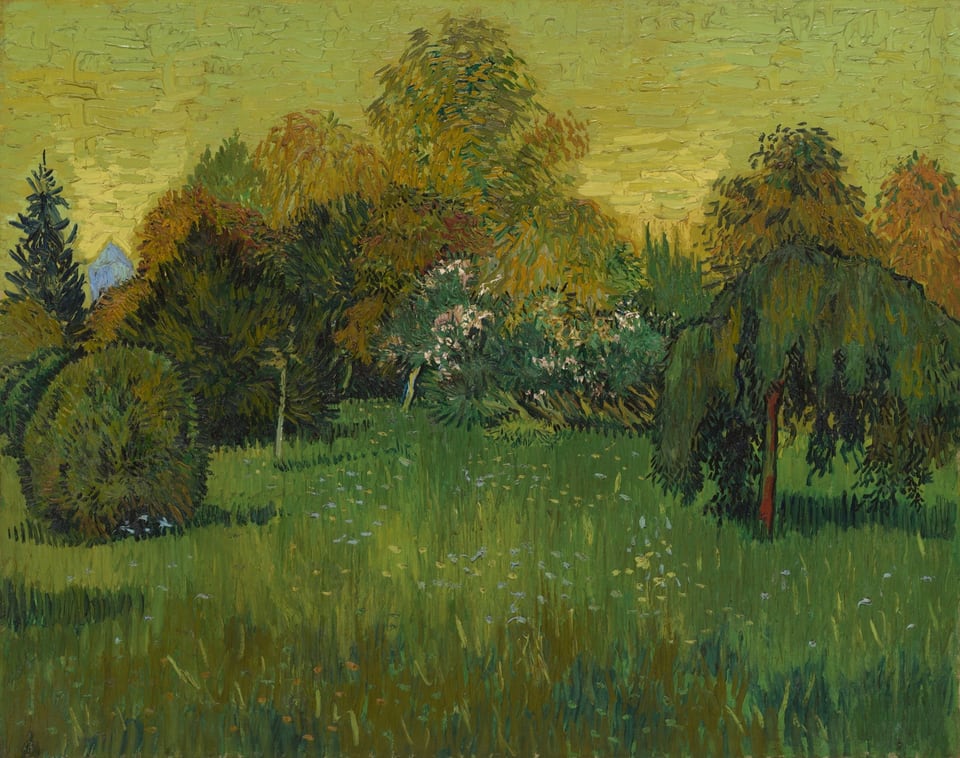
Lush grasses dotted with small white flowers lead into a grove of bushy trees in every shade from deep green to gold, beneath a heavy yellow sky. More about this work
About this work
Lush grasses dotted with small white flowers lead into a grove of bushy trees in every shade from deep green to gold, beneath a heavy yellow sky. Van Gogh painted this corner of the public garden near his Yellow House in Arles in 1888, one of several views he called The Poet’s Garden, intended to decorate the room he was preparing for Paul Gauguin, whose arrival he eagerly awaited. He imagined the garden as a place where poets of the past, such as Petrarch and Boccaccio, might have walked, and he painted it with thick, energetic strokes of saturated colour.
Written by Ochre Editions.
What you’re looking at
Lush tall grasses with small white flowers foreground a grove of bushy trees of varying types and heights, their leaves ranging from deep green to golden. Beneath a dense and heavy yellow sky, a small blue triangle suggesting a mountain peak crests above the treeline at far left.
Description from the Art Institute of Chicago.
How it was made
- Oil paint
- Pigment ground in a drying oil, usually linseed. It dries slowly, so painters could blend on the canvas, build up thin translucent glazes, and rework a picture over weeks. Canvas replaced wooden panels in the 1500s because it is lighter and can be rolled.
Vincent van Gogh
Dutch, 1853–1890 · Born in Zundert; died in Auvers-sur-Oise.
Van Gogh worked as an art dealer, teacher and lay preacher before he turned to art in 1880, at twenty-seven. His early pictures of Dutch peasants are dark and heavy; in Paris from 1886 he met the Impressionists and Neo-Impressionists, and his palette brightened. In Arles in 1888–89 he painted with intense colour and thick, directional strokes, and he worked on at the asylum in Saint-Rémy and finally at Auvers-sur-Oise. The Poet’s Garden belongs to a group made to decorate Gauguin’s room in the Yellow House.
Written by Ochre Editions.
Post-Impressionism
Artists who kept Impressionism's colour but pushed towards structure, symbol and feeling.
Rights and the museum’s record
Public domain. The Art Institute of Chicago has dedicated this image to the public domain under CC0, so anyone may copy, adapt and use it, for any purpose, without asking. Our prints and files are reproductions made from the museum’s image; the museum doesn’t endorse them.
- Object number
- 1933.433
- Credit
- Courtesy of the Art Institute of Chicago
- Type
- Painting
- Department
- Painting and Sculpture of Europe
- Licence
- CC0 1.0 Universal
- Museum record
- See it on the museum’s site
Report this work
More by Vincent van Gogh
All their works