Unknown maker
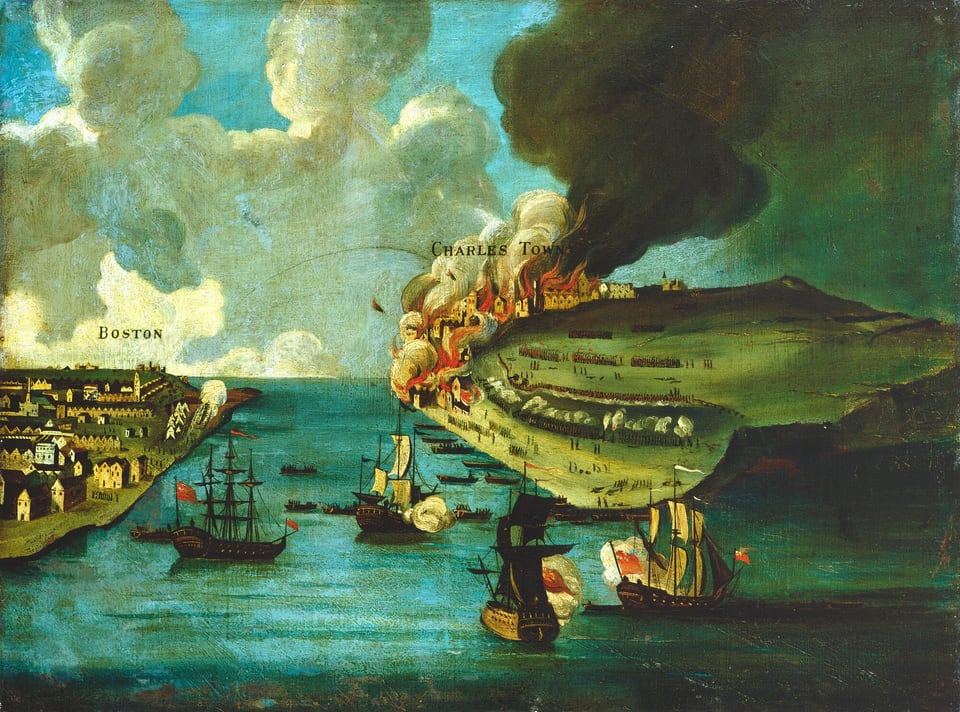
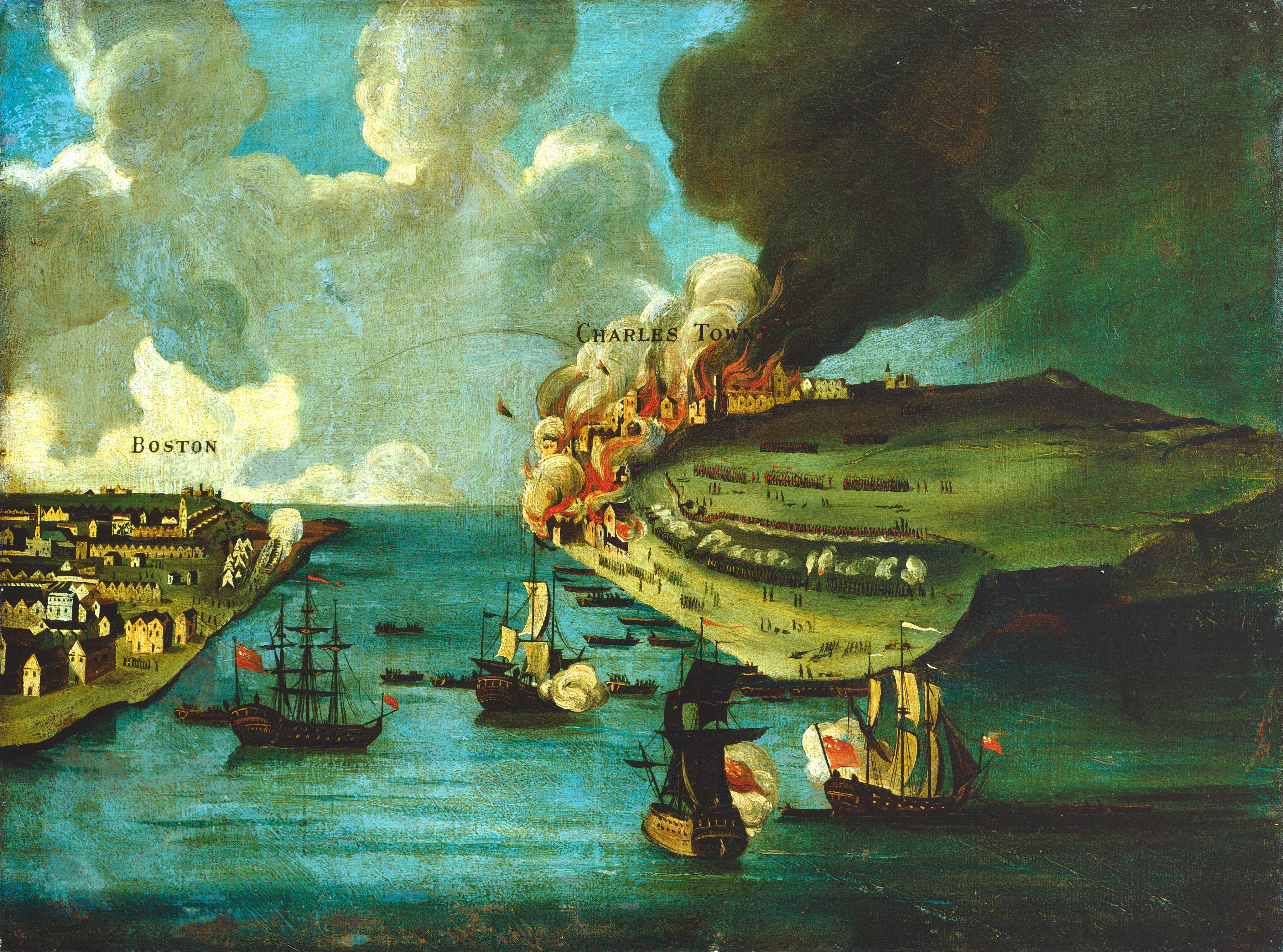
Attack on Bunker's Hill, with the Burning of Charles Town1783 or after
An unrecorded American artist painted this in 1783 or after. It is now at the National Gallery of Art in Washington, DC. More about this work
About this work
We look across and down at a channel of water separating two landmasses labeled "Boston" and "Charles Town" in this horizontal landscape painting. Four three-masted ships are in the aquamarine-blue harbor between us and the land. Three of them have their sails unfurled and smoke billows from the broad, starboard side of each. Tidy rows of brown houses line the area of Boston. A puff of white smoke rises from the farthest point. Two arrow-shaped missiles, perhaps projectiles on fire, arc toward Charles Town, where billowing gray plumes of smoke rise from vivid orange fire on the far side of the landmass. Rowboats bring soldiers to the shore of Charles Town, close to where hundreds of soldiers line up and fire at each other. Much of the rest of Charles Town is a hill leading to sheer cliffs to our right. Tan and gray-colored smoke mixes among bright white clouds against a pale blue sky on the top half of the painting.
Description from the National Gallery of Art.
An unrecorded American artist painted this in 1783 or after. It is now at the National Gallery of Art in Washington, DC.
How it was made
- Oil paint
- Pigment ground in a drying oil, usually linseed. It dries slowly, so painters could blend on the canvas, build up thin translucent glazes, and rework a picture over weeks. Canvas replaced wooden panels in the 1500s because it is lighter and can be rolled.
Rights and the museum’s record
Public domain. The National Gallery of Art has dedicated this image to the public domain under CC0, so anyone may copy, adapt and use it, for any purpose, without asking. Our prints and files are reproductions made from the museum’s image; the museum doesn’t endorse them.
- Object number
- 1953.5.86
- Credit
- Courtesy National Gallery of Art, Washington
- Type
- Painting
- Licence
- CC0 1.0 Universal
- Museum record
- See it on the museum’s site
Report this work
Close in colour