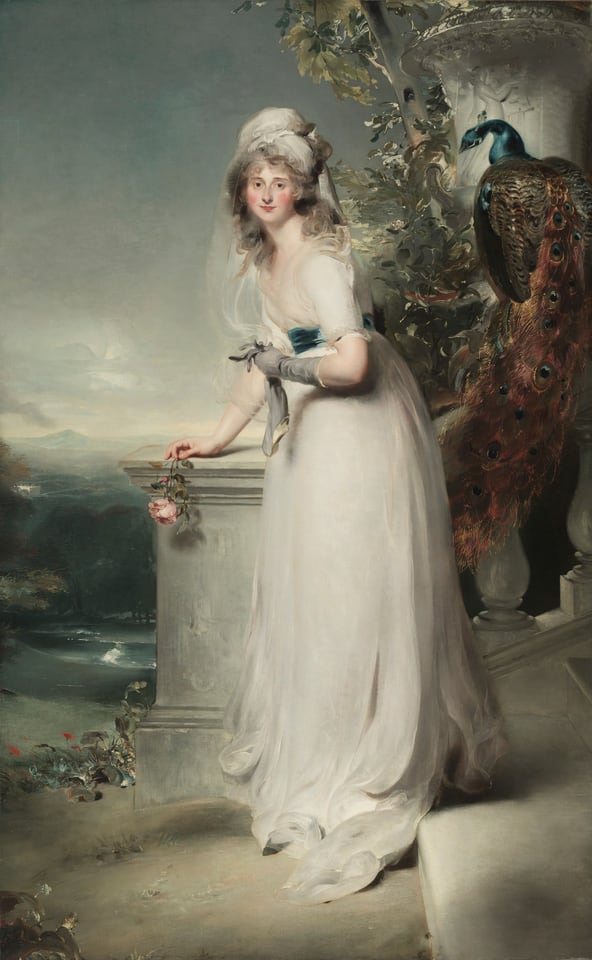
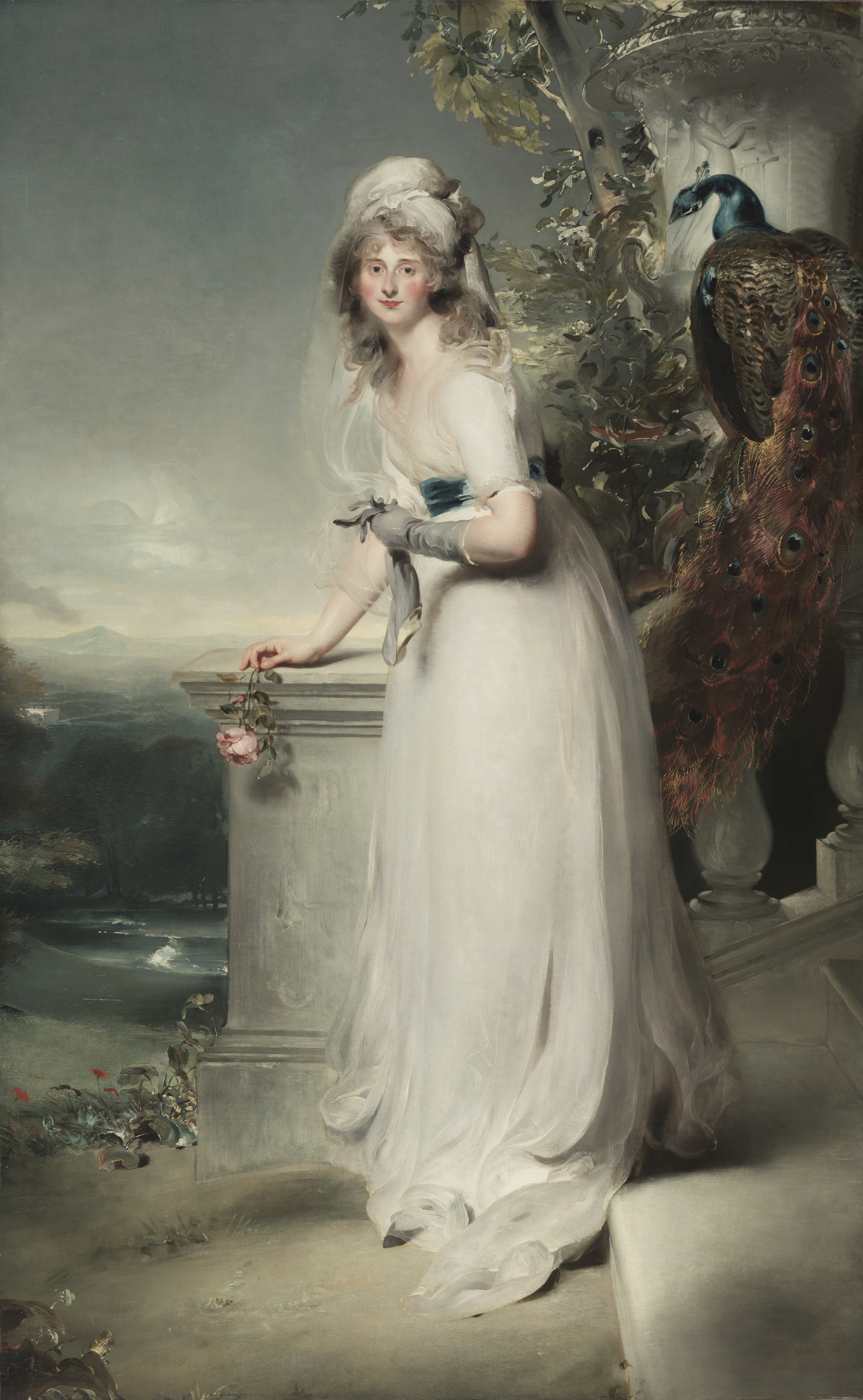
Portrait of Catherine Grey, Lady Manners1794
The Irish poet Lady Manners rejected as “unflattering” this portrait representing her as the goddess Juno, symbolized here by the peacock. More about this work
About this work
The Irish poet Lady Manners rejected as “unflattering” this portrait representing her as the goddess Juno, symbolized here by the peacock. Thomas Lawrence exhibited the painting at the Royal Academy in 1794 with the label “to be disposed of [sold],” but it was still in the artist’s collection when he died. Though it offended Lady Manners, the painting displays all the hallmarks of Lawrence’s flamboyant style:dazzling, fluid brushwork and an innovative use of unconventional colors that helped secure his role as the most fashionable portrait painter in turn-of-the-century Britain.
Text from the Cleveland Museum of Art.
How it was made
- Oil paint
- Pigment ground in a drying oil, usually linseed. It dries slowly, so painters could blend on the canvas, build up thin translucent glazes, and rework a picture over weeks. Canvas replaced wooden panels in the 1500s because it is lighter and can be rolled.
Thomas Lawrence
English, 1769–1830 · Born in Bristol; died in London.
Lawrence was a child prodigy in pastel portraiture and largely self-taught. He moved to London as a teenager, exhibited a full-length of Queen Charlotte at the Royal Academy at twenty-one, and succeeded Joshua Reynolds as Painter in Ordinary to George III. After 1815 the Prince Regent commissioned him to paint the leaders of the alliance against Napoleon for the Waterloo Chamber at Windsor Castle. He became President of the Royal Academy in 1820 and was the leading portraitist of his day.
Written by Ochre Editions.
Rights and the museum’s record
Public domain. The Cleveland Museum of Art has dedicated this image to the public domain under CC0, so anyone may copy, adapt and use it, for any purpose, without asking. Our prints and files are reproductions made from the museum’s image; the museum doesn’t endorse them.
- Object number
- 1961.220
- Credit
- Courtesy of the Cleveland Museum of Art
- Type
- Painting
- Department
- European Painting and Sculpture
- Licence
- CC0 1.0 Universal
- Museum record
- See it on the museum’s site
Report this work
More by Thomas Lawrence
All their works
Close in colour