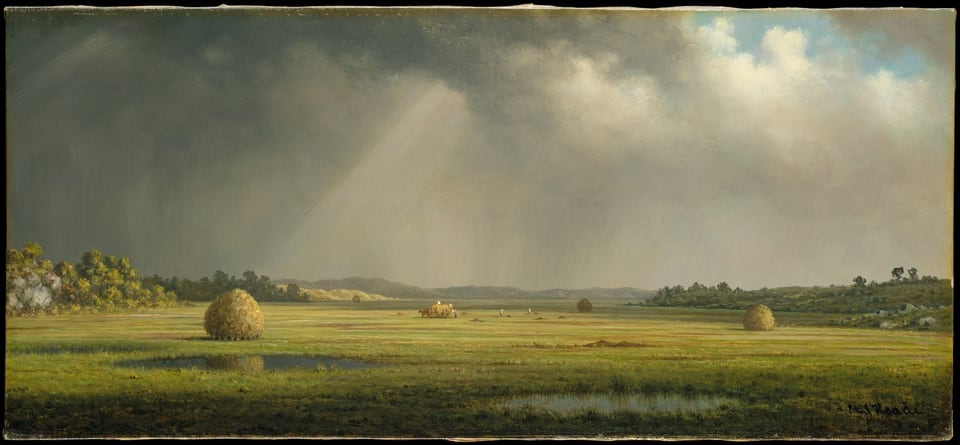
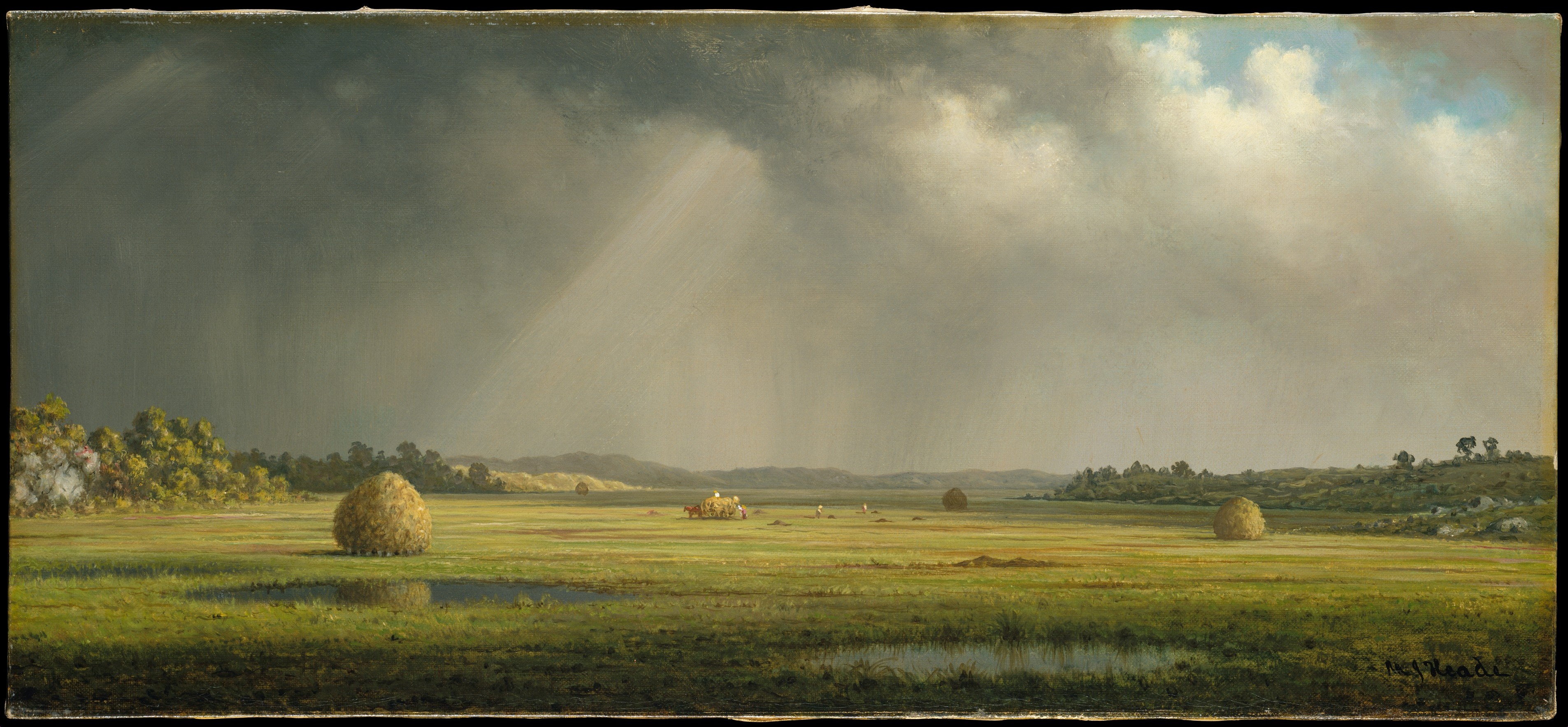
Newburyport Meadowsca. 1876–81
Haystacks dot the flat salt marshes near Newburyport, Massachusetts, beneath a broad sky. More about this work
About this work
Haystacks dot the flat salt marshes near Newburyport, Massachusetts, beneath a broad sky. Martin Johnson Heade painted the marshes of the northeastern coast more than a hundred times, fascinated by the way light and weather transformed their level horizons from hour to hour. These quiet, horizontal compositions, with their patient attention to atmosphere, are among the most distinctive American landscapes of the nineteenth century.
Written by Ochre Editions.
How it was made
- Oil paint
- Pigment ground in a drying oil, usually linseed. It dries slowly, so painters could blend on the canvas, build up thin translucent glazes, and rework a picture over weeks. Canvas replaced wooden panels in the 1500s because it is lighter and can be rolled.
Martin Johnson Heade
1819–1904
Heade travelled restlessly and worked in many genres, but is best known for three subjects: the salt marshes of New England and New Jersey, with haystacks under changing skies; hummingbirds and orchids, which he studied on journeys to Brazil and Central America; and, in later years, lush still lifes of magnolias and other flowers, painted after he settled in St Augustine, Florida. Approaching Thunder Storm is an early example of his brooding coastal scenes.
Written by Ochre Editions.
Rights and the museum’s record
Public domain. The Met has dedicated this image to the public domain under CC0, so anyone may copy, adapt and use it, for any purpose, without asking. Our prints and files are reproductions made from the museum’s image; the museum doesn’t endorse them.
- Object number
- 1985.117
- Credit
- Courtesy of The Metropolitan Museum of Art
- Type
- Painting
- Department
- The American Wing
- Licence
- CC0 1.0 Universal
- Museum record
- See it on the museum’s site
Report this work
More by Martin Johnson Heade
All their works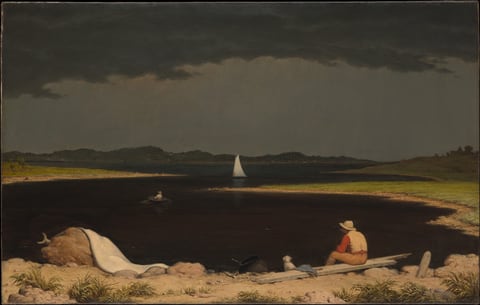

Close in colour