Rio de Janeiro Bay1864
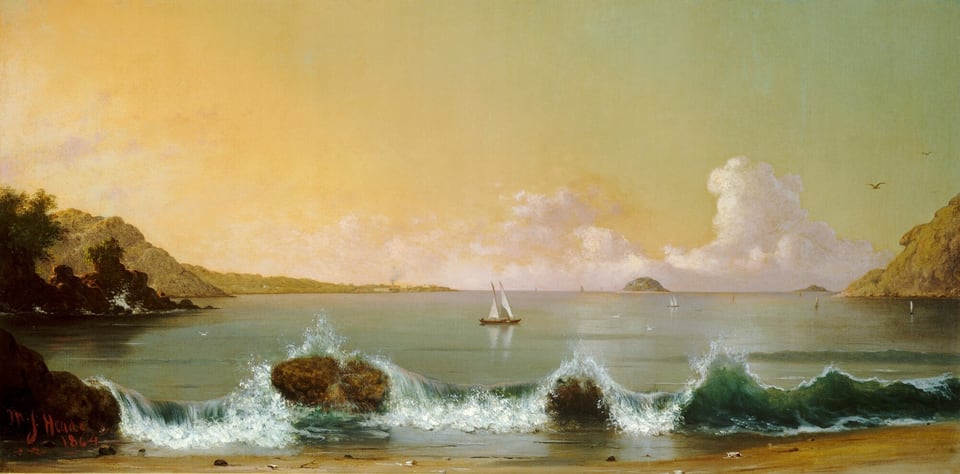
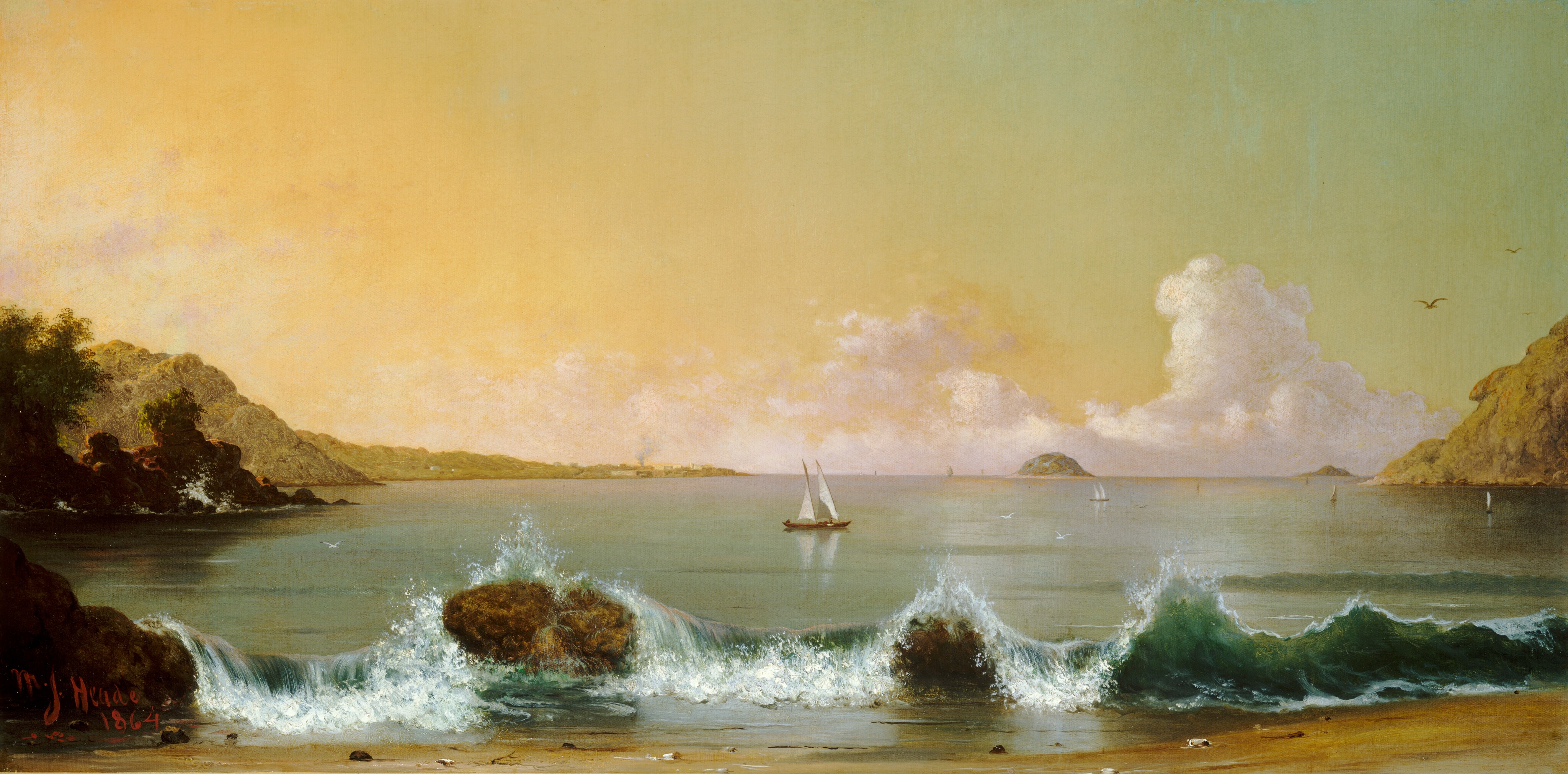
Waves of bottle-green water break over boulders on a sandy shore, while sailboats dot the bay and hills curve around it beneath a sky glowing from butter yellow to mint green. More about this work
About this work
Waves of bottle-green water break over boulders on a sandy shore, while sailboats dot the bay and hills curve around it beneath a sky glowing from butter yellow to mint green. Martin Johnson Heade travelled to Brazil in 1863 to paint its hummingbirds for a planned book, and he also recorded the landscape around Rio de Janeiro. The meticulous detail, the luminous sky and the stillness of the distant boats show the clear, contemplative light that unites his work, whether marsh, coast or tropical shore. He signed and dated it in 1864.
Written by Ochre Editions.
What you’re looking at
Across a short stretch of sand in front of us, waves of bottle-green water break over two boulders on the shoreline, with sailboats in the water beyond, in this wide, horizontal painting. One boulder is at the left edge of the painting; the other is a short distance away, about a quarter of the way across. The water cascades down between those large rocks. Across the rest of the beach, the waves flare up to break toward us in white, foamy surf. The land curves back into view on both sides of the canvas with muted, sage-green hills and, to our left, dark green trees on more craggy boulders. A more distant finger of land to our left stretches nearly halfway across the horizon, which comes about halfway up the composition. Minuscule in scale there, smoke pours out of a chimney, which is surrounded by pale yellow buildings. A mound emerges from the horizon to our right of center. About ten sailboats float on the water. The closest one to us is near the center of the painting, and the tiny forms of people aboard can just barely be made out. The other boats become smaller as they move back to the horizon, and some are only a touch of white or gray on the canvas. White and pale lavender-purple clouds sweep up from the horizon into the sky, which glows butter yellow along the left edge. The sky cools to mint green in the upper right corner. Several white or brown birds fly across the sky or low over the water. The artist signed and dated the lower left, “M. J. Heade 1864.”
Description from the National Gallery of Art.
How it was made
- Oil paint
- Pigment ground in a drying oil, usually linseed. It dries slowly, so painters could blend on the canvas, build up thin translucent glazes, and rework a picture over weeks. Canvas replaced wooden panels in the 1500s because it is lighter and can be rolled.
Martin Johnson Heade
1819–1904
Heade travelled restlessly and worked in many genres, but is best known for three subjects: the salt marshes of New England and New Jersey, with haystacks under changing skies; hummingbirds and orchids, which he studied on journeys to Brazil and Central America; and, in later years, lush still lifes of magnolias and other flowers, painted after he settled in St Augustine, Florida. Approaching Thunder Storm is an early example of his brooding coastal scenes.
Written by Ochre Editions.
Rights and the museum’s record
Public domain. The National Gallery of Art has dedicated this image to the public domain under CC0, so anyone may copy, adapt and use it, for any purpose, without asking. Our prints and files are reproductions made from the museum’s image; the museum doesn’t endorse them.
- Object number
- 1965.2.1
- Credit
- Courtesy National Gallery of Art, Washington
- Type
- Painting
- Licence
- CC0 1.0 Universal
- Museum record
- See it on the museum’s site
Report this work
More by Martin Johnson Heade
All their works
Close in colour