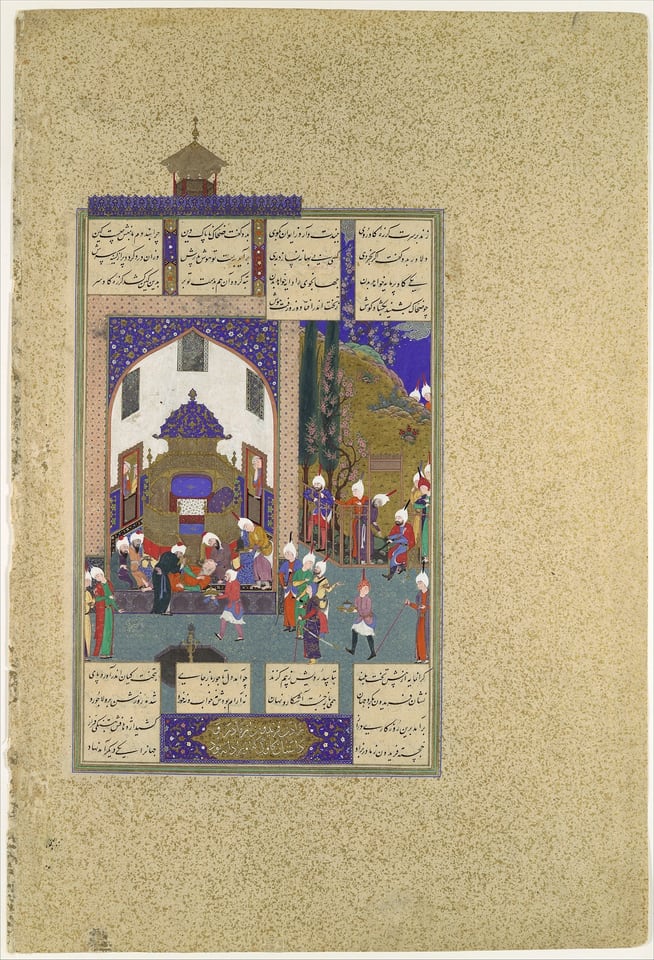
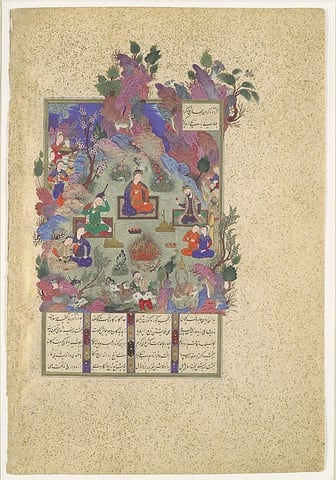
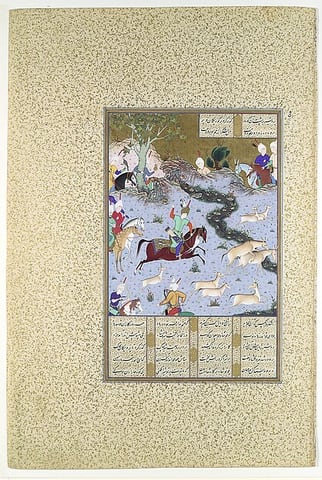
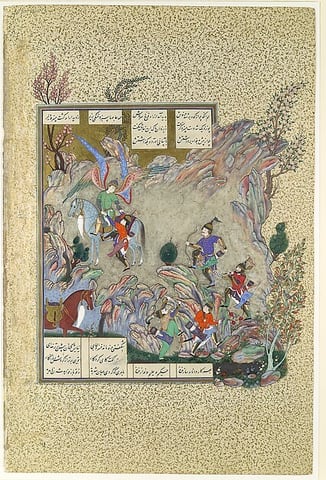
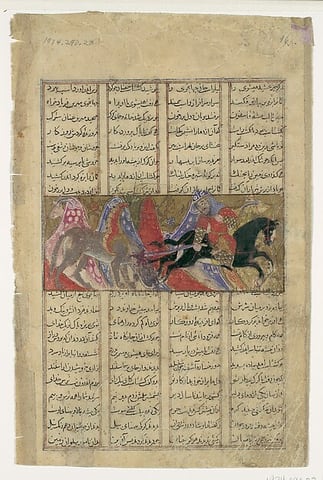
"Zahhak is Told His Fate", Folio 29v from the Shahnama (Book of Kings) of Shah Tahmaspca. 1524
The tyrant Zahhak, from whose shoulders grew two serpents that fed on human brains, dreamed that three warriors attacked him and that the youngest struck him down with a mace shaped like a cow’s head. More about this work
About this work
The tyrant Zahhak, from whose shoulders grew two serpents that fed on human brains, dreamed that three warriors attacked him and that the youngest struck him down with a mace shaped like a cow’s head. Terrified, he summoned his wise men; after days of silence one at last dared to explain that a prince named Faridun, not yet born, would take his throne. The episode sets in motion one of the great cycles of Ferdowsi’s Shahnama. This page comes from the copy made for Shah Tahmasp at the Safavid court in Tabriz, one of the most ambitious illustrated books of its age.
Written by Ochre Editions.
How it was made
- Opaque watercolour
- Watercolour made opaque with white or chalk and laid in flat, even layers. Persian and Indian painters ground their colours from minerals, applied them with the finest brushes and burnished the finished page.
- Watercolour
- Pigment in gum arabic, thinned with water and laid in transparent washes. Nothing white is painted: the light is the paper showing through.
- Ink on paper
- Ink made from soot and animal glue, ground with water on an inkstone. A single brush can give a hair-fine line or a broad wash, and nothing can be corrected.
Rights and the museum’s record
Public domain. The Met has dedicated this image to the public domain under CC0, so anyone may copy, adapt and use it, for any purpose, without asking. Our prints and files are reproductions made from the museum’s image; the museum doesn’t endorse them.
- Object number
- 1970.301.4
- Credit
- Courtesy of The Metropolitan Museum of Art
- Type
- Codices
- Department
- Islamic Art
- Licence
- CC0 1.0 Universal
- Museum record
- See it on the museum’s site
Report this work
More by Abu'l Qasim Firdausi
All their works
Close in colour