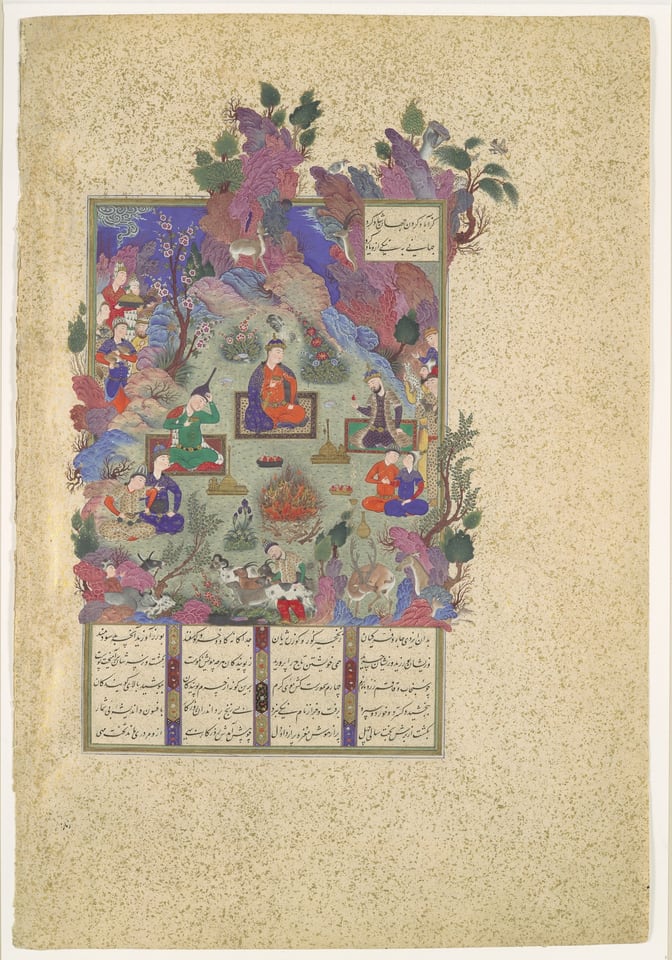
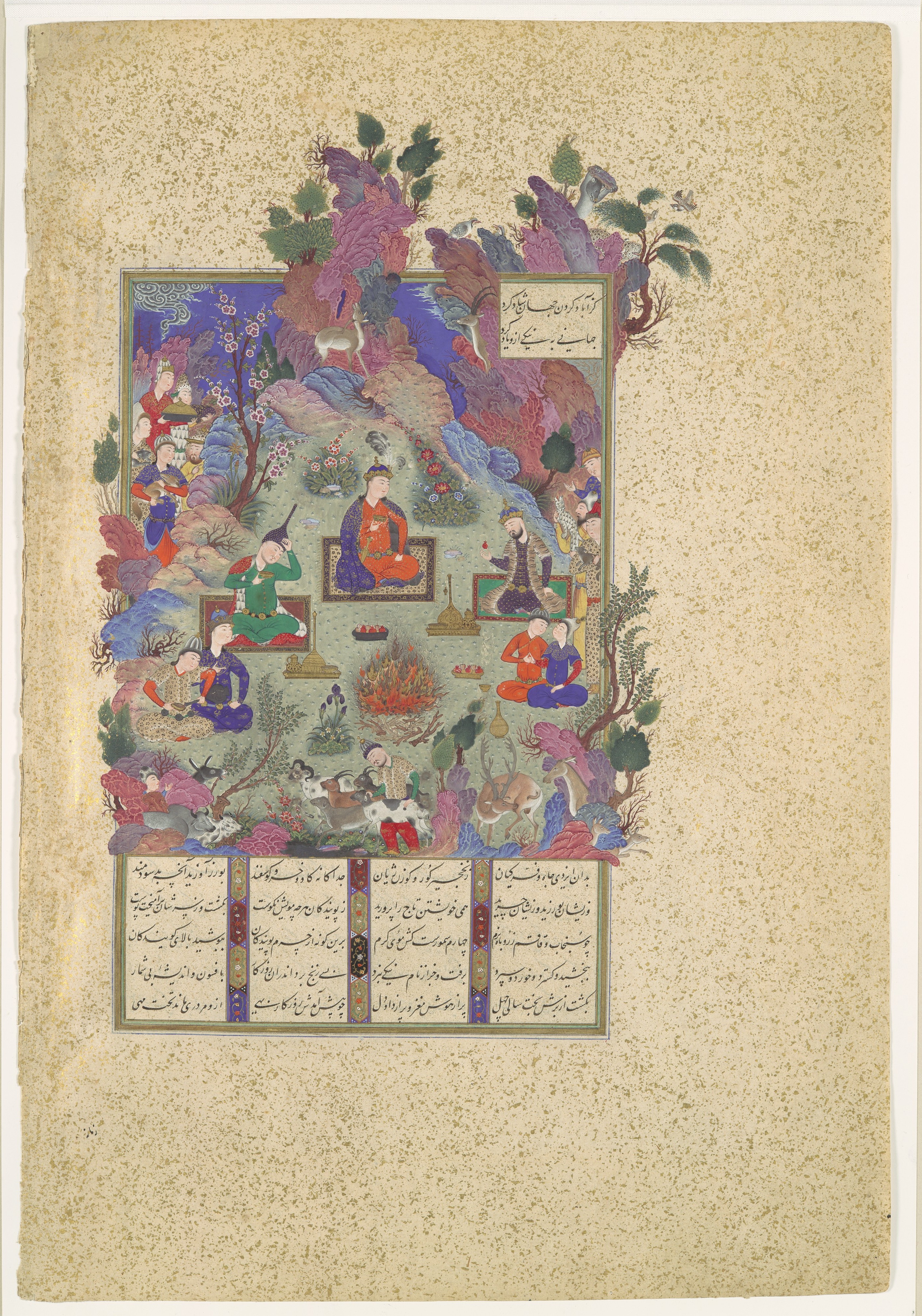
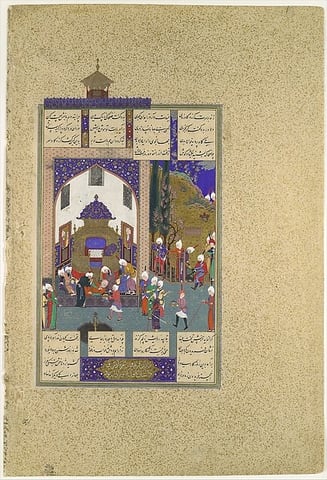
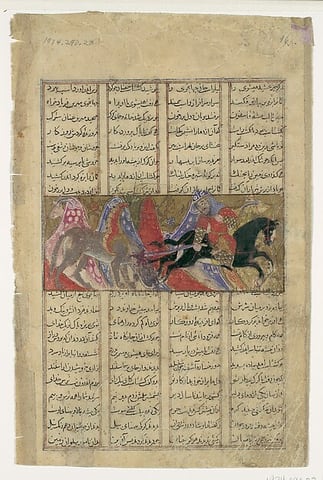
"The Feast of Sada", Folio 22v from the Shahnama (Book of Kings) of Shah Tahmaspca. 1525
King Hushang, an early ruler in Ferdowsi’s mythic history of Iran, hurls a stone at a serpent; it misses, strikes a rock and throws off sparks, and so fire is discovered. More about this work
About this work
King Hushang, an early ruler in Ferdowsi’s mythic history of Iran, hurls a stone at a serpent; it misses, strikes a rock and throws off sparks, and so fire is discovered. In thanks he founds the Feast of Sada, celebrated around a great blaze, with animals gathered in the surrounding landscape. This page belongs to the Shahnama made for the young Safavid ruler Shah Tahmasp in the 1520s and 1530s. With 258 paintings by the leading artists of the royal workshop in Tabriz, it is among the most lavish illustrated books ever produced.
Written by Ochre Editions.
How it was made
- Opaque watercolour
- Watercolour made opaque with white or chalk and laid in flat, even layers. Persian and Indian painters ground their colours from minerals, applied them with the finest brushes and burnished the finished page.
- Watercolour
- Pigment in gum arabic, thinned with water and laid in transparent washes. Nothing white is painted: the light is the paper showing through.
- Ink on paper
- Ink made from soot and animal glue, ground with water on an inkstone. A single brush can give a hair-fine line or a broad wash, and nothing can be corrected.
Rights and the museum’s record
Public domain. The Met has dedicated this image to the public domain under CC0, so anyone may copy, adapt and use it, for any purpose, without asking. Our prints and files are reproductions made from the museum’s image; the museum doesn’t endorse them.
- Object number
- 1970.301.2
- Credit
- Courtesy of The Metropolitan Museum of Art
- Type
- Codices
- Department
- Islamic Art
- Licence
- CC0 1.0 Universal
- Museum record
- See it on the museum’s site
Report this work
More by Abu'l Qasim Firdausi
All their works
Close in colour