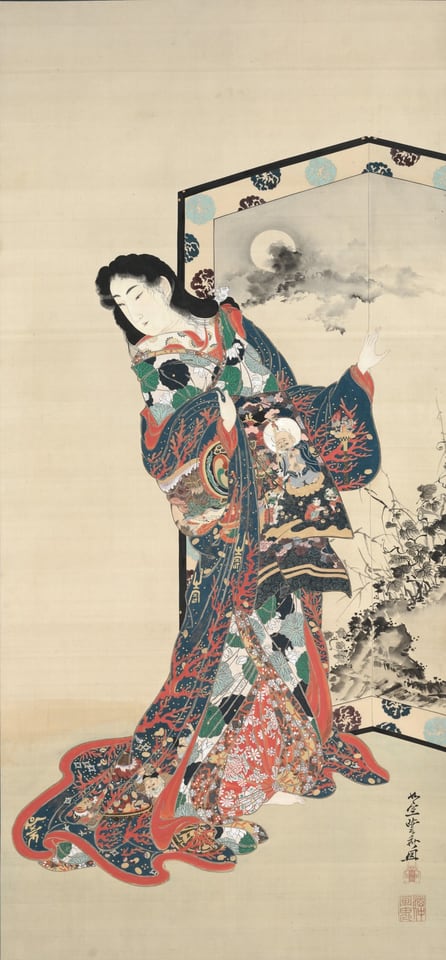
Hell Courtesan1871–89
Kawanabe Kyōsai repeated this large-scale composition with variations a number of times. More about this work
About this work
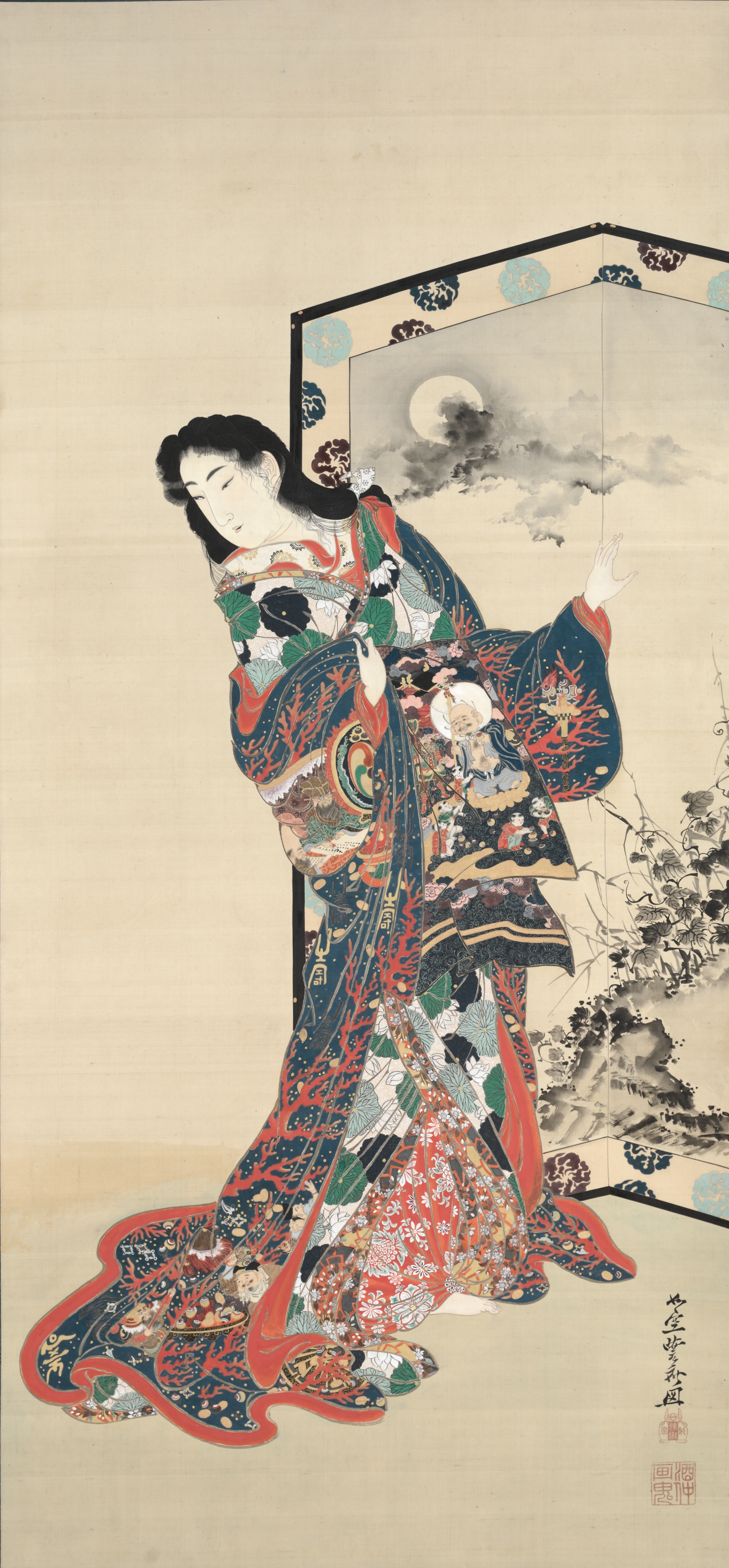
Kawanabe Kyōsai repeated this large-scale composition with variations a number of times. In this version, a famous 15th-century courtesan known for wearing a robe with images of the Buddhist hells stands before a folding screen. Legend has it that she was abducted by bandits, and wore the garment to symbolize her belief that her suffering in her current life was punishment for sins committed in a former life. Here, in a parody depiction of the garment, the courtesan stands in for Benzaiten, the goddess of everything that flows, while the remaining members of the Seven Gods of Good Fortune appear on her outer robe. One of them reports sins to Enma, the King of Hell, who is writing out his judgments on the recently deceased.
Text from the Cleveland Museum of Art.
How it was made
- Hanging scroll
- A painting mounted on silk with a wooden roller at the foot. It was rolled up for storage and brought out to hang for a season, a guest or an occasion.
- Ink and colour on silk
- Silk was sized with glue and alum so it would hold a crisp brushline, and mineral colours were built up in thin layers. The sheen of the weave still shows through.
Kawanabe Kyōsai
Japanese, 1831–1889
Rights and the museum’s record
Public domain. The Cleveland Museum of Art has dedicated this image to the public domain under CC0, so anyone may copy, adapt and use it, for any purpose, without asking. Our prints and files are reproductions made from the museum’s image; the museum doesn’t endorse them.
- Object number
- 1985.268
- Credit
- Courtesy of the Cleveland Museum of Art
- Type
- Painting
- Department
- Japanese Art
- Licence
- CC0 1.0 Universal
- Museum record
- See it on the museum’s site
Report this work
Close in colour