Love as Follyc. 1773/1776
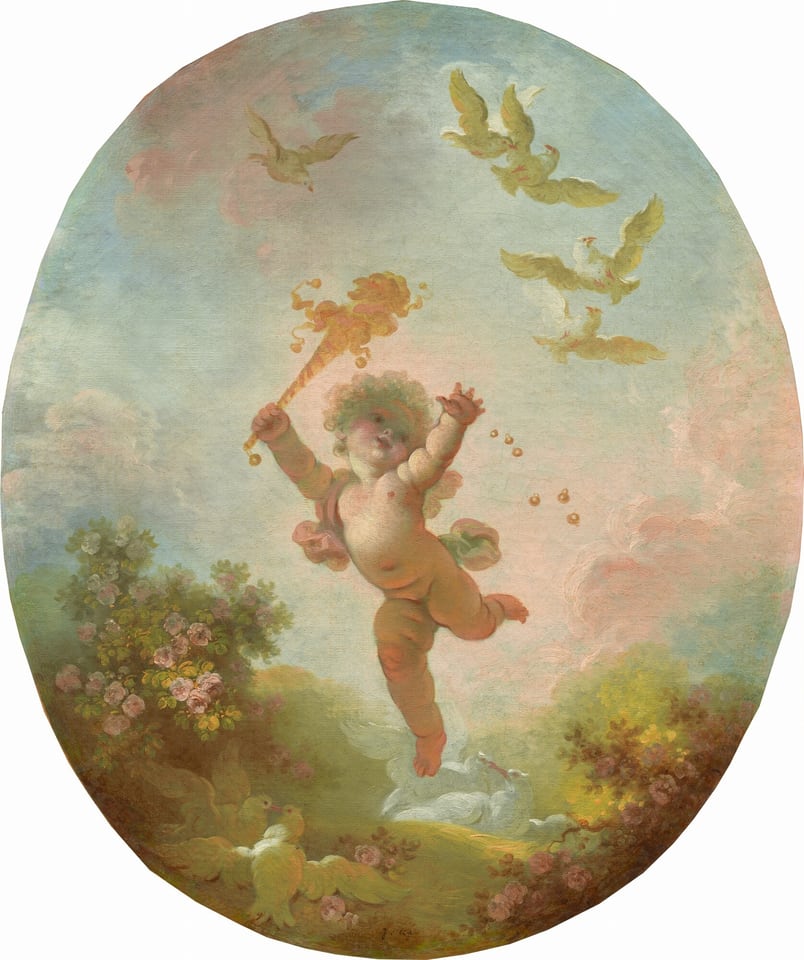
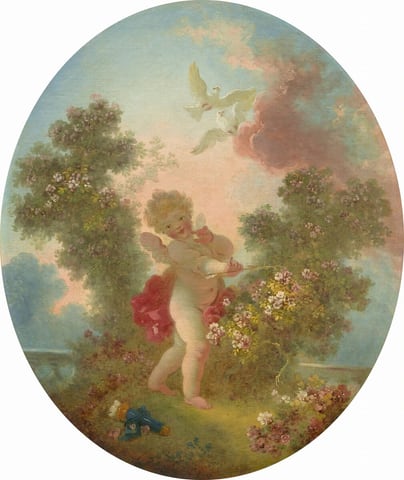
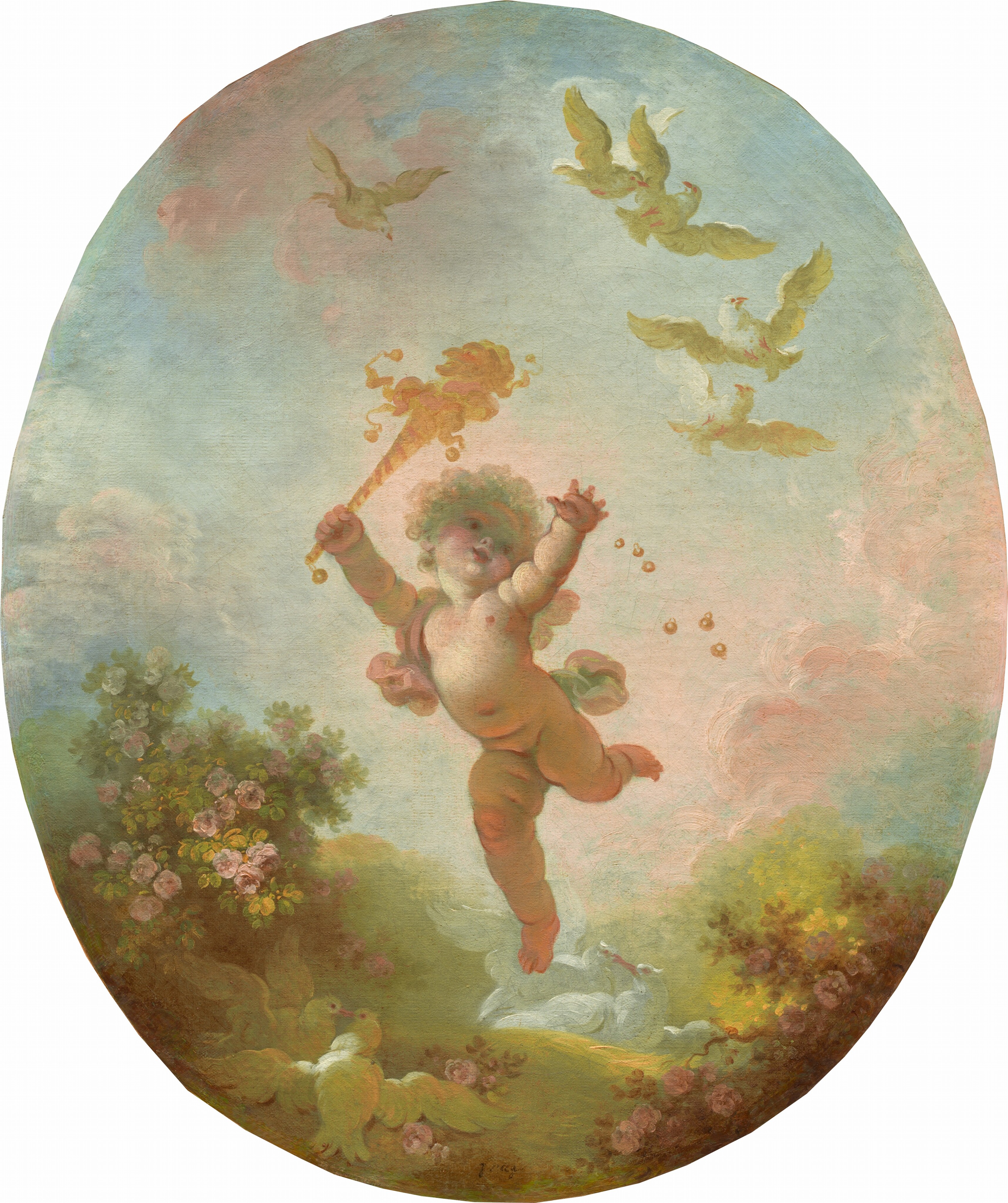
A smiling Cupid floats through the air with a flaming torch, arms flung wide, as white birds wheel around him among clouds and pink blossoms. More about this work
About this work
A smiling Cupid floats through the air with a flaming torch, arms flung wide, as white birds wheel around him among clouds and pink blossoms. Fragonard painted this small oval and its companion, Love the Sentinel, in the mid-1770s, when he was the most spirited painter of love in Rococo France. Here the god of love is all reckless abandon, and the torch he carries is the fire of passion. The quick, feathery brushwork and pastel palette show Fragonard at his lightest.
Written by Ochre Editions.
What you’re looking at
This oval painting shows a cherubic child floating mid-air with one leg bent and their arms outstretched. The cherub has curly hair, a round face, and pale skin dusted with rosy pink and light teal shadows. They are smiling gently. The cherub is nude with a draped cloth over one shoulder, and in one hand they hold a flaming torch. Surrounding the cherub are white birds in flight. The background consists of pale blue and soft white clouds, with blooming pink flowers and foliage on the pale green ground.
Description from the National Gallery of Art.
How it was made
- Oil paint
- Pigment ground in a drying oil, usually linseed. It dries slowly, so painters could blend on the canvas, build up thin translucent glazes, and rework a picture over weeks. Canvas replaced wooden panels in the 1500s because it is lighter and can be rolled.
Jean Honoré Fragonard
French, 1732–1806 · Born in Grasse; died in Paris.
Fragonard studied with Chardin and then Boucher, won the Prix de Rome and spent five years in Italy, where he drew the gardens of the Villa d’Este. Back in Paris he largely set aside official commissions to paint for private collectors: playful love scenes such as The Swing, rapidly brushed “fantasy figures” and luminous landscapes. The Revolution ended the taste for his art, and he spent his last years as an administrator of the new national museum at the Louvre.
Written by Ochre Editions.
Rights and the museum’s record
Public domain. The National Gallery of Art has dedicated this image to the public domain under CC0, so anyone may copy, adapt and use it, for any purpose, without asking. Our prints and files are reproductions made from the museum’s image; the museum doesn’t endorse them.
- Object number
- 1970.17.111
- Credit
- Courtesy National Gallery of Art, Washington
- Type
- Painting
- Licence
- CC0 1.0 Universal
- Museum record
- See it on the museum’s site
Report this work
More by Jean Honoré Fragonard
All their works
Close in colour