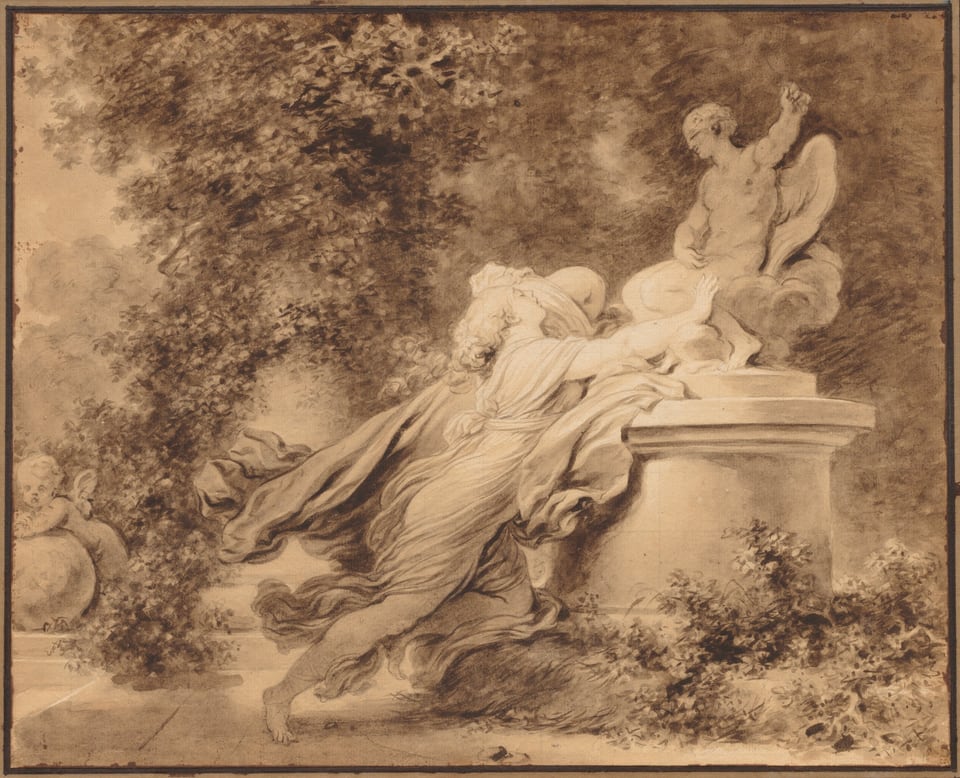
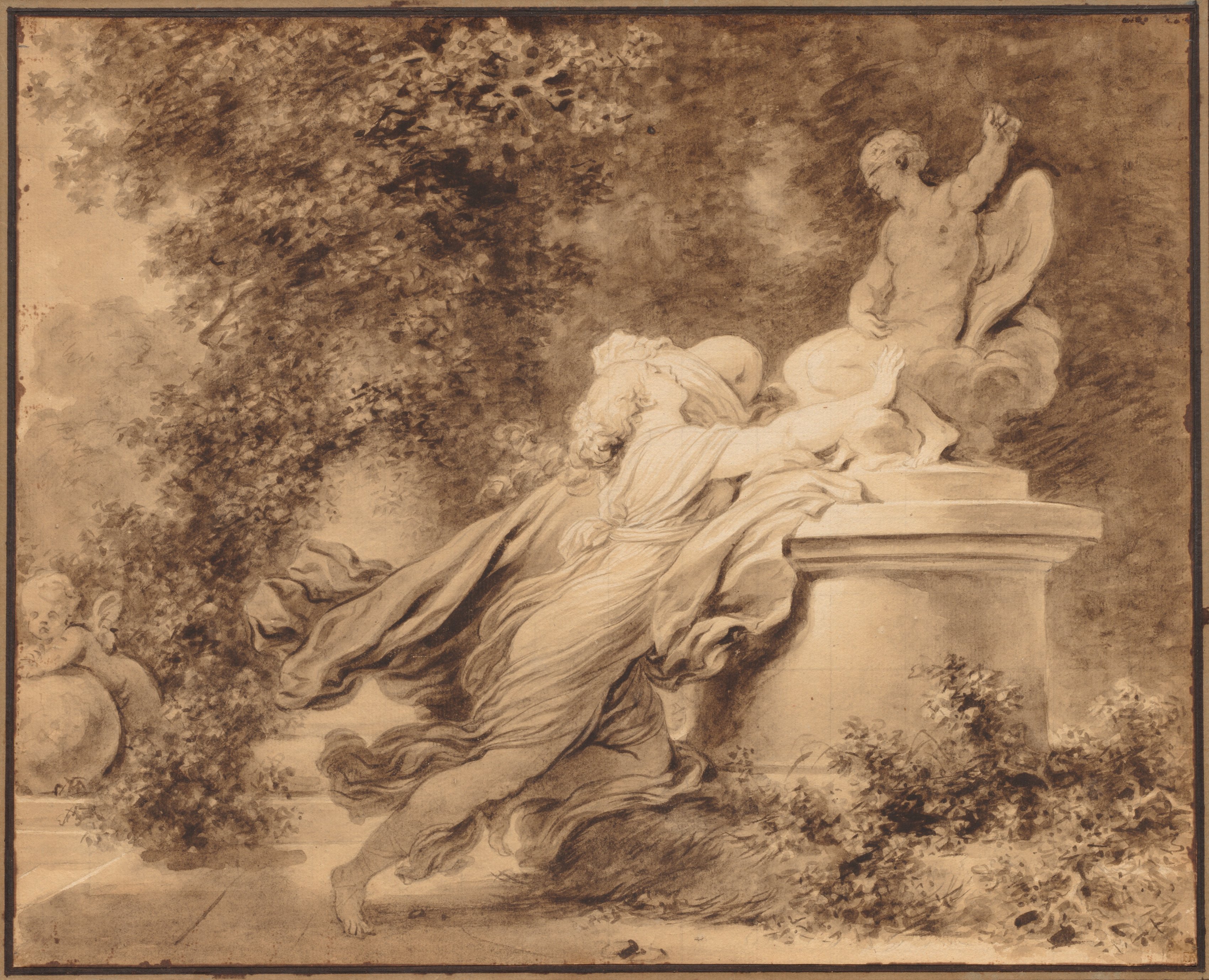
Invocation to Lovec. 1781
Fragonard used gardens as the setting for love and courtship in some of his most important works. More about this work
About this work
Fragonard used gardens as the setting for love and courtship in some of his most important works. One such scene, this drawing depicts a woman pleading for help from a statue of Eros, the god of love. He wears a blindfold, suggesting an uncertain outcome for the woman, as does a Cupid who indifferently leans on an orb nearby. Like other artists in 18th-century France, Fragonard was deeply influenced by historic imagery of the Garden of Love—a pastoral and idyllic contained landscape. He revisited the specific image seen here multiple times, in two oil paintings (Musée du Louvre and private collection, New York) and another drawing (Princeton University Art Museum).
Text from the Cleveland Museum of Art.
How it was made
- Graphite
- Pencil. Graphite has been used for drawing since the 1500s; in 1795 Nicolas-Jacques Conté mixed it with clay, so its hardness could be graded.
- Laid paper
- Handmade on a mould of close-set wires, which leave fine parallel lines you can see when the sheet is held to the light.
Jean Honoré Fragonard
French, 1732–1806 · Born in Grasse; died in Paris.
Fragonard studied with Chardin and then Boucher, won the Prix de Rome and spent five years in Italy, where he drew the gardens of the Villa d’Este. Back in Paris he largely set aside official commissions to paint for private collectors: playful love scenes such as The Swing, rapidly brushed “fantasy figures” and luminous landscapes. The Revolution ended the taste for his art, and he spent his last years as an administrator of the new national museum at the Louvre.
Written by Ochre Editions.
Rights and the museum’s record
Public domain. The Cleveland Museum of Art has dedicated this image to the public domain under CC0, so anyone may copy, adapt and use it, for any purpose, without asking. Our prints and files are reproductions made from the museum’s image; the museum doesn’t endorse them.
- Object number
- 1943.657
- Credit
- Courtesy of the Cleveland Museum of Art
- Type
- Drawing
- Department
- Drawings
- Licence
- CC0 1.0 Universal
- Museum record
- See it on the museum’s site
Report this work
More by Jean Honoré Fragonard
All their works
Close in colour