The Last Supperc. 1500
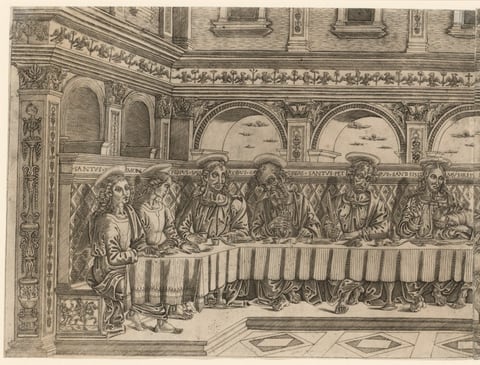
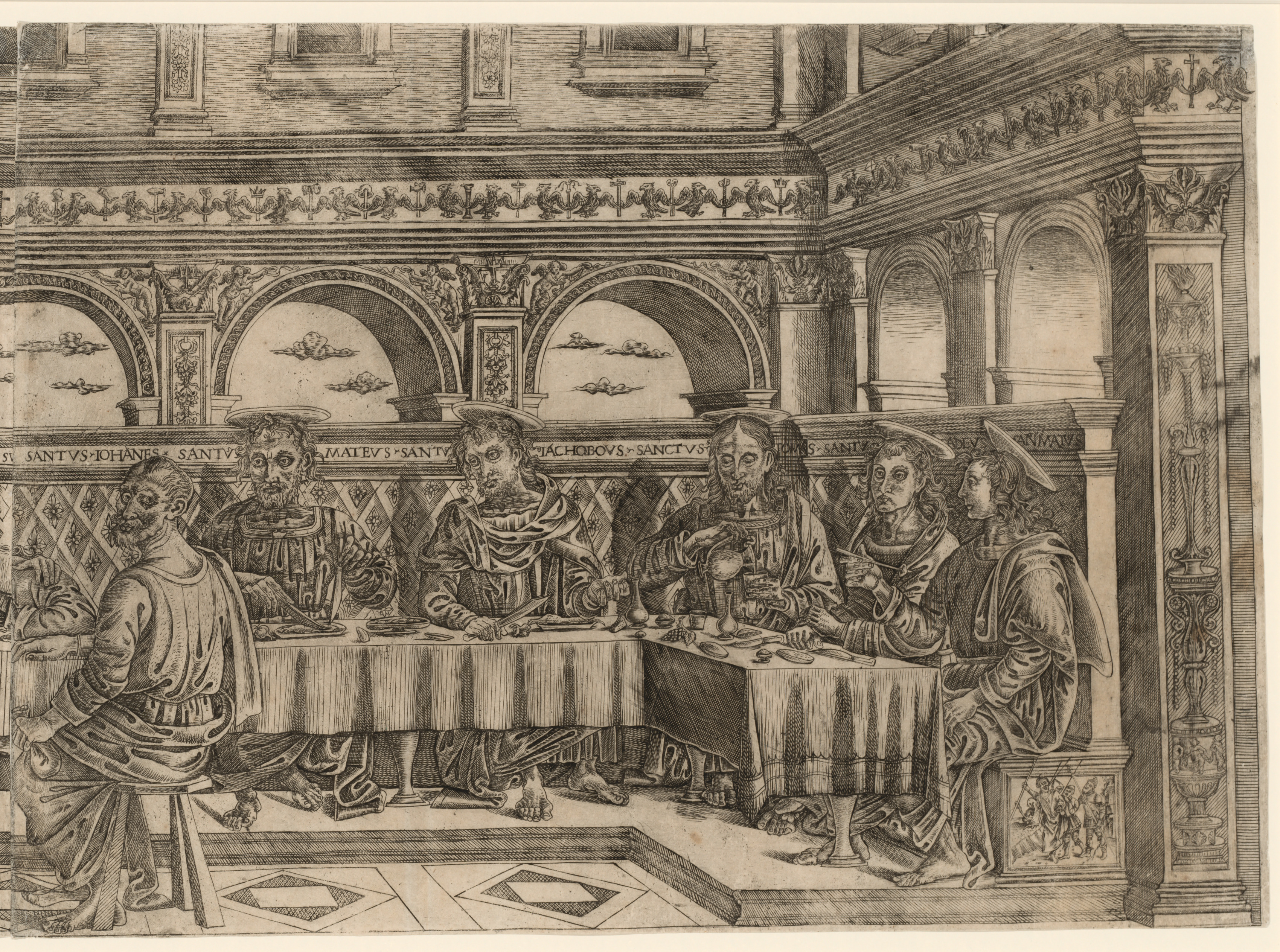
Because large prints were often displayed on a wall, they were susceptible to damage and often have not survived. This large print of the Last Supper , however, is in excellent condition. More about this work
About this work
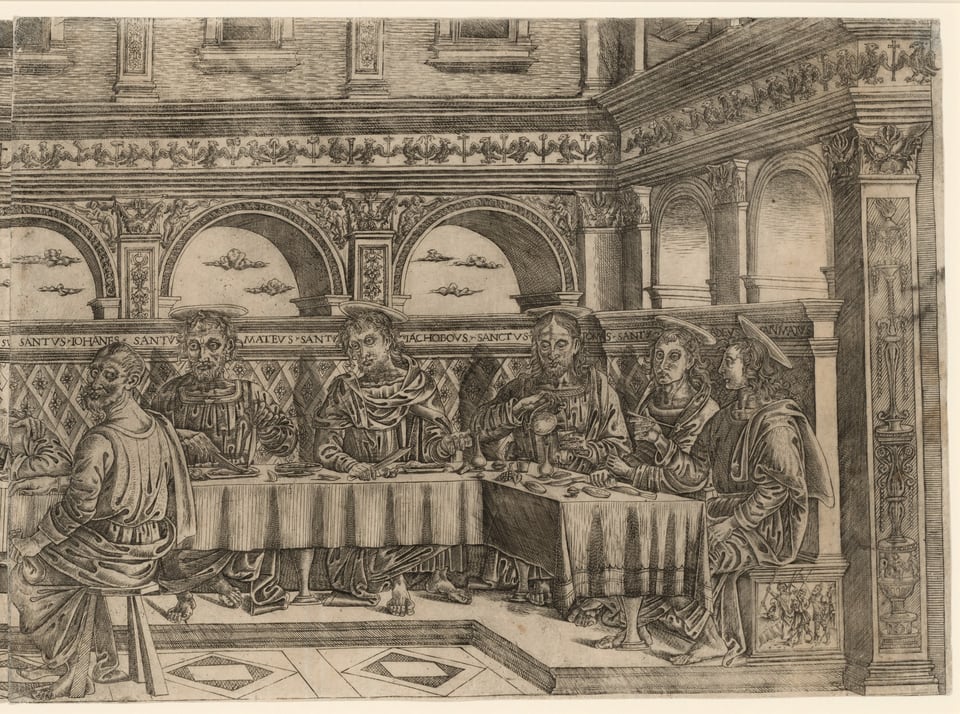
Because large prints were often displayed on a wall, they were susceptible to damage and often have not survived. This large print of the Last Supper , however, is in excellent condition. It was engraved on two plates and printed on two separate sheets of paper. The composition is believed to be a fairly close copy of a fresco by Perugino in the convent of San Onofrio in Florence, around 1495. The scene is set within an arched interior embellished by a frieze of eagles and by half pilasters with floral decorations and putti. Fluffy clouds are visible beyond the archways. Christ and the apostles are on a bench arranged behind the table. Judas, instead, sits on a stool in the middle of the room, looking over his shoulder towards the viewer. The engraver included two reliefs at both ends of the bench. The panel on the right shows Judas with four soldiers, while the one on the left features a knight, a squire, and a banner. On it, the letters LVC . . . TNO have been interpreted as the artist's signature.
Text from the Cleveland Museum of Art.
How it was made
- Engraving
- Lines cut directly into a metal plate with a steel burin, which makes them swell and taper. It took years to master, and for centuries it was how paintings travelled as pictures.
Renaissance
European art from about 1400 to 1600, when painters rediscovered perspective and the classical past.
Rights and the museum’s record
Public domain. The Cleveland Museum of Art has dedicated this image to the public domain under CC0, so anyone may copy, adapt and use it, for any purpose, without asking. Our prints and files are reproductions made from the museum’s image; the museum doesn’t endorse them.
- Object number
- 1940.473.b
- Credit
- Courtesy of the Cleveland Museum of Art
- Type
- Department
- Prints
- Licence
- CC0 1.0 Universal
- Museum record
- See it on the museum’s site
Report this work
More by Lucantonio degli Uberti
All their works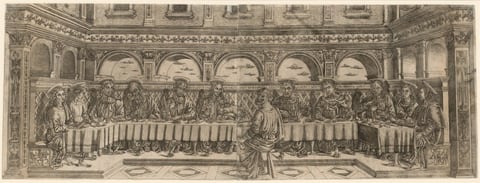
Close in colour