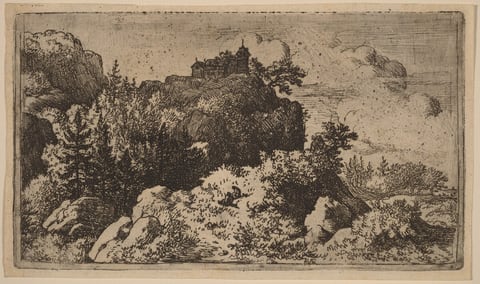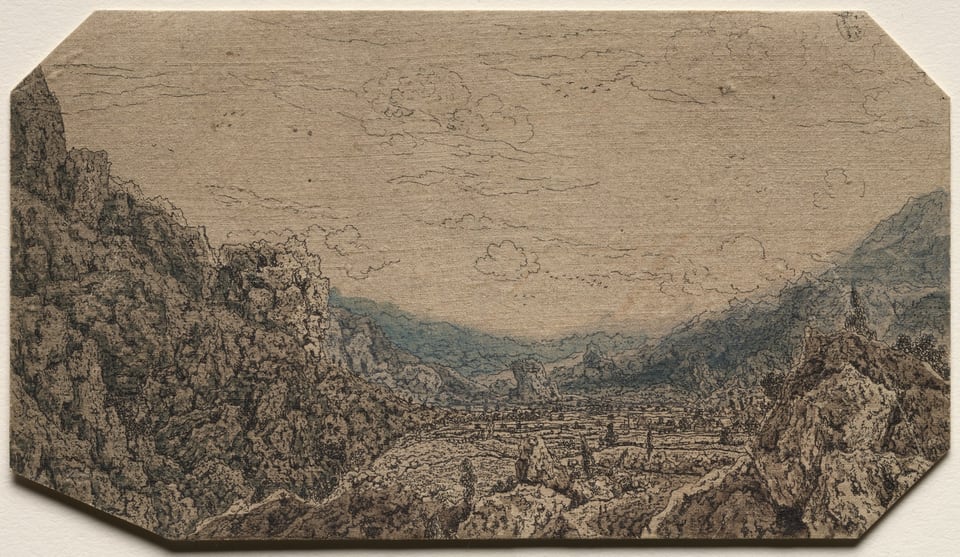
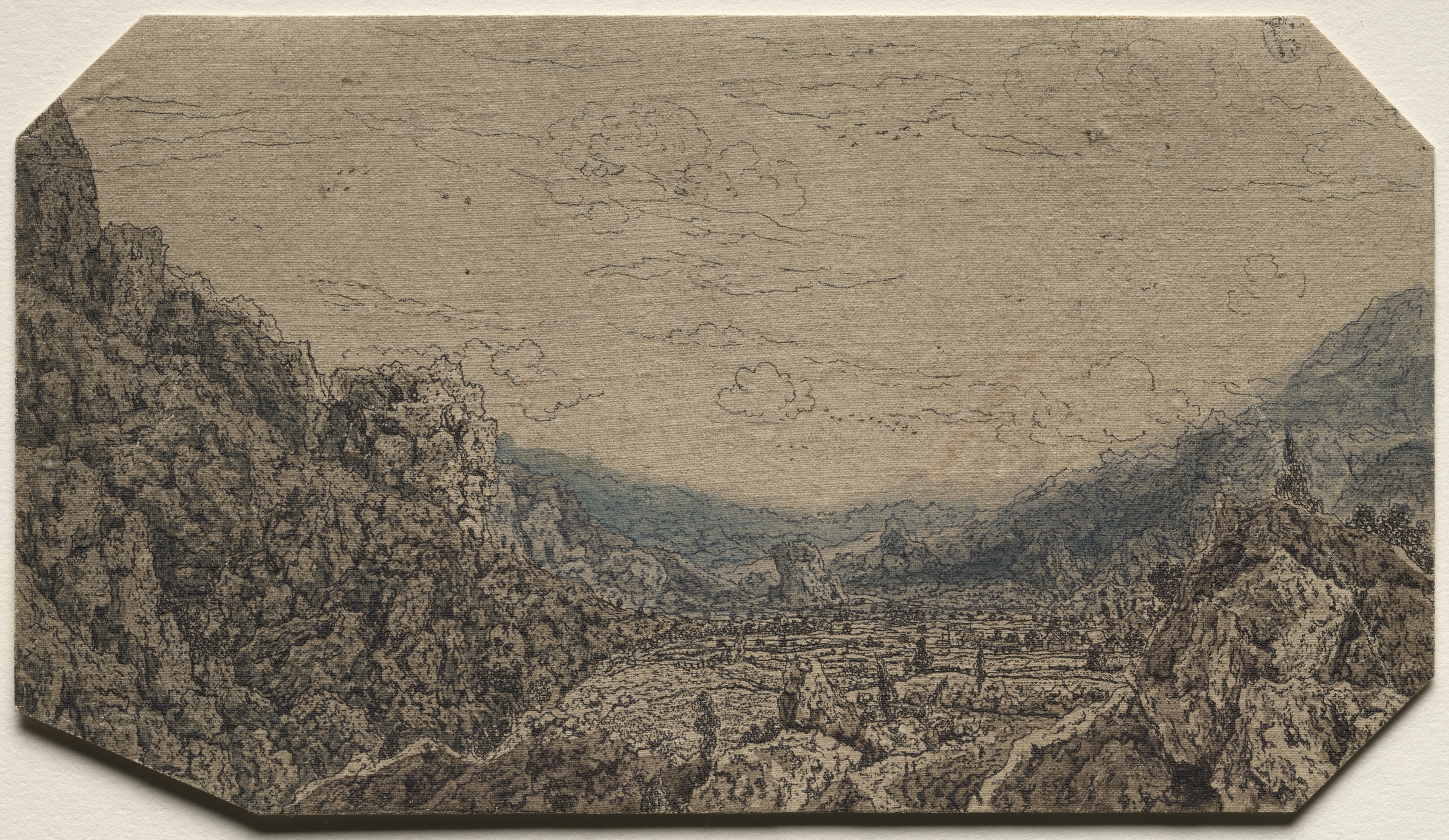
Enclosed Valleyc. 1623–30
To make his dreamy and mysterious landscapes, Hercules Seghers combined a number of etching and coloring techniques in order to make prints that met his expressive ends, and which he considered printed paintings. More about this work
About this work
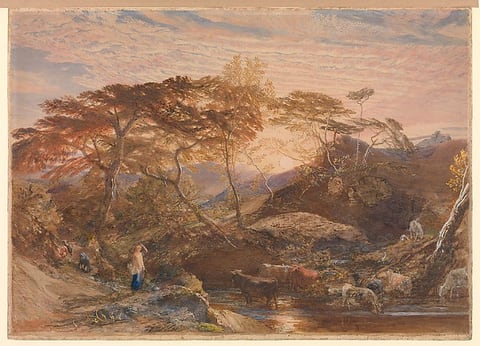
To make his dreamy and mysterious landscapes, Hercules Seghers combined a number of etching and coloring techniques in order to make prints that met his expressive ends, and which he considered printed paintings. He created 54 etchings, but instead of producing standardized editions printed in black ink on white paper, he made each impression a unique and individualized work of art. He often printed in colored inks on paper prepared with a colored ground, or on cloth (as here), and then painted the printed impression by hand. Cleveland’s etching is one of only ten known impressions of the first state of this print.
Text from the Cleveland Museum of Art.
How it was made
- Etching
- The artist draws with a needle through a waxy coating on a copper plate, and acid bites the exposed lines. The plate is then inked, wiped and printed under pressure, so the line keeps the freedom of drawing.
- Watercolour
- Pigment in gum arabic, thinned with water and laid in transparent washes. Nothing white is painted: the light is the paper showing through.
Hercules Seghers
Dutch, 1589/90–c. 1638
Dutch Golden Age
Seventeenth-century painting from the Dutch Republic: still lifes, interiors, portraits and flat, wide skies.
Rights and the museum’s record
Public domain. The Cleveland Museum of Art has dedicated this image to the public domain under CC0, so anyone may copy, adapt and use it, for any purpose, without asking. Our prints and files are reproductions made from the museum’s image; the museum doesn’t endorse them.
- Object number
- 1951.349
- Credit
- Courtesy of the Cleveland Museum of Art
- Type
- Department
- Prints
- Licence
- CC0 1.0 Universal
- Museum record
- See it on the museum’s site
Report this work
Close in colour