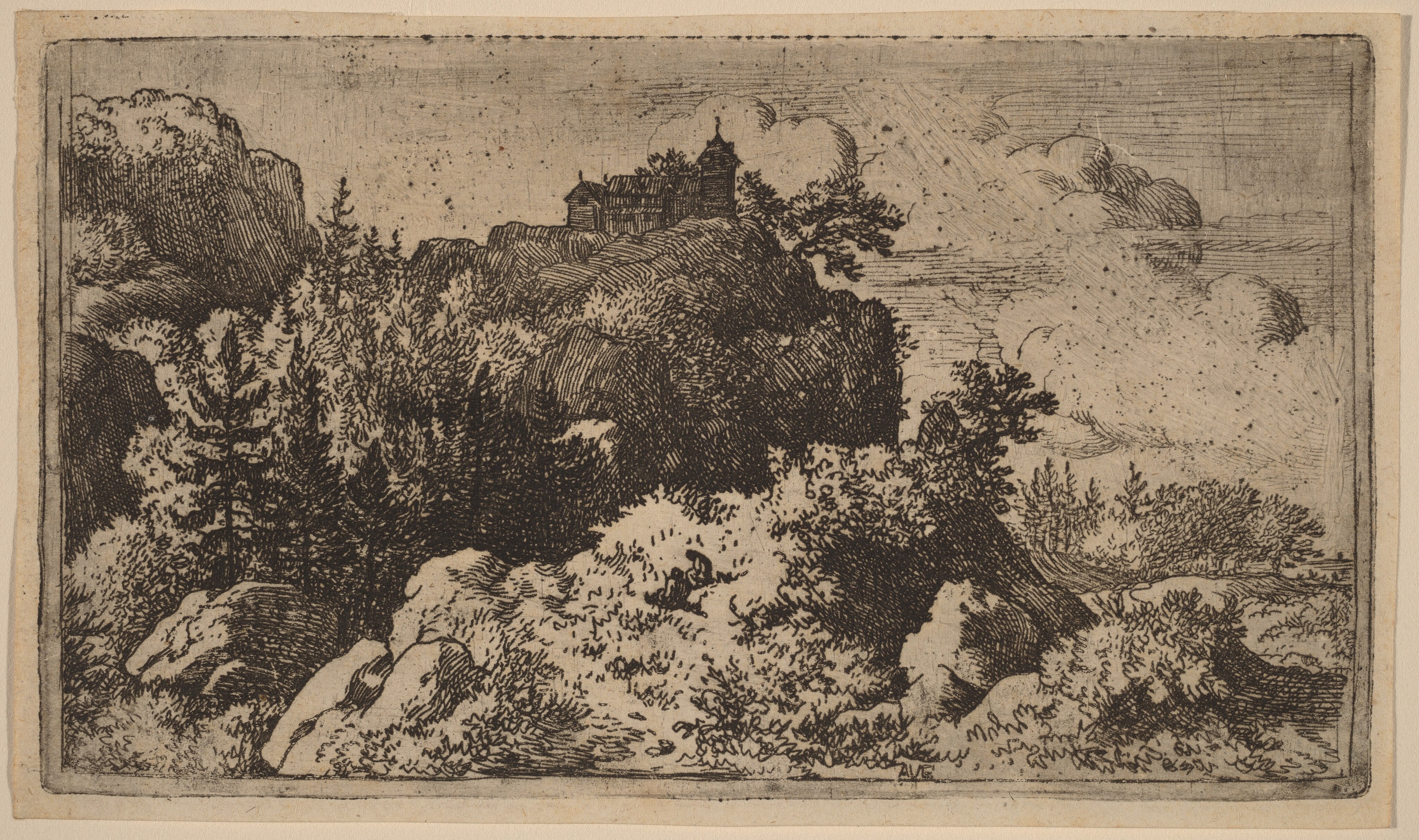
Firs in the Defileprobably c. 1645/1656
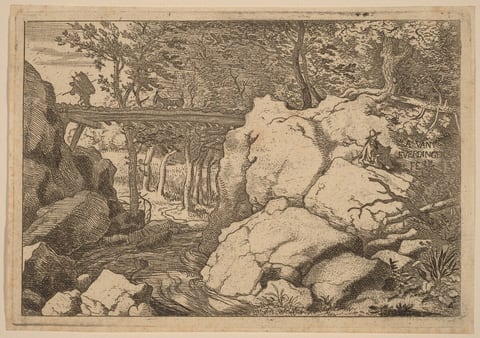
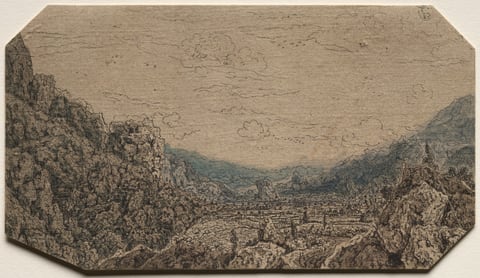
A narrow mountain pass opens before us, choked with rocks and dark firs, and a building stands silhouetted on the heights in the distance. More about this work
About this work
A narrow mountain pass opens before us, choked with rocks and dark firs, and a building stands silhouetted on the heights in the distance. Allart van Everdingen travelled to Norway and Sweden in the 1640s, and the rugged scenery he saw there, so unlike the flat Dutch countryside, became his signature subject in paintings and in a large body of etchings like this one. Short, dense strokes and hatching build the texture of needles, bark and stone, and the high horizon makes the landscape feel steep and enclosing.
Written by Ochre Editions.
What you’re looking at
The image shows a slightly elevated perspective of a rugged landscape with dense vegetation and rock formations. The horizon is high in the upper third of the image, with a distant building or castle on a hill. The structure is silhouetted against the sky and partially obscured by foliage. Intricate line work and hatching create detailed textures and shading, especially in the trees and clouds. The color palette is monochromatic, using varying shades of brown and sepia to give the artwork an antiquated and rustic appearance.
Description from the National Gallery of Art.
How it was made
- Etching
- The artist draws with a needle through a waxy coating on a copper plate, and acid bites the exposed lines. The plate is then inked, wiped and printed under pressure, so the line keeps the freedom of drawing.
Allart van Everdingen
Dutch, 1621–1675
Everdingen trained in Utrecht and Haarlem and in 1644 travelled to Scandinavia, where he sketched the mountains, forests and waterfalls of Norway and Sweden. Back in Haarlem and later in Amsterdam, he made these northern scenes his speciality, introducing the rushing waterfall into Dutch painting and influencing Jacob van Ruisdael. He was also a prolific etcher of landscapes and made a well-known series illustrating the fable of Reynard the Fox.
Written by Ochre Editions.
Rights and the museum’s record
Public domain. The National Gallery of Art has dedicated this image to the public domain under CC0, so anyone may copy, adapt and use it, for any purpose, without asking. Our prints and files are reproductions made from the museum’s image; the museum doesn’t endorse them.
- Object number
- 1973.15.115
- Credit
- Courtesy National Gallery of Art, Washington
- Type
- Licence
- CC0 1.0 Universal
- Museum record
- See it on the museum’s site