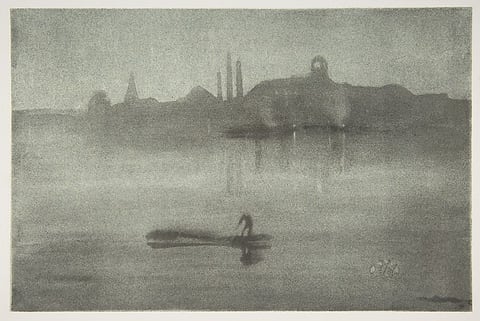
Nocturne: Palaces1879–80
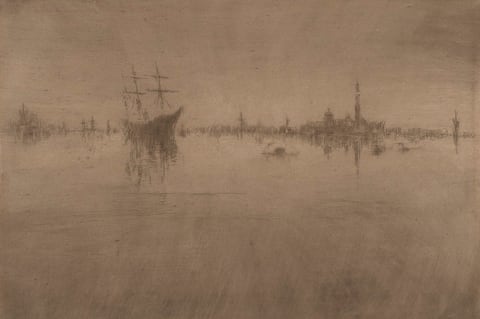
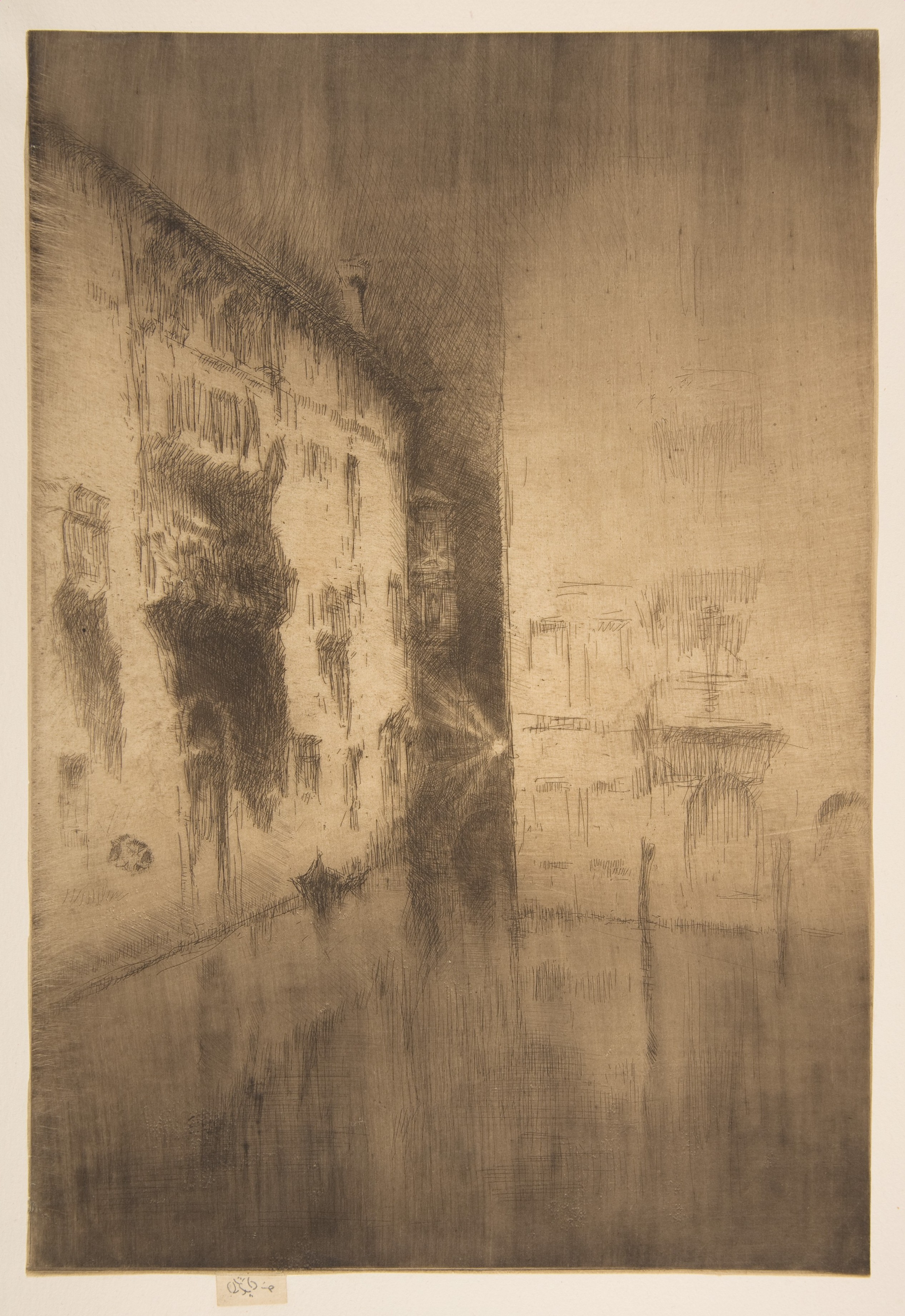
Dark palaces rise above a narrow Venetian canal at night, their doorways and windows emerging from veils of brown ink. More about this work
About this work
Dark palaces rise above a narrow Venetian canal at night, their doorways and windows emerging from veils of brown ink. Whistler, who spent fourteen months in Venice in 1879–80, avoided the famous sights and sought out back canals, doorways and courtyards. When printing this plate he left ink on its surface and wiped it selectively, so that every impression is a slightly different evening, darker or more luminous by turns. The image owes as much to the printer’s hand as to the etched line.
Written by Ochre Editions.
How it was made
- Drypoint
- Lines scratched straight into the plate with a needle throw up a ridge of metal, the burr, which holds ink and prints a soft, furred line. The burr wears down, so early impressions are the richest.
- Etching
- The artist draws with a needle through a waxy coating on a copper plate, and acid bites the exposed lines. The plate is then inked, wiped and printed under pressure, so the line keeps the freedom of drawing.
- Pen and ink
- Drawn with a quill or reed pen, often with wash added by brush to model light and shadow.
James McNeill Whistler
American, 1834–1903 · Born in Lowell, Massachusetts; died in London.
Whistler spent part of his boyhood in Russia, left West Point without graduating and trained as a painter in Paris before settling in London in 1859. He held that a picture was an arrangement of colour and form, and named his works symphonies, harmonies and nocturnes; a hostile review of one nocturne led to his 1878 libel suit against John Ruskin. He was equally committed to etching, and in his Venice plates of 1879–80 he left films of ink on the copper to suggest water and dusk.
Written by Ochre Editions.
Rights and the museum’s record
Public domain. The Met has dedicated this image to the public domain under CC0, so anyone may copy, adapt and use it, for any purpose, without asking. Our prints and files are reproductions made from the museum’s image; the museum doesn’t endorse them.
- Object number
- 40.63.8
- Credit
- Courtesy of The Metropolitan Museum of Art
- Type
- Prints
- Department
- Drawings and Prints
- Licence
- CC0 1.0 Universal
- Museum record
- See it on the museum’s site
Report this work
More by James McNeill Whistler
All their works