Unknown maker
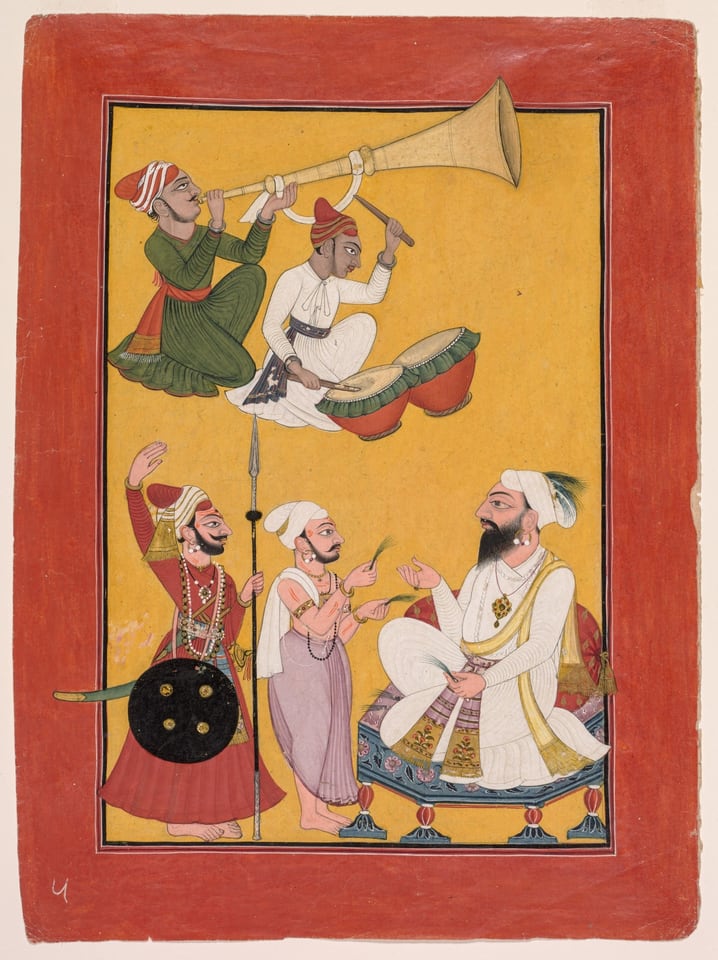
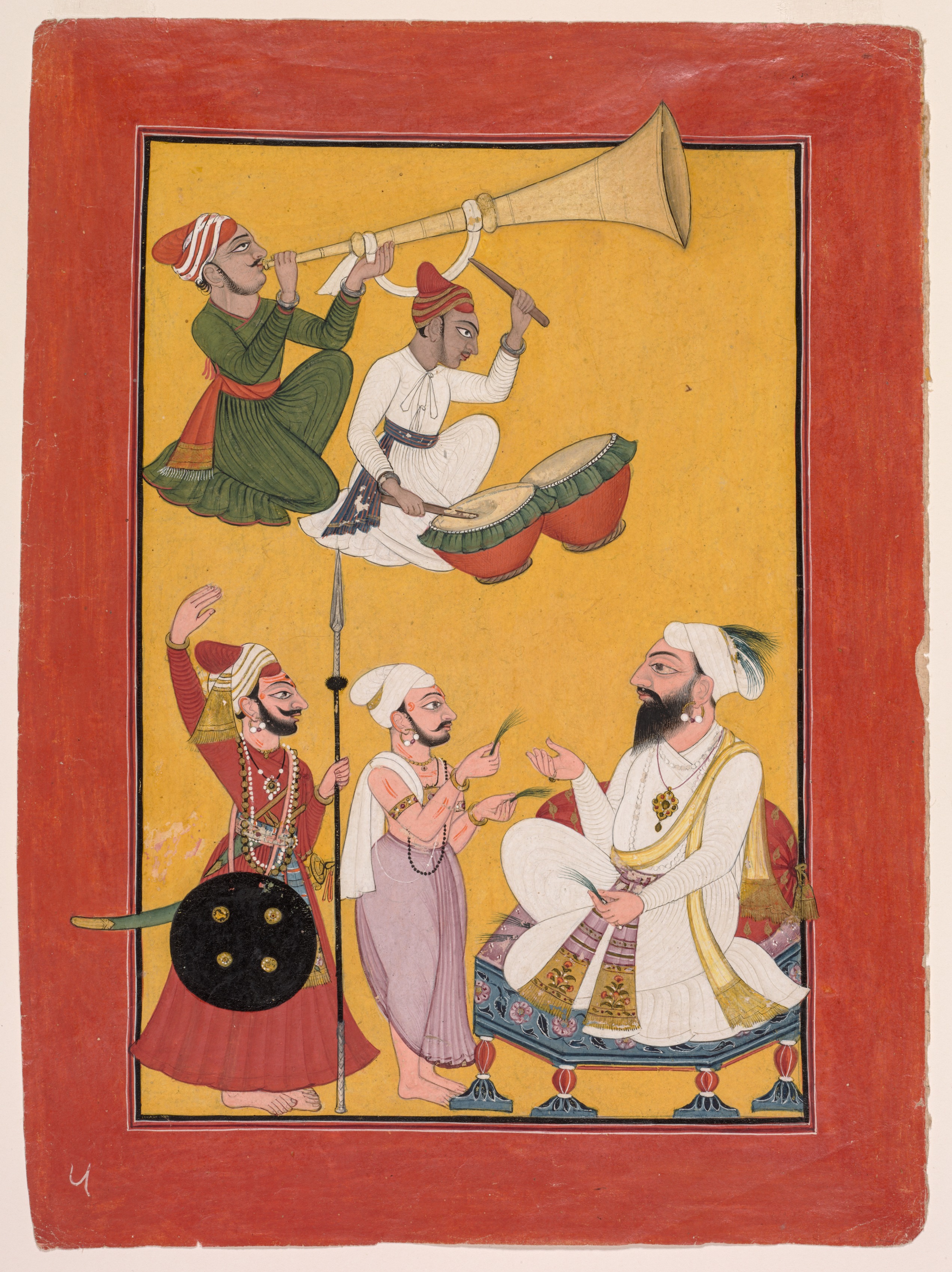
Celebrations of Krishna's Birth, from a Bhagavata Puranac. 1725–30
The Hindu kingdom of Mankot in the western foothills of the Himalayas developed a bold style of painting in which figures in strict profile stand out against an intense yellow ground. More about this work
About this work
The Hindu kingdom of Mankot in the western foothills of the Himalayas developed a bold style of painting in which figures in strict profile stand out against an intense yellow ground. Musicians enthusiastically proclaim the arrival of infant Krishna at the village of Vraj, where he was brought as a newborn to grow to maturity in safety among the cowherders. He was secreted away from the evil king Kamsa who wanted to murder the child on account of a prophecy that foretold his own death by Krishna. Krishna’s adoptive father Nanda, the village headmaster, receives tufts of grass as tokens of congratulations from a well-wisher, while a soldier salutes him.
Text from the Cleveland Museum of Art.
How it was made
- Opaque watercolour
- Watercolour made opaque with white or chalk and laid in flat, even layers. Persian and Indian painters ground their colours from minerals, applied them with the finest brushes and burnished the finished page.
- Gold ground
- Gold leaf laid over a red clay and burnished to a mirror shine, often tooled with punches so it flickers in candlelight. Behind sacred figures it stands for heavenly light.
- Tempera
- Pigment bound with egg yolk. It dries in minutes and can’t be blended wet, so painters built up form with fine, hatched strokes. It was Europe’s main panel technique before oil.
Rights and the museum’s record
Public domain. The Cleveland Museum of Art has dedicated this image to the public domain under CC0, so anyone may copy, adapt and use it, for any purpose, without asking. Our prints and files are reproductions made from the museum’s image; the museum doesn’t endorse them.
- Object number
- 1988.70
- Credit
- Courtesy of the Cleveland Museum of Art
- Type
- Painting
- Department
- Indian and Southeast Asian Art
- Licence
- CC0 1.0 Universal
- Museum record
- See it on the museum’s site
Report this work
Close in colour