Corte del Paradiso1880
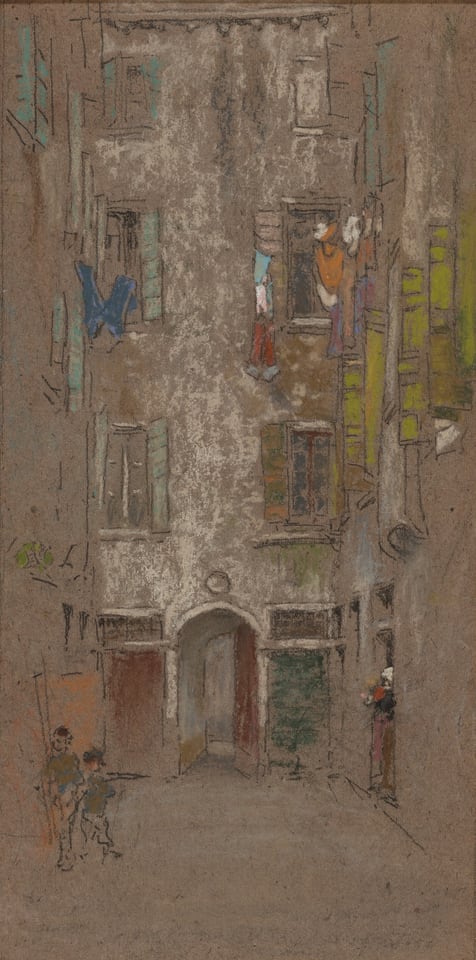
A narrow Venetian courtyard, the Corte del Paradiso, is evoked with a few lines of black chalk and touches of coloured pastel on brown paper, the bare sheet standing for walls and shadow. More about this work
About this work
A narrow Venetian courtyard, the Corte del Paradiso, is evoked with a few lines of black chalk and touches of coloured pastel on brown paper, the bare sheet standing for walls and shadow. During his fourteen months in Venice in 1879–80 Whistler made nearly a hundred pastels like this, seeking out quiet corners rather than famous monuments. Exhibited in London in 1881, they sold well and helped restore his finances after his bankruptcy.
Written by Ochre Editions.
What you’re looking at
A work made of pastel and black chalk on brown wove paper with fibrous inclusions.
Description from the Art Institute of Chicago.
How it was made
- Pastel
- Sticks of almost pure pigment with very little binder. The colour sits on the paper as powder: bright, matte and fragile.
- Chalk
- Natural black, red and white chalks. Used together on toned paper they could give the warmth of flesh with very little effort, and they were favourites for studies from life.
James McNeill Whistler
American, 1834–1903 · Born in Lowell, Massachusetts; died in London.
Whistler spent part of his boyhood in Russia, left West Point without graduating and trained as a painter in Paris before settling in London in 1859. He held that a picture was an arrangement of colour and form, and named his works symphonies, harmonies and nocturnes; a hostile review of one nocturne led to his 1878 libel suit against John Ruskin. He was equally committed to etching, and in his Venice plates of 1879–80 he left films of ink on the copper to suggest water and dusk.
Written by Ochre Editions.
Rights and the museum’s record
Public domain. The Art Institute of Chicago has dedicated this image to the public domain under CC0, so anyone may copy, adapt and use it, for any purpose, without asking. Our prints and files are reproductions made from the museum’s image; the museum doesn’t endorse them.
- Object number
- 2002.679
- Credit
- Courtesy of the Art Institute of Chicago
- Type
- Drawing and Watercolor
- Department
- Prints and Drawings
- Licence
- CC0 1.0 Universal
- Museum record
- See it on the museum’s site
Report this work
More by James McNeill Whistler
All their works
Close in colour