Unknown maker
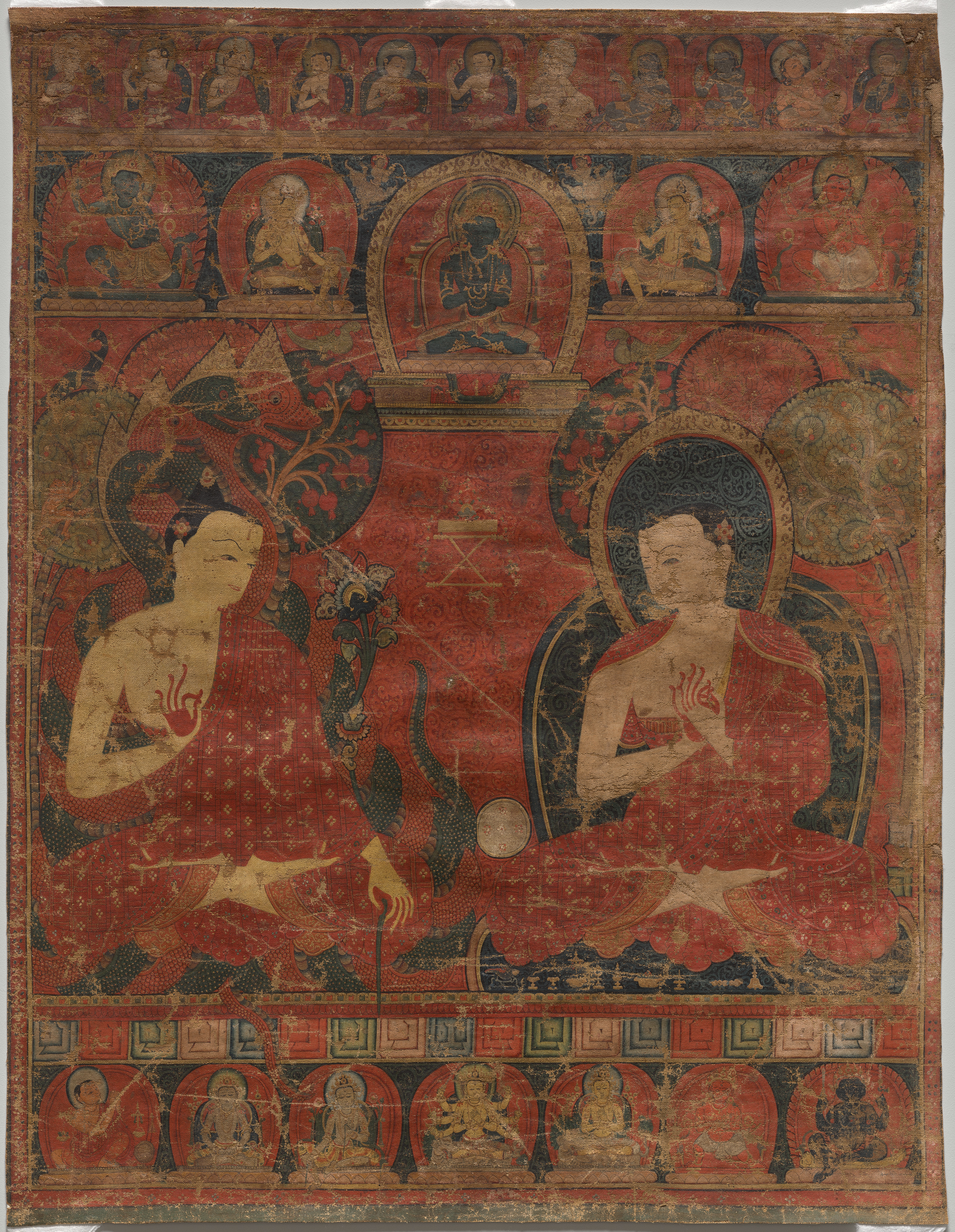
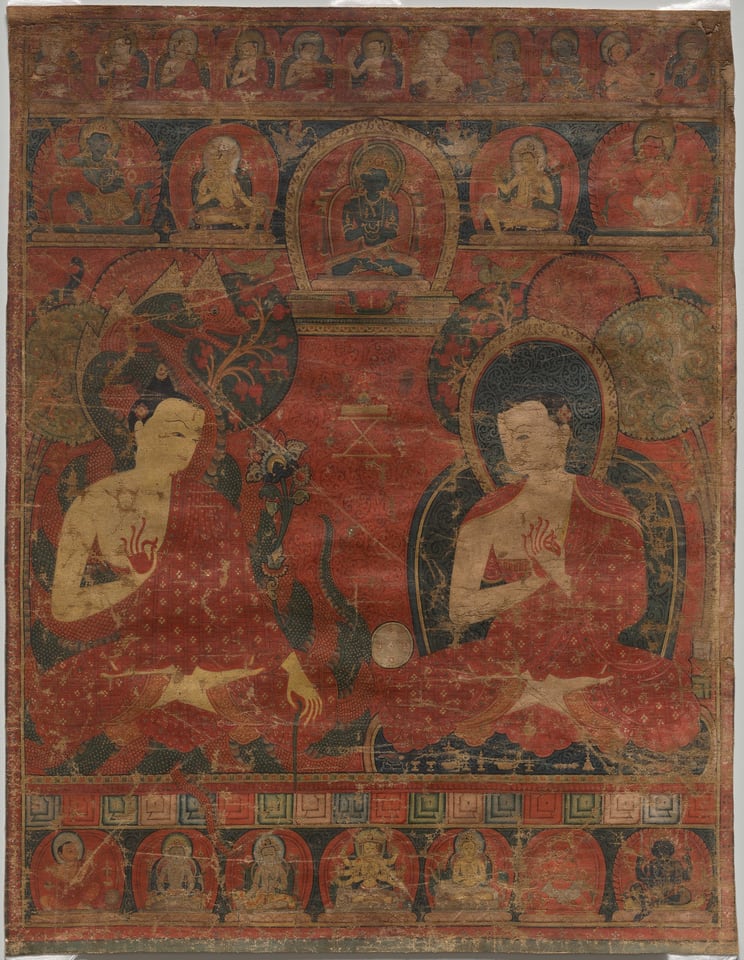
Nagarjuna (c. 150–250 CE) with a Buddhist Masterc. 1300s
Nagarjuna, the Buddhist philosopher from southern India, sits on his eponymous red and black serpents, or naga . His interlocutor may be his disciple Aryadeva. More about this work
About this work
Nagarjuna, the Buddhist philosopher from southern India, sits on his eponymous red and black serpents, or naga . His interlocutor may be his disciple Aryadeva. A volume of the Perfection of Wisdom , honored with flowers, is on a golden bookstand between their heads. The figures sit beneath flowering and fruiting trees with peacocks and parrots, evoking the landscape of India. Lineage masters of the Sakya order of Buddhism are aligned in the top row, beginning with Virupa at the upper right. The monk who was the donor of this painting is in the lower left corner.
Text from the Cleveland Museum of Art.
How it was made
- Opaque watercolour
- Watercolour made opaque with white or chalk and laid in flat, even layers. Persian and Indian painters ground their colours from minerals, applied them with the finest brushes and burnished the finished page.
- Tempera
- Pigment bound with egg yolk. It dries in minutes and can’t be blended wet, so painters built up form with fine, hatched strokes. It was Europe’s main panel technique before oil.
Rights and the museum’s record
Public domain. The Cleveland Museum of Art has dedicated this image to the public domain under CC0, so anyone may copy, adapt and use it, for any purpose, without asking. Our prints and files are reproductions made from the museum’s image; the museum doesn’t endorse them.
- Object number
- 1985.186
- Credit
- Courtesy of the Cleveland Museum of Art
- Type
- Painting
- Department
- Indian and Southeast Asian Art
- Licence
- CC0 1.0 Universal
- Museum record
- See it on the museum’s site