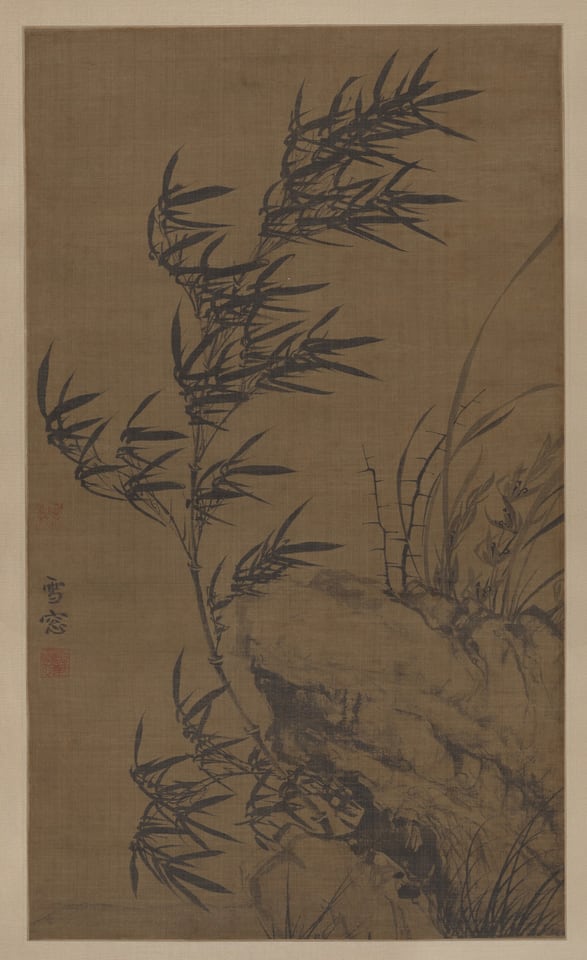
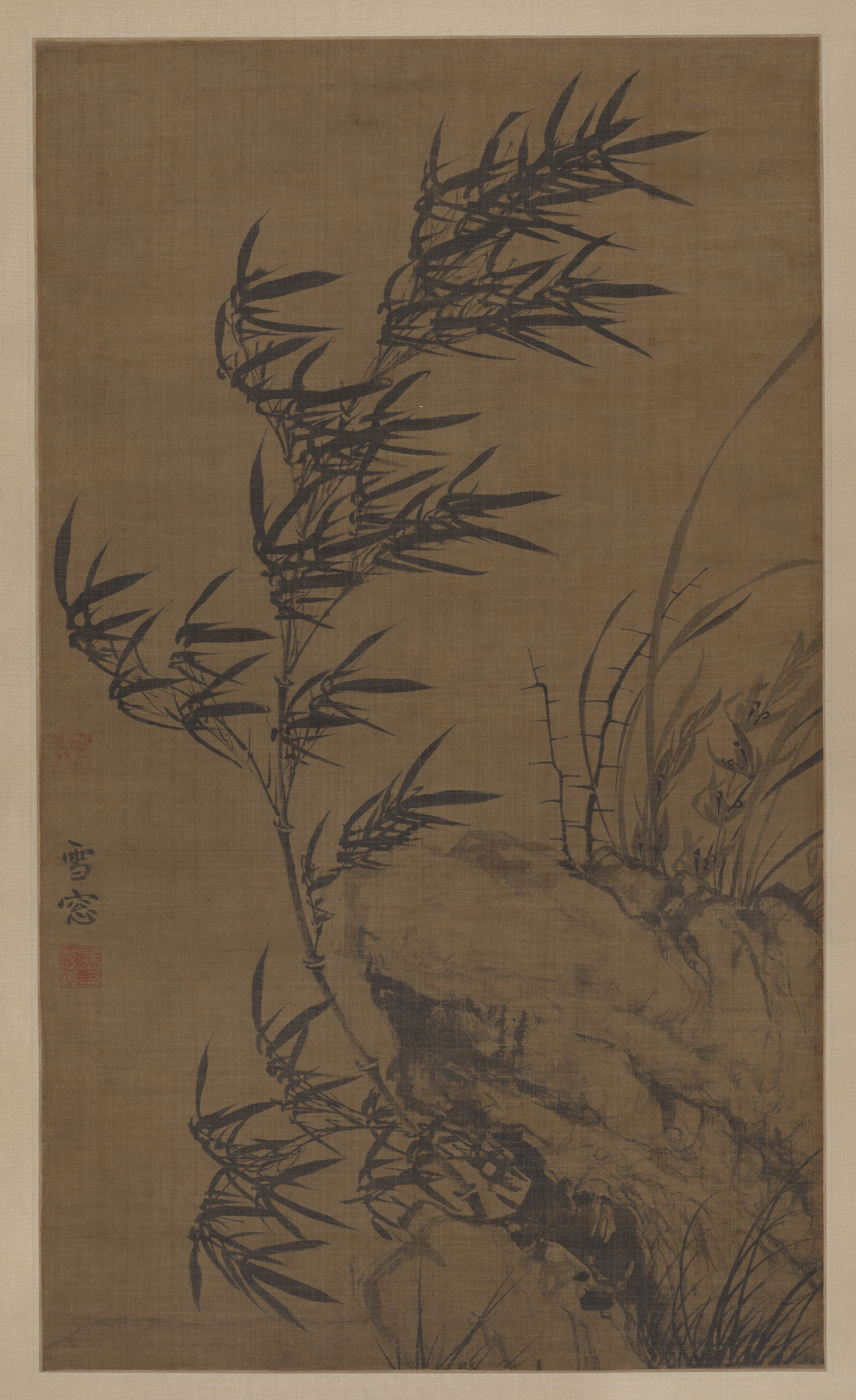
Bamboo in the Wind1300s
Bamboo is an evergreen plant that does not break under the weight of snow or the force of the wind, and thus became a favorite motif in literati painting and Chan Buddhism as a metaphor for the virtue of not yielding to worldly temptations. More about this work
About this work
Bamboo is an evergreen plant that does not break under the weight of snow or the force of the wind, and thus became a favorite motif in literati painting and Chan Buddhism as a metaphor for the virtue of not yielding to worldly temptations. Xuechuang, also known as monk Puming, was a native of Songjiang, near Shanghai, who spent his life as a monk in Suzhou. In 1338, he presided over Yunyan temple on Tiger Hill. Here, he masterfully depicts a bamboo gently bent in a subtle breeze. Puming’s paintings were revered in Japan and Korea.
Text from the Cleveland Museum of Art.
How it was made
- Hanging scroll
- A painting mounted on silk with a wooden roller at the foot. It was rolled up for storage and brought out to hang for a season, a guest or an occasion.
- Ink and colour on silk
- Silk was sized with glue and alum so it would hold a crisp brushline, and mineral colours were built up in thin layers. The sheen of the weave still shows through.
Puming (Xuechuang)
Chinese, active before 1274–after 1329
Chinese painting
Ink and colour on silk and paper, from imperial courts to scholars' retreats.
Rights and the museum’s record
Public domain. The Cleveland Museum of Art has dedicated this image to the public domain under CC0, so anyone may copy, adapt and use it, for any purpose, without asking. Our prints and files are reproductions made from the museum’s image; the museum doesn’t endorse them.
- Object number
- 1953.246
- Credit
- Courtesy of the Cleveland Museum of Art
- Type
- Painting
- Department
- Chinese Art
- Licence
- CC0 1.0 Universal
- Museum record
- See it on the museum’s site
Report this work
Close in colour