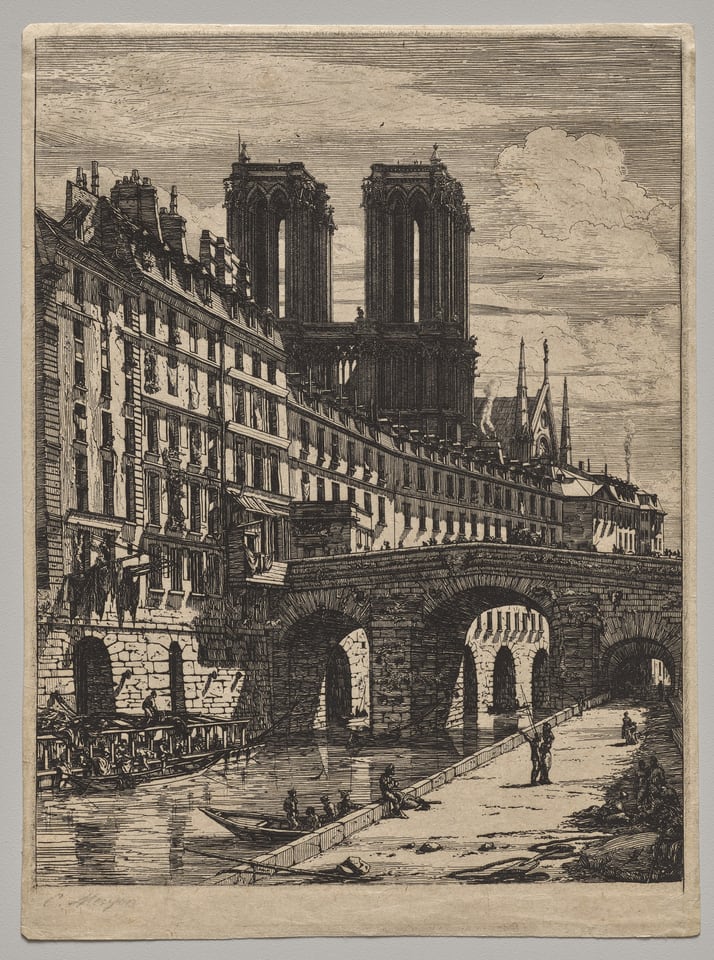
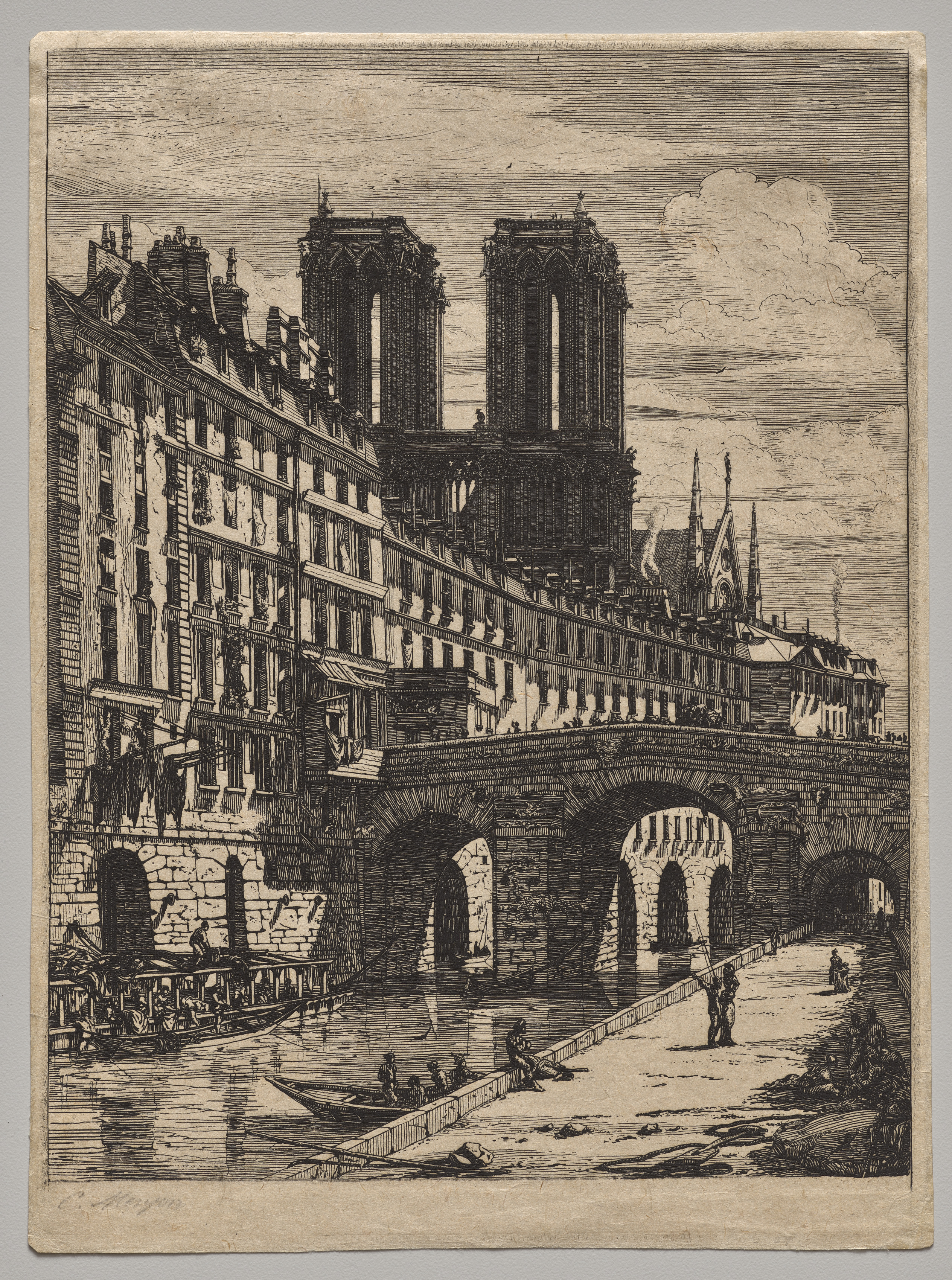
The Petit Pont1850
Charles Meryon used etching—a technique that involves drawing on a printing plate with a needle’s point—to create minutely detailed images of Paris that imaginatively present recognizable sites. More about this work
About this work
Charles Meryon used etching—a technique that involves drawing on a printing plate with a needle’s point—to create minutely detailed images of Paris that imaginatively present recognizable sites. This print features bateaux-lavoirs (wash boats) on the Seine River, where laundresses could purchase a spot to do their washing. The boats appealed to Meryon, who was fascinated by Paris’s gradual transformation. Since they attracted crowds of working-class women, administrators considered the boats unsightly and unhygienic, repeatedly pushing them closer to the city’s outskirts until few remained by the end of the 1800s.
Text from the Cleveland Museum of Art.
How it was made
- Etching
- The artist draws with a needle through a waxy coating on a copper plate, and acid bites the exposed lines. The plate is then inked, wiped and printed under pressure, so the line keeps the freedom of drawing.
- Engraving
- Lines cut directly into a metal plate with a steel burin, which makes them swell and taper. It took years to master, and for centuries it was how paintings travelled as pictures.
Rights and the museum’s record
Public domain. The Cleveland Museum of Art has dedicated this image to the public domain under CC0, so anyone may copy, adapt and use it, for any purpose, without asking. Our prints and files are reproductions made from the museum’s image; the museum doesn’t endorse them.
- Object number
- 1953.10
- Credit
- Courtesy of the Cleveland Museum of Art
- Type
- Department
- Prints
- Licence
- CC0 1.0 Universal
- Museum record
- See it on the museum’s site
Report this work
More by Charles Meryon
All their works
Close in colour