Giant Magnolias on a Blue Velvet Clothc. 1890
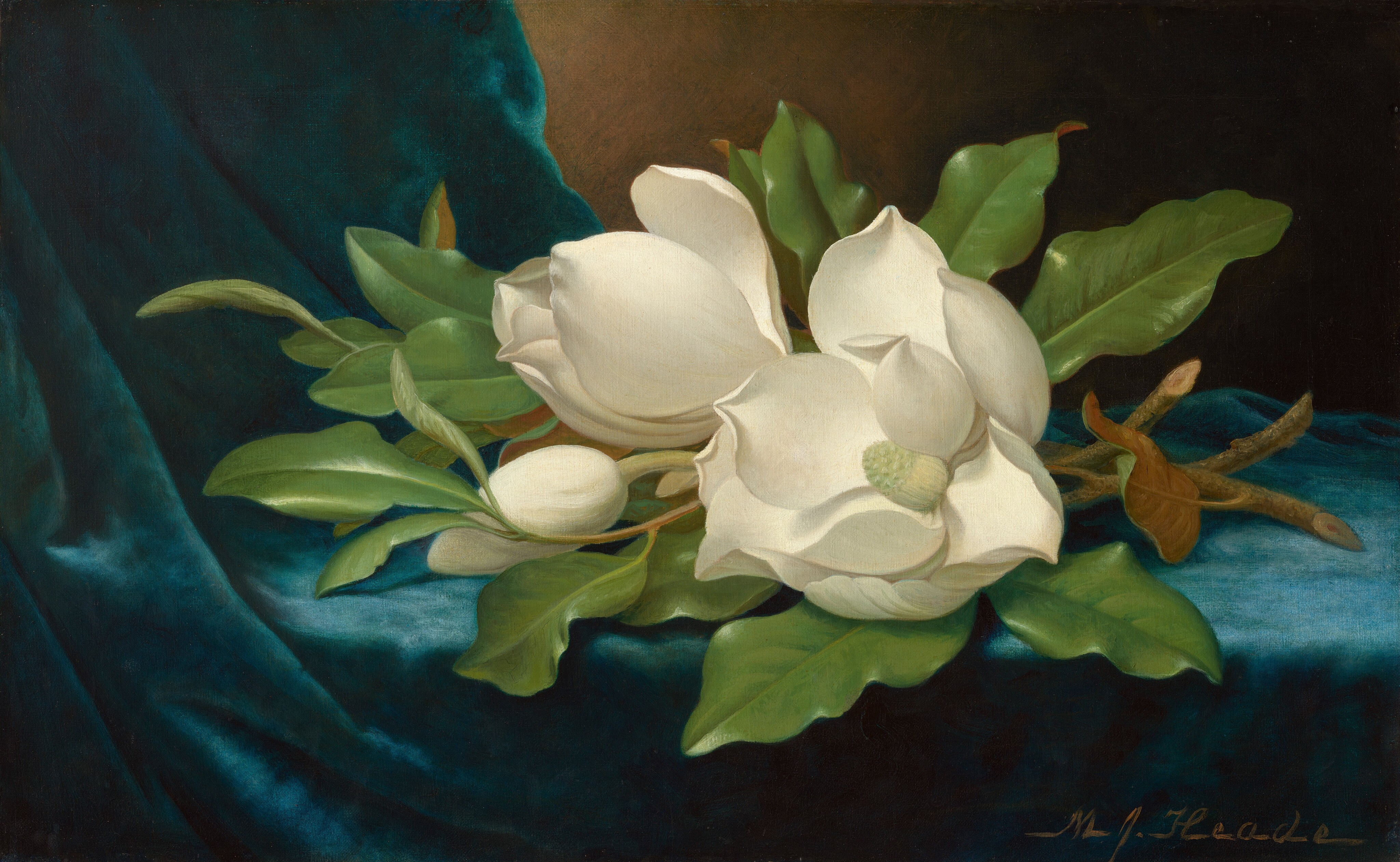
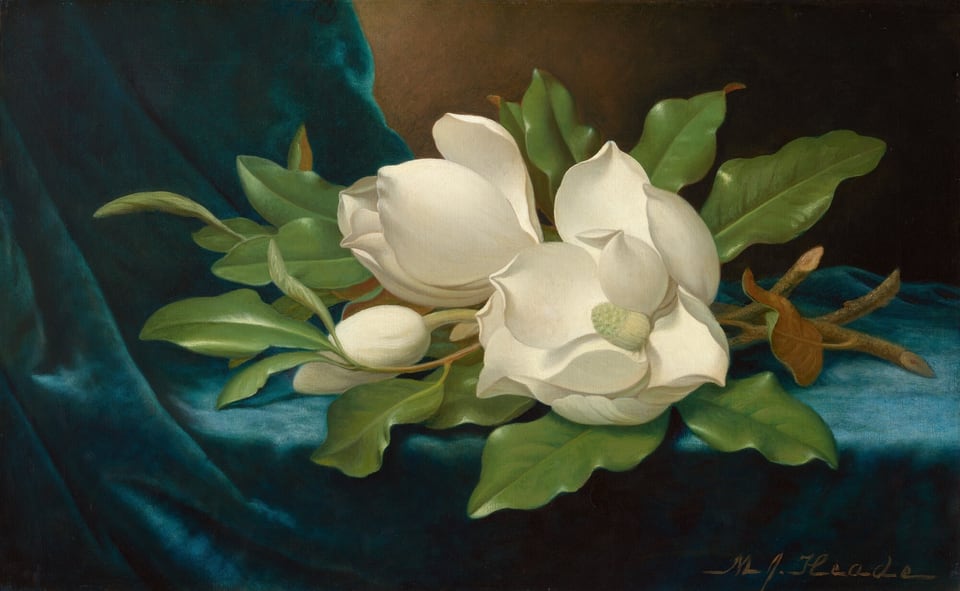
Three magnolia blossoms, from a tight bud to a fully open flower with an oval stamen at its heart, lie with their glossy leaves across a sapphire velvet cloth, brightly lit from the left against a dark background. More about this work
About this work
Three magnolia blossoms, from a tight bud to a fully open flower with an oval stamen at its heart, lie with their glossy leaves across a sapphire velvet cloth, brightly lit from the left against a dark background. Martin Johnson Heade settled in St Augustine, Florida, in 1883, and in his last decades he painted the region’s flowers with lavish sensuality. The contrast of creamy petals, waxy green leaves and the deep, shimmering blue of the velvet makes this one of the best-known American still lifes of its time.
Written by Ochre Editions.
What you’re looking at
Twigs of a magnolia tree with light green, glossy leaves and three cream-white blossoms lie on a sapphire-blue cloth in this horizontal still life painting. Brightly lit from our left, the blossoms and leaves nearly fill the composition, and the cut ends lie on the fabric to our right. The blue fabric cascades from the upper left and across the table or ledge. The three flowers are in various stages of bloom. The tightest bud is to our left, overlapped by a stem and the tender, unfurling leaves of a branch. The blossom next to it, at the center, is starting to open. The petals of the third blossom, to our right, splay open around the flower’s oval-shaped stamen. Light glints off the waxy leaves surrounding the flowers. The tawny-brown underside of one leaf is visible where it turns over, near the cut ends of the branches. Light shimmering on the fabric darkens from bright blue to our right, to deep royal blue in the shadows to the upper left, suggesting the fabric is velvet. The background is streaked with tan and pine green behind the fabric, and becomes nearly black in the shadows of the upper right corner and along the bottom edge. The artist signed the lower right corner, "MJ. Heade."
Description from the National Gallery of Art.
How it was made
- Oil paint
- Pigment ground in a drying oil, usually linseed. It dries slowly, so painters could blend on the canvas, build up thin translucent glazes, and rework a picture over weeks. Canvas replaced wooden panels in the 1500s because it is lighter and can be rolled.
Martin Johnson Heade
1819–1904
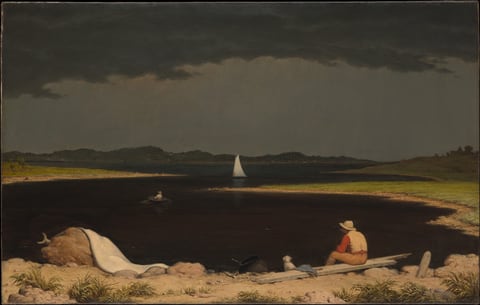
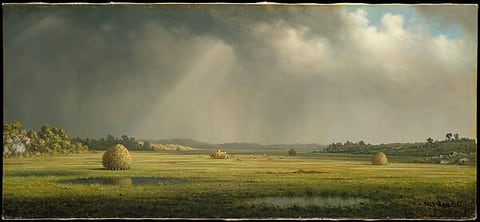
Heade travelled restlessly and worked in many genres, but is best known for three subjects: the salt marshes of New England and New Jersey, with haystacks under changing skies; hummingbirds and orchids, which he studied on journeys to Brazil and Central America; and, in later years, lush still lifes of magnolias and other flowers, painted after he settled in St Augustine, Florida. Approaching Thunder Storm is an early example of his brooding coastal scenes.
Written by Ochre Editions.
Rights and the museum’s record
Public domain. The National Gallery of Art has dedicated this image to the public domain under CC0, so anyone may copy, adapt and use it, for any purpose, without asking. Our prints and files are reproductions made from the museum’s image; the museum doesn’t endorse them.
- Object number
- 1996.14.1
- Credit
- Courtesy National Gallery of Art, Washington
- Type
- Painting
- Licence
- CC0 1.0 Universal
- Museum record
- See it on the museum’s site