Mrs. Paul Cobb Methuenc. 1776/1777
Mrs. More about this work
About this work
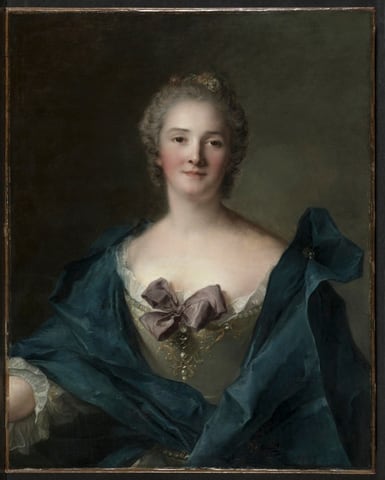
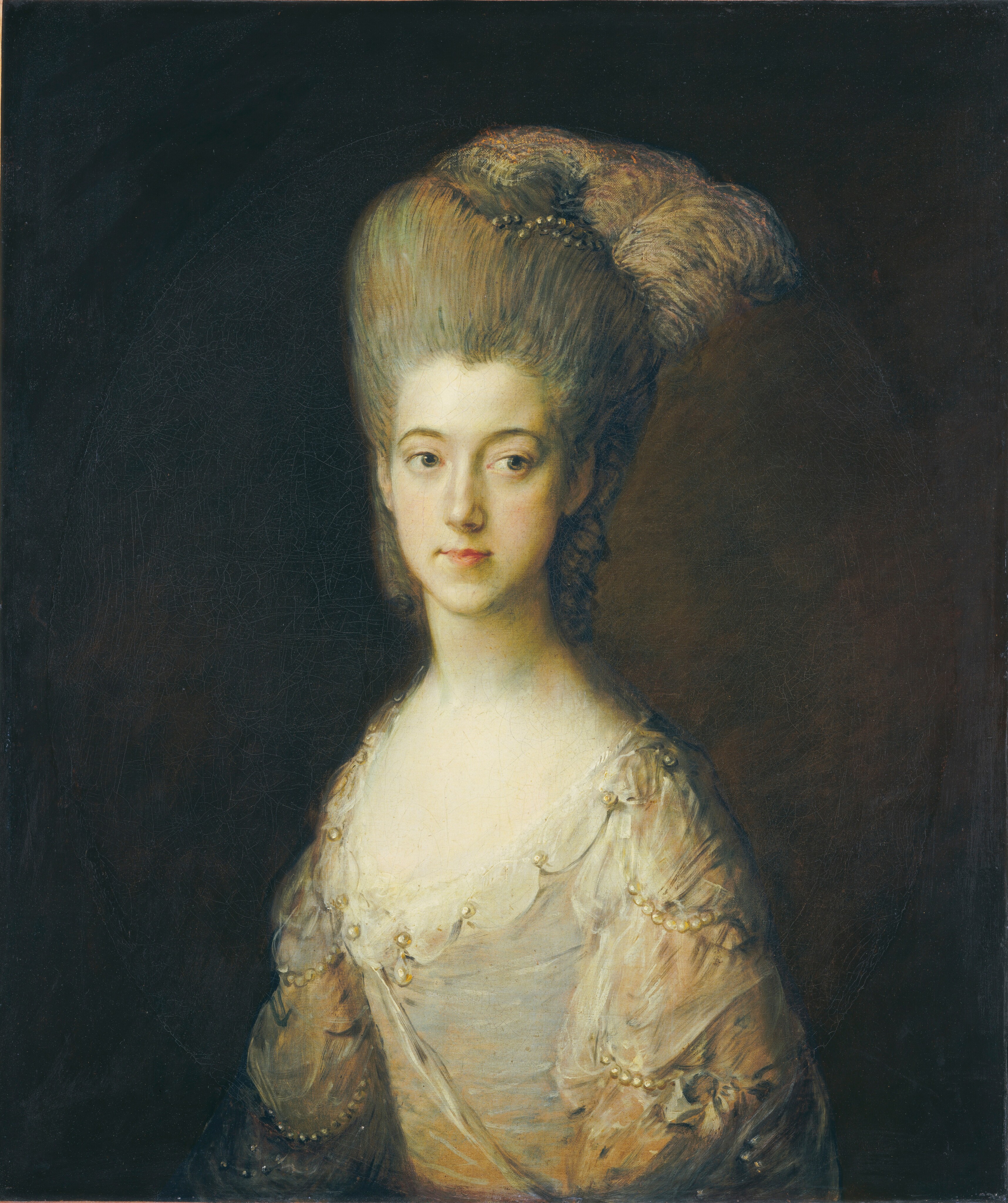
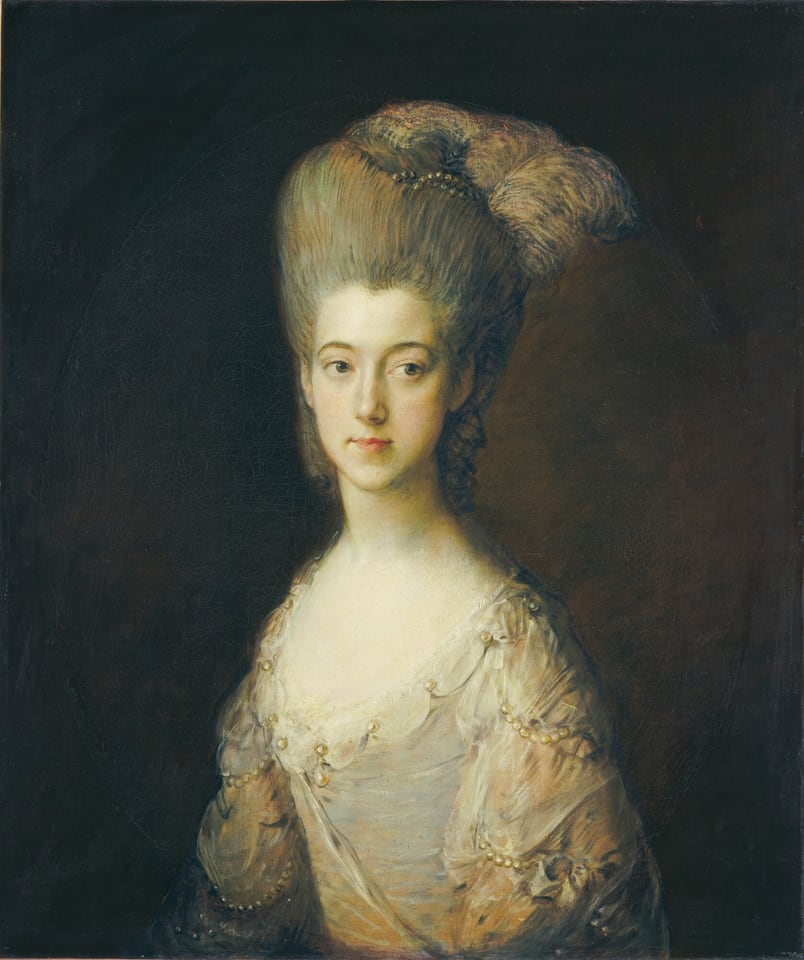
Mrs. Paul Cobb Methuen, her powdered hair piled high beneath a bank of white feathers and sparkling ornaments, glances sideways out of a dark background, her white dress trimmed with pearls and shimmering from silver to pale gold. Gainsborough painted her in the mid-1770s, soon after moving from Bath to London, where his fluid, feathery brushwork made him the chief rival of Joshua Reynolds. The virtuoso fabric, achieved with quick, flickering strokes, contrasts with the delicate, slightly reserved face.
Written by Ochre Editions.
What you’re looking at
Shown from the waist up, a young, pale-skinned woman with her gray hair piled high atop her head is lit starkly against a dark background in this vertical portrait painting. The woman’s shoulders are angled to our left. Her face is square to us, but she looks off to our right from the corners of her eyes, which are gray rimmed with golden brown around the pupils. She has a thin face, smooth cheeks, a bow-shaped pink mouth, and a narrow chin. Her hair is mostly swept up high under a bank of pearl-white feathers and some sparkling ornaments. A few ringlets hang down the back of her neck. The bodice of her white dress scoops low across her chest and sits just above her sloping shoulders. The dress is adorned with pearls on the sleeves and around the neckline, and the fabric shimmers from silvery white to pale gold. The background is earth-brown around her face and deepens to almost black in the corners.
Description from the National Gallery of Art.
How it was made
- Oil paint
- Pigment ground in a drying oil, usually linseed. It dries slowly, so painters could blend on the canvas, build up thin translucent glazes, and rework a picture over weeks. Canvas replaced wooden panels in the 1500s because it is lighter and can be rolled.
Thomas Gainsborough
English, 1727–1788 · Born in Sudbury; died in London.
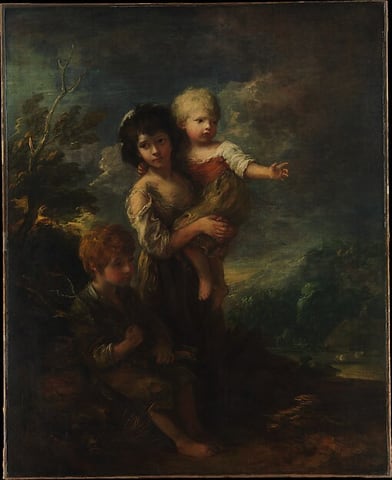
Gainsborough trained in London with the French engraver Hubert Gravelot, then built his career as a portraitist first in Suffolk and later in fashionable Bath before moving to London in 1774. He was a founder member of the Royal Academy and a favourite painter of George III’s family. Although portraits paid his way, his own preference was landscape, and late works such as Cottage Children (The Wood Gatherers) bring the two together in his fluent, feathery brushwork.
Written by Ochre Editions.
Rights and the museum’s record
Public domain. The National Gallery of Art has dedicated this image to the public domain under CC0, so anyone may copy, adapt and use it, for any purpose, without asking. Our prints and files are reproductions made from the museum’s image; the museum doesn’t endorse them.
- Object number
- 1942.9.20
- Credit
- Courtesy National Gallery of Art, Washington
- Type
- Painting
- Licence
- CC0 1.0 Universal
- Museum record
- See it on the museum’s site