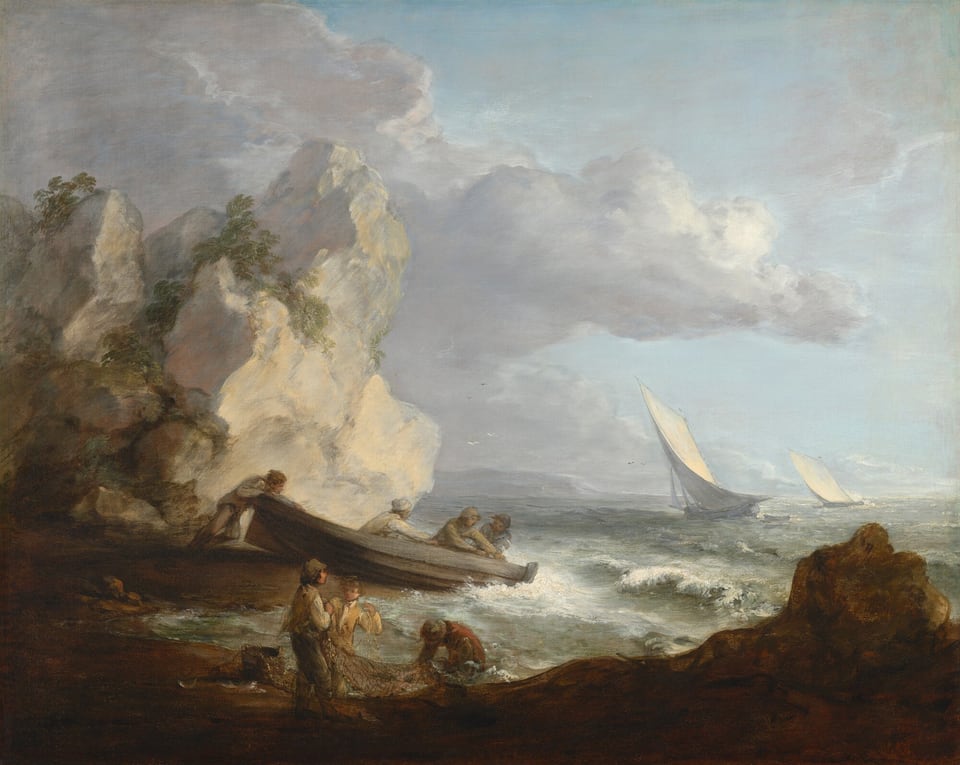
Seashore with Fishermenc. 1781/1782
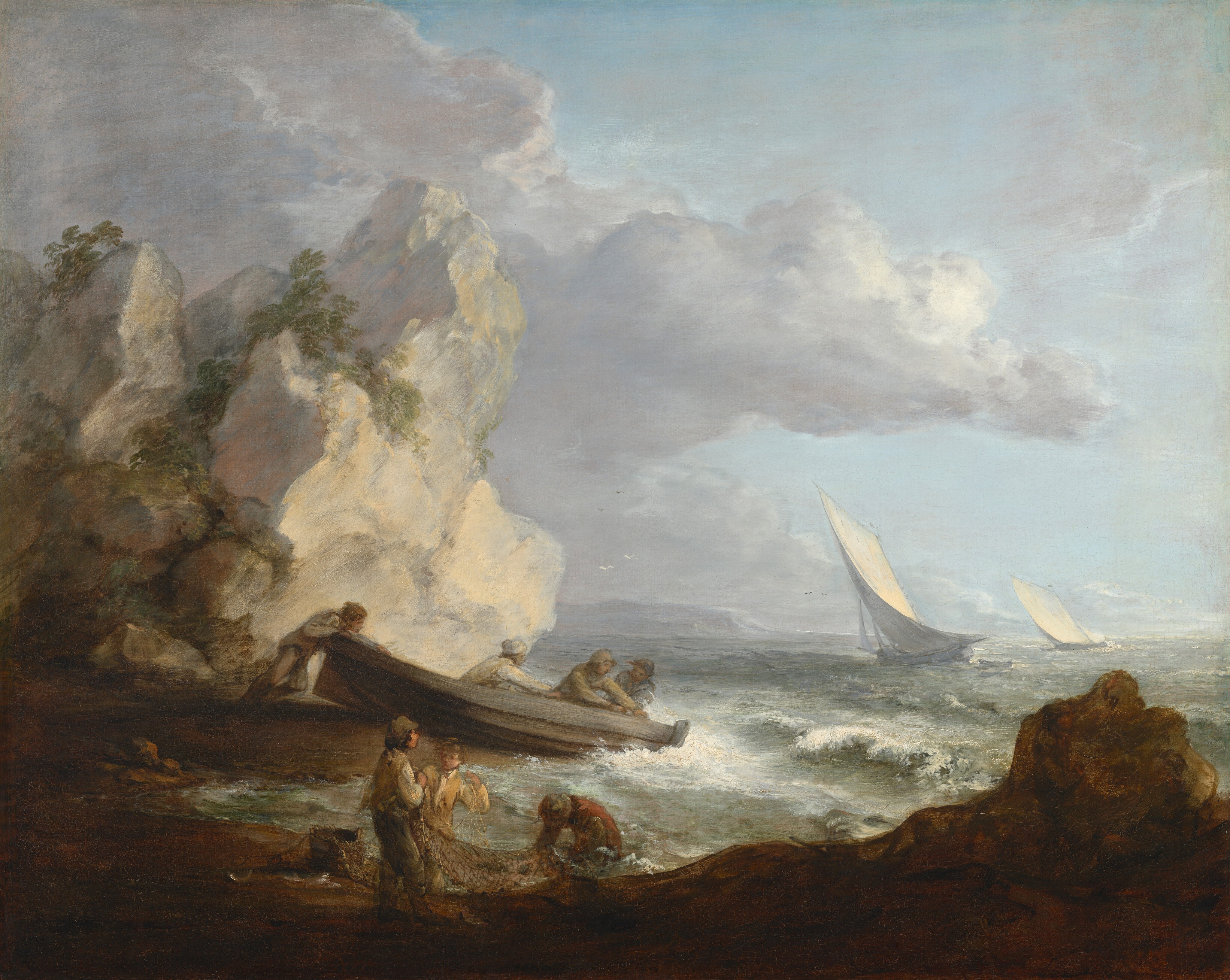
Fishermen push a boat out from a rocky shore while others in the foreground haul a net through the surf, beneath a towering pale cliff and a sky of drifting lavender cloud. More about this work
About this work
Fishermen push a boat out from a rocky shore while others in the foreground haul a net through the surf, beneath a towering pale cliff and a sky of drifting lavender cloud. Gainsborough turned to coastal scenes in the early 1780s and painted them with a freedom that struck his contemporaries; brushwork this loose was rare in British painting of the time. The cool palette of greens, blues and creams captures the fresh air and movement of the sea.
Written by Ochre Editions.
What you’re looking at
From a rocky shoreline, we look on several light-skinned people working by the sea with a boat and a net in this freely painted, almost square seascape. The scene is framed by a silhouette of low boulders along the lower right corner, and a towering cream-white rock rising two-thirds of the way up the composition to our left. Scrubby, celery-green vegetation grows on the rocky outcropping. Near the center, close to the towering white rocks, three people sit, reaching for something near one end of a boat while a fourth person braces against the rock, presumably to push the boat out to the sea. Closer to us, three people on the shore work with a net. Two stand with the net hooked over their shoulders, and a third person crouches in the water with head down. The people all wear simple shirts and pants in shades of tan, mustard yellow, burnt orange, and pale blue. All but two wear hats. The sea meets the shore with frothy white foam and cresting, low waves. The sea beyond fades from pale sage green to arctic blue along the horizon, which comes about a third of the way up the composition. Two sail boats tilt against the wind in the distance. Pale, smoky lavender-purple clouds drift across the ice-blue sky.
Description from the National Gallery of Art.
How it was made
- Oil paint
- Pigment ground in a drying oil, usually linseed. It dries slowly, so painters could blend on the canvas, build up thin translucent glazes, and rework a picture over weeks. Canvas replaced wooden panels in the 1500s because it is lighter and can be rolled.
Thomas Gainsborough
English, 1727–1788 · Born in Sudbury; died in London.
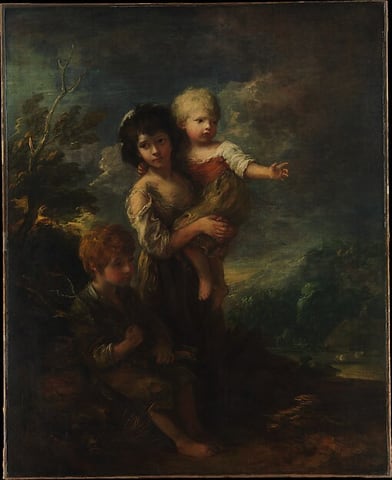
Gainsborough trained in London with the French engraver Hubert Gravelot, then built his career as a portraitist first in Suffolk and later in fashionable Bath before moving to London in 1774. He was a founder member of the Royal Academy and a favourite painter of George III’s family. Although portraits paid his way, his own preference was landscape, and late works such as Cottage Children (The Wood Gatherers) bring the two together in his fluent, feathery brushwork.
Written by Ochre Editions.
Rights and the museum’s record
Public domain. The National Gallery of Art has dedicated this image to the public domain under CC0, so anyone may copy, adapt and use it, for any purpose, without asking. Our prints and files are reproductions made from the museum’s image; the museum doesn’t endorse them.
- Object number
- 1970.17.121
- Credit
- Courtesy National Gallery of Art, Washington
- Type
- Painting
- Licence
- CC0 1.0 Universal
- Museum record
- See it on the museum’s site