Lady and Gentleman on Horsebackc. 1655, reworked 1660/1665
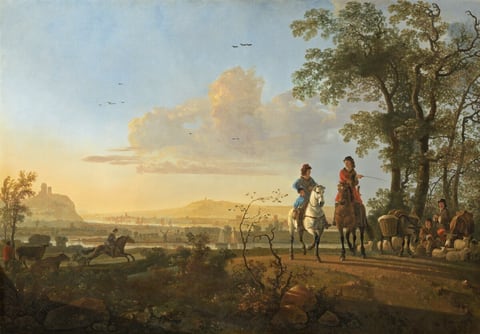
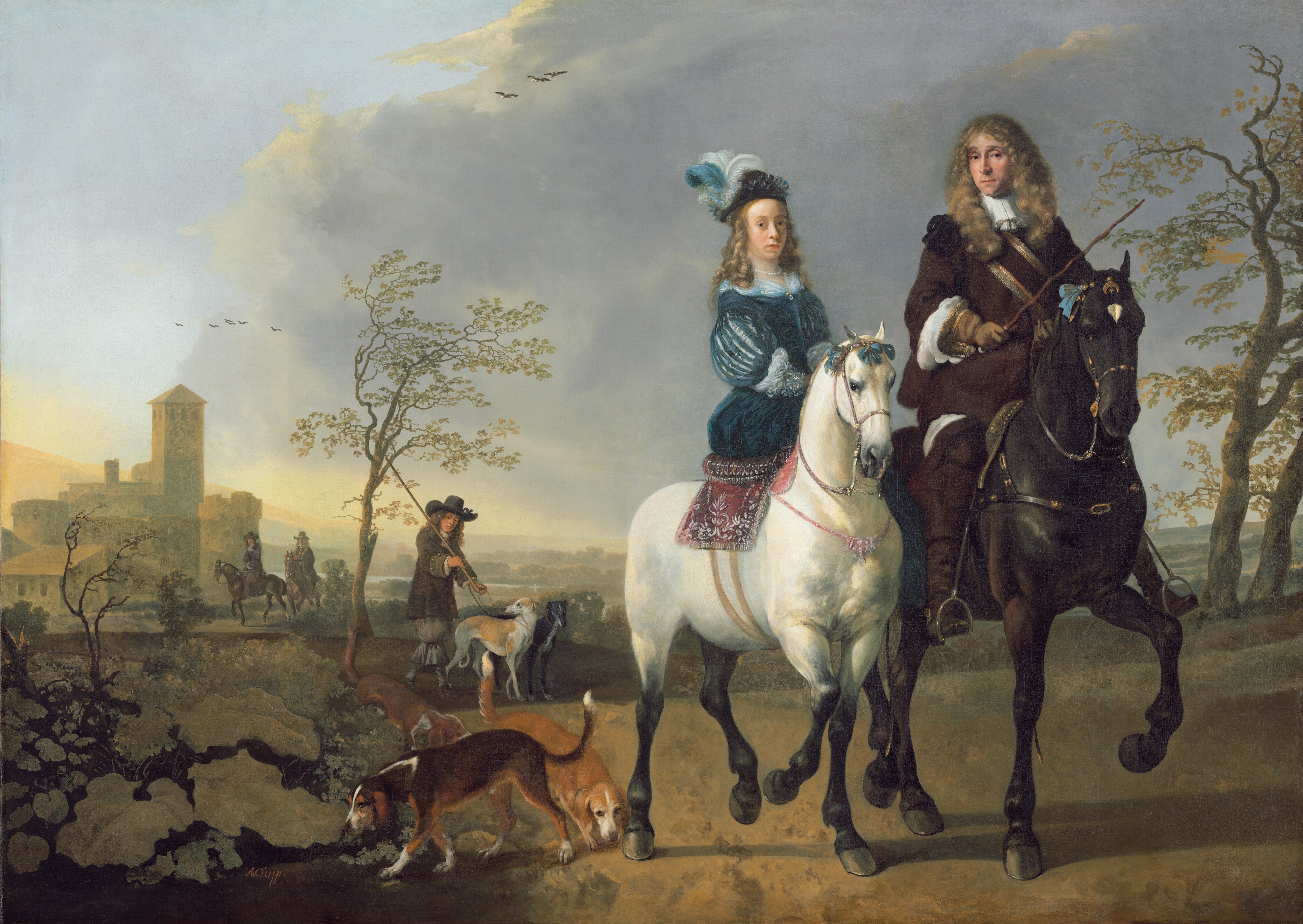
An elegantly dressed couple ride out with their hounds: she sits side-saddle on a white horse with blue bows on its bridle, he on a chestnut with a white blaze, riding crop at his hip. More about this work
About this work
An elegantly dressed couple ride out with their hounds: she sits side-saddle on a white horse with blue bows on its bridle, he on a chestnut with a white blaze, riding crop at his hip. Dogs nose through the undergrowth, a huntsman leads a pair of greyhounds along the path, and two more riders follow behind. Cuyp, the great painter of Dordrecht and its golden light, silhouettes the pair against a slate-blue cloud while the sky warms to yellow over a distant town. The dating records that he began the picture around 1655 and returned to rework it some years later.
Written by Ochre Editions.
What you’re looking at
An elegantly dressed man and woman ride horses toward us and to our right in a landscape with low, rolling hills, stone buildings, and trees in this horizontal painting. The two horses and riders take up the right half of the composition. Both people have pale skin and look at us. The woman has a high forehead, a straight nose, a round face, and curly blond hair falling to her shoulders. She wears a sapphire-blue dress with slashed sleeves to reveal a white garment beneath. Her hat is adorned with blue and white feathers, and she wears a string of pearls around her neck. The legs of her white horse darken to black below the knees, and the bridle is tied with blue bows near the horse’s ears. The sidesaddle sits on a woven, rug-like blanket. Next to her, to our right, the man rides a larger chestnut-brown horse with a white triangle between its eyes. The man looks at us out of the corners of his dark eyes under gathered brows. He has a long, straight nose and is cleanshaven, though a hint of a five o’clock shadow slightly darkens his cleft chin. His light brown hair falls in curls down past his shoulders, and he wears a dark brown coat with voluminous white fabric rippling out above tan-colored gloves. He holds a riding crop in his right hand, on our left, resting against his hip. Near the white horse’s feet, to our left, a dark brown dog with a white nose sniffs at a plant. Behind it, another reddish-brown dog sniffs the ground near the horse’s back hoof. A third dog stands beyond, partially obscured by bushes and plants growing in the lower left corner of the canvas. A man wearing a tall black, wide-brimmed hat and carrying a long staff leads two slender dogs resembling grayhounds on leashes along the path, a little behind the riders. Two more elegantly dressed men ride horses toward us father back on the path. Sand-colored stone buildings, hazy in the distance, are clustered around a squared tower, possibly a bell tower, to our left. The land dips gently to the horizon line in the deep distance. The riders are silhouetted against a swirling slate-blue cloud that fills most of the sky in the top two-thirds of the painting. The sky clears to pale blue to our left and then warms to golden yellow along the horizon, beyond the buildings. The artist signed the painting near the lower left corner: “A. Cuijp.”
Description from the National Gallery of Art.
How it was made
- Oil paint
- Pigment ground in a drying oil, usually linseed. It dries slowly, so painters could blend on the canvas, build up thin translucent glazes, and rework a picture over weeks. Canvas replaced wooden panels in the 1500s because it is lighter and can be rolled.
Aelbert Cuyp
Dutch, 1620–1691
Cuyp spent his life in Dordrecht, where he trained with his father, the portraitist Jacob Gerritsz. Cuyp. Influenced by Dutch painters returning from Italy, such as Jan Both, he bathed river views, cattle in meadows and riders in a warm, golden light. His work was little known outside Dordrecht in his lifetime but was eagerly collected in Britain from the late eighteenth century.
Written by Ochre Editions.
Rights and the museum’s record
Public domain. The National Gallery of Art has dedicated this image to the public domain under CC0, so anyone may copy, adapt and use it, for any purpose, without asking. Our prints and files are reproductions made from the museum’s image; the museum doesn’t endorse them.
- Object number
- 1942.9.15
- Credit
- Courtesy National Gallery of Art, Washington
- Type
- Painting
- Licence
- CC0 1.0 Universal
- Museum record
- See it on the museum’s site