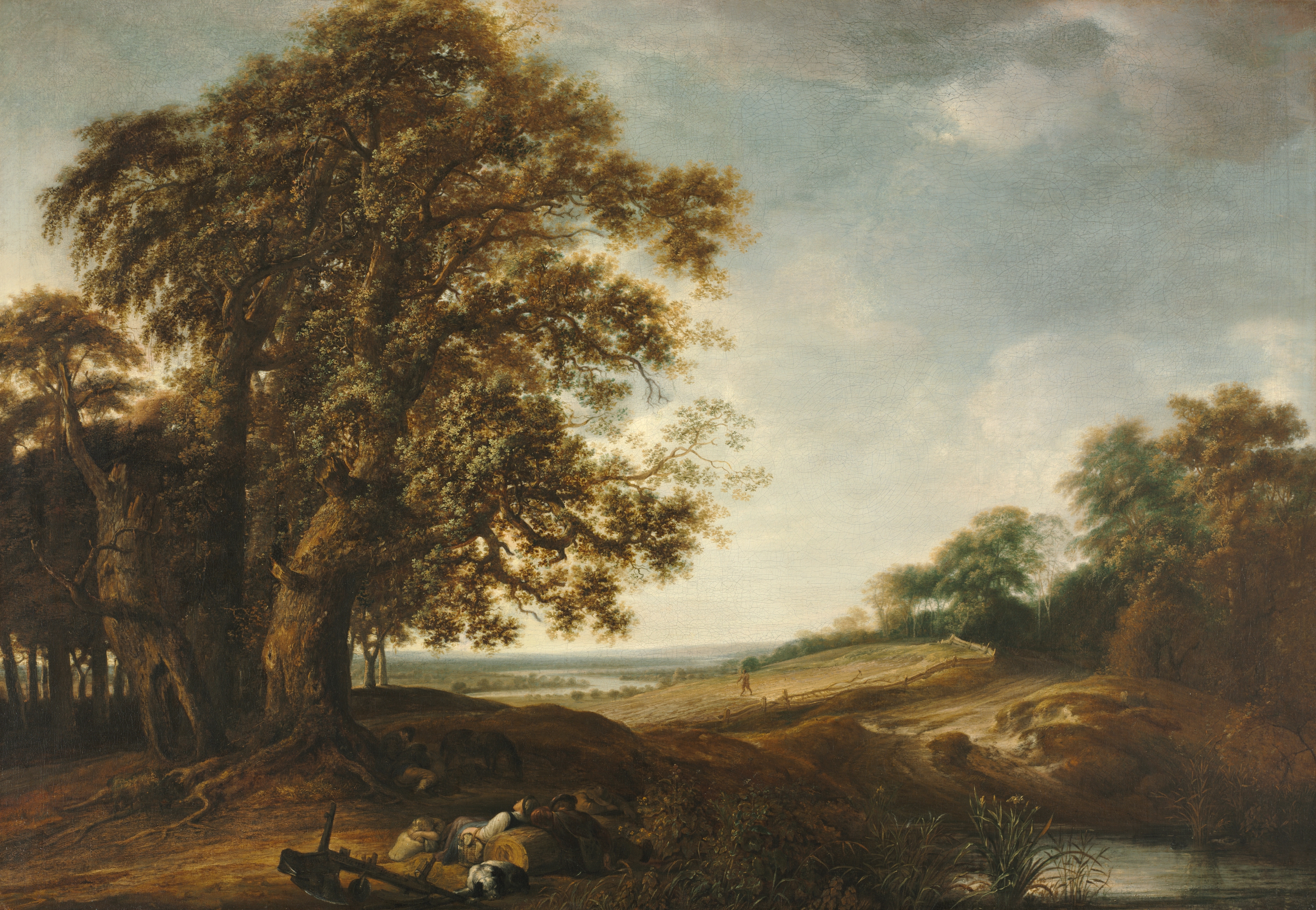
Sleeping Peasants near Fields (Parable of the Weeds)1650–53
During the 1600s Protestant leaders denounced visual representations, in a belief that a strict understanding of the scriptures was the only way to achieve salvation. More about this work
About this work
During the 1600s Protestant leaders denounced visual representations, in a belief that a strict understanding of the scriptures was the only way to achieve salvation. As a result, Protestants did not generally commission religious images. However, where religious painting did appear, they often depicted verses from the Bible with strict didactic values, such as Sleeping Peasants near Fields (Parable of the Weeds). The subject of this painting is the Parable of the Weeds from Matthew 13:24-30. Simon de Vlieger has illustrated the point in the story where the peasants sleep after sowing good seeds, and the enemy, depicted here as a satyr, mixes in bad seeds in the fields as well. When the weeds begin to grow, confused, the peasants ask the farmer if they should remove the seeds. The farmer replies that they should let the weeds and wheat grow together, and he will destroy the weeds after the harvest. The lesson of the story is that good and evil people often mix together; but in the end the pious will prevail and the wicked will be destroyed.
Text from the Cleveland Museum of Art.
How it was made
- Oil paint
- Pigment ground in a drying oil, usually linseed. It dries slowly, so painters could blend on the canvas, build up thin translucent glazes, and rework a picture over weeks. Canvas replaced wooden panels in the 1500s because it is lighter and can be rolled.
Simon de Vlieger
Dutch, 1601–1653
Dutch Golden Age
Seventeenth-century painting from the Dutch Republic: still lifes, interiors, portraits and flat, wide skies.
Rights and the museum’s record
Public domain. The Cleveland Museum of Art has dedicated this image to the public domain under CC0, so anyone may copy, adapt and use it, for any purpose, without asking. Our prints and files are reproductions made from the museum’s image; the museum doesn’t endorse them.
- Object number
- 1975.76
- Credit
- Courtesy of the Cleveland Museum of Art
- Type
- Painting
- Department
- European Painting and Sculpture
- Licence
- CC0 1.0 Universal
- Museum record
- See it on the museum’s site