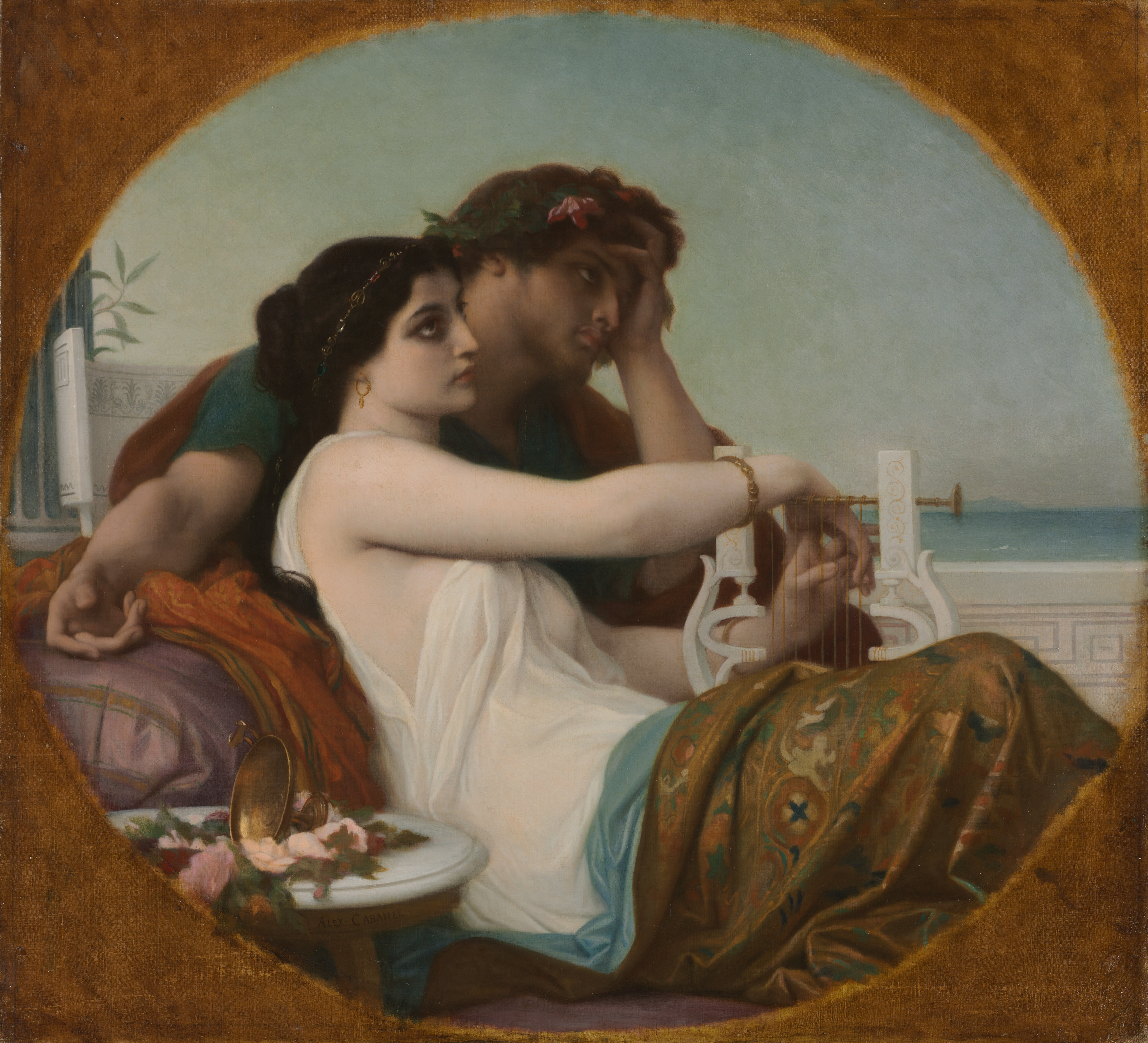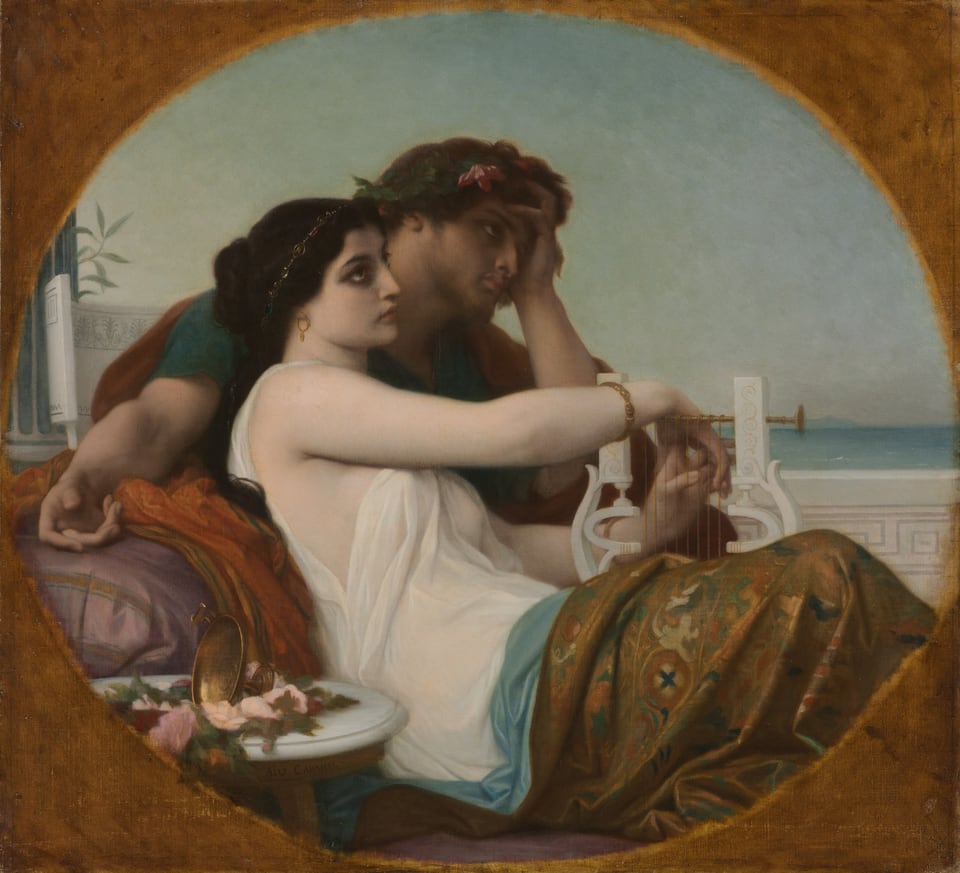
Aglaida and Bonifacec. 1857
The French painter Alexandre Cabanel was a favorite of Emperor Napoleon III and a leader of the academic style that emphasized precise drawing and smoothly modeled forms. More about this work
About this work
The French painter Alexandre Cabanel was a favorite of Emperor Napoleon III and a leader of the academic style that emphasized precise drawing and smoothly modeled forms. This painting depicts the wealthy Roman woman Aglaida and her concubine slave Boniface, here living as pagan sinners in Rome around 290 CE. On a trip to Tarsus on the Anatolian coast, Boniface converted to Christianity and was tortured and beheaded. Aglaida also converted to Christianity, gave all her possessions to the poor, and built a church for Boniface's relics.
Text from the Cleveland Museum of Art.
How it was made
- Oil paint
- Pigment ground in a drying oil, usually linseed. It dries slowly, so painters could blend on the canvas, build up thin translucent glazes, and rework a picture over weeks. Canvas replaced wooden panels in the 1500s because it is lighter and can be rolled.
Alexandre Cabanel
French, 1823–1889
Rights and the museum’s record
Public domain. The Cleveland Museum of Art has dedicated this image to the public domain under CC0, so anyone may copy, adapt and use it, for any purpose, without asking. Our prints and files are reproductions made from the museum’s image; the museum doesn’t endorse them.
- Object number
- 2007.275
- Credit
- Courtesy of the Cleveland Museum of Art
- Type
- Painting
- Department
- Modern European Painting and Sculpture
- Licence
- CC0 1.0 Universal
- Museum record
- See it on the museum’s site