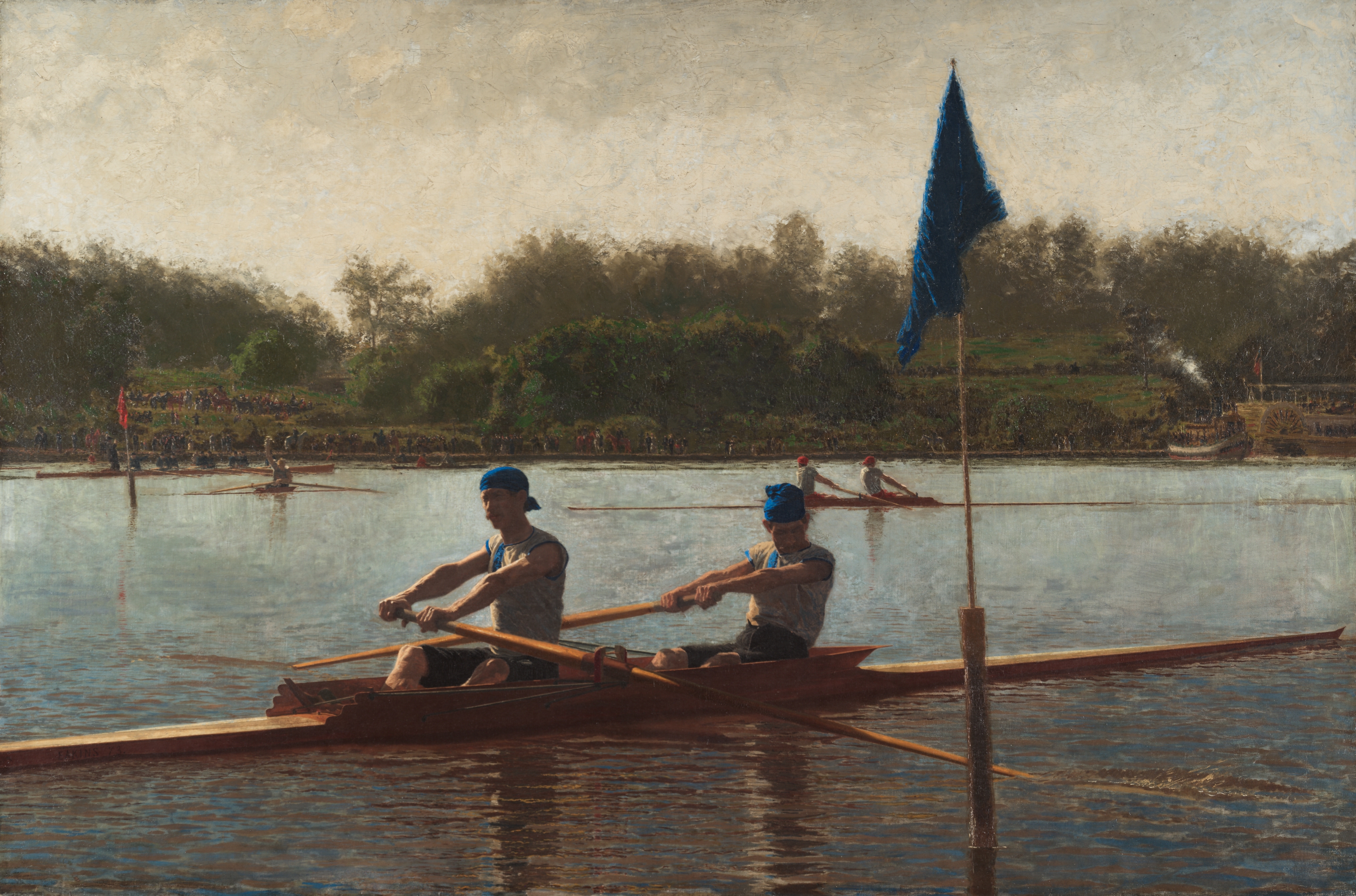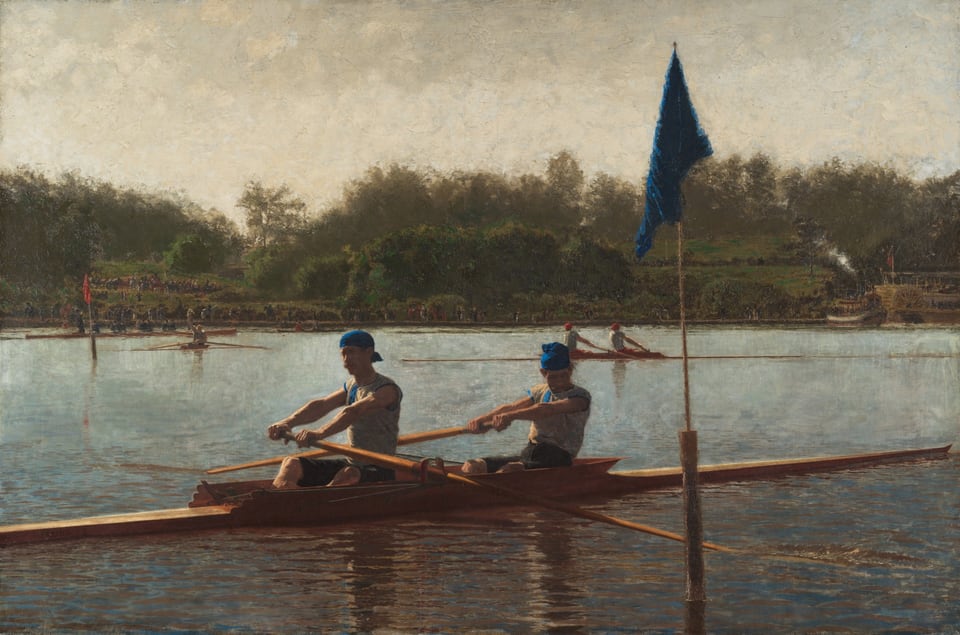
The Biglin Brothers Turning the Stake1873
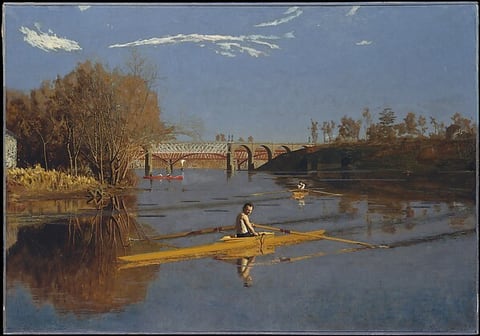
Eakins's painting celebrates athletic teamwork while commemorating an actual event, a famous rowing race that took place on the Schuylkill River in Philadelphia during May 1872. More about this work
About this work
Eakins's painting celebrates athletic teamwork while commemorating an actual event, a famous rowing race that took place on the Schuylkill River in Philadelphia during May 1872. Throngs of spectators line the riverbank and watch as Barney and John Biglin negotiate the tricky turn around a stake marking the halfway point in the contest. Their competitors, seen in the middle distance at the right, lag behind. The Biglin brothers won the race, cementing their status as the most celebrated oarsmen of the era. Trained in the United States and France, Eakins spent almost his entire artistic career in his hometown of Philadelphia. He is renowned for the unsentimental realism in his paintings, whose compositions he developed through painstakingly prepared figure and perspective drawings.
Text from the Cleveland Museum of Art.
How it was made
- Oil paint
- Pigment ground in a drying oil, usually linseed. It dries slowly, so painters could blend on the canvas, build up thin translucent glazes, and rework a picture over weeks. Canvas replaced wooden panels in the 1500s because it is lighter and can be rolled.
Thomas Eakins
American, 1844–1916 · Born and died in Philadelphia, Pennsylvania.
Eakins studied in Paris under Jean-Léon Gérôme and was impressed in Spain by Velázquez and Ribera, then returned to Philadelphia, where he spent his life. He painted rowers, boxers and his city’s doctors and scholars with a frank realism grounded in anatomy, perspective and, later, photography. A demanding teacher at the Pennsylvania Academy of the Fine Arts, he was forced to resign in 1886 over his use of nude models. Max Schmitt in a Single Scull was the first of his rowing pictures.
Written by Ochre Editions.
Rights and the museum’s record
Public domain. The Cleveland Museum of Art has dedicated this image to the public domain under CC0, so anyone may copy, adapt and use it, for any purpose, without asking. Our prints and files are reproductions made from the museum’s image; the museum doesn’t endorse them.
- Object number
- 1927.1984
- Credit
- Courtesy of the Cleveland Museum of Art
- Type
- Painting
- Department
- American Painting and Sculpture
- Licence
- CC0 1.0 Universal
- Museum record
- See it on the museum’s site