The Chaperonec. 1908
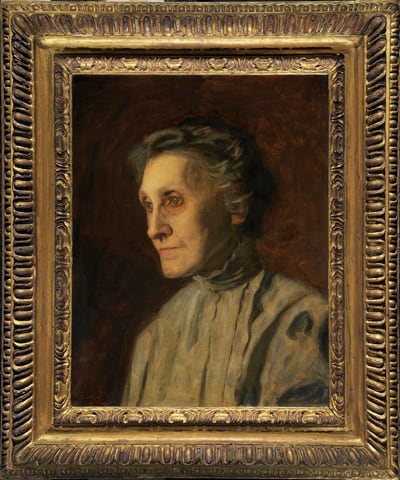
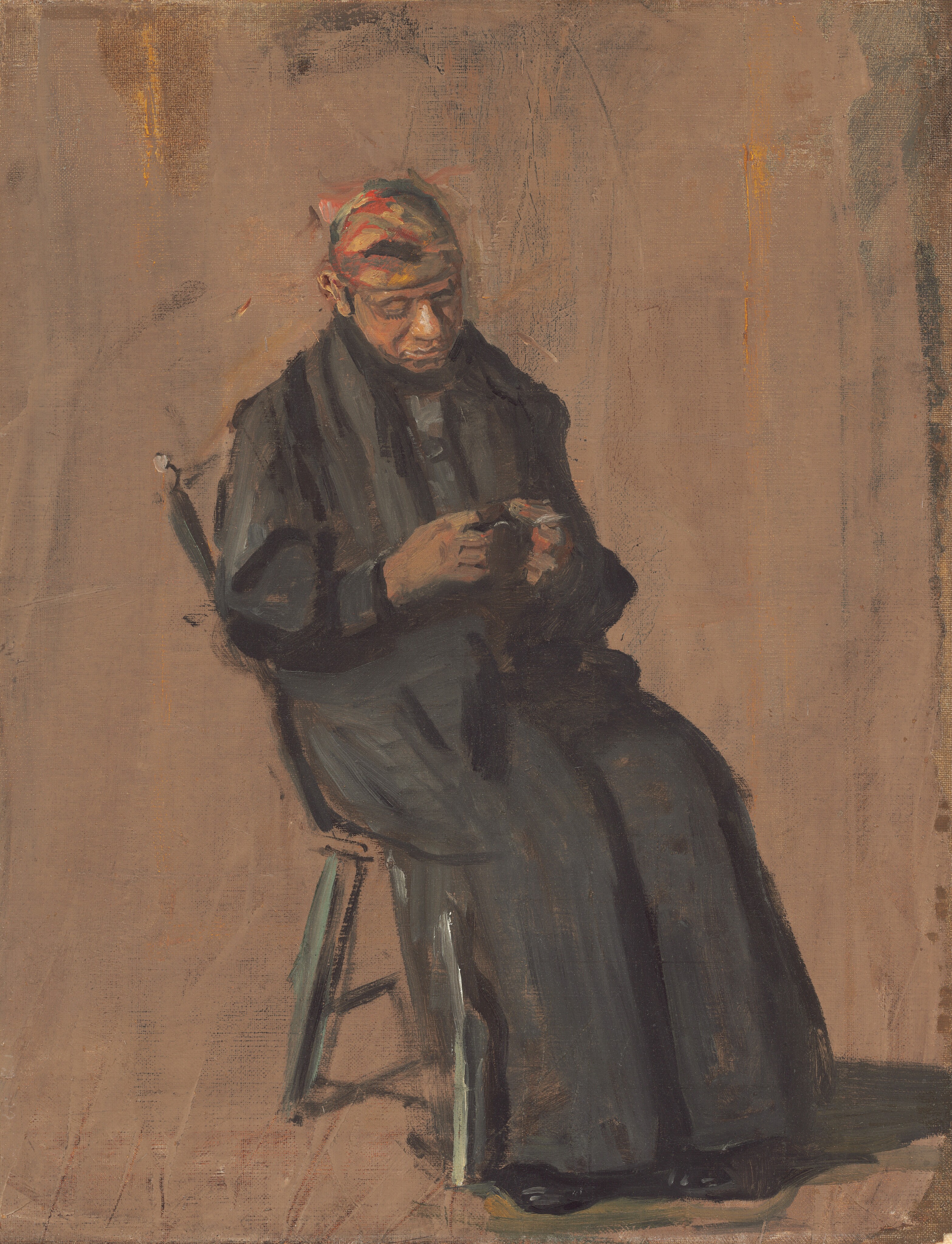
An elderly woman in a dark blue gown and head covering sits absorbed in the work in her hands, her eyes lowered. More about this work
About this work
An elderly woman in a dark blue gown and head covering sits absorbed in the work in her hands, her eyes lowered. She is the chaperone from Thomas Eakins’s late paintings of William Rush, the Philadelphia sculptor shown carving a statue from a nude model while an older woman sits by for propriety, knitting. Eakins returned to the subject around 1908, near the end of his career, and this study shows his sympathetic interest in the quiet, watchful figure at the edge of the scene.
Written by Ochre Editions.
What you’re looking at
This painting shows a person seated on a stool or chair, wearing a long, dark-blue robe or gown. They are slightly turned toward the right, looking downward at something they hold in their hands, and their head is covered with a cloth or cap. The background is textured with earthy tones, mostly tan with some patches of yellow ochre and gray.
Description from the National Gallery of Art.
How it was made
- Oil paint
- Pigment ground in a drying oil, usually linseed. It dries slowly, so painters could blend on the canvas, build up thin translucent glazes, and rework a picture over weeks. Canvas replaced wooden panels in the 1500s because it is lighter and can be rolled.
Thomas Eakins
American, 1844–1916 · Born and died in Philadelphia, Pennsylvania.
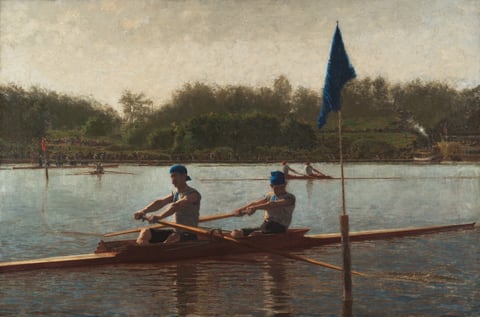
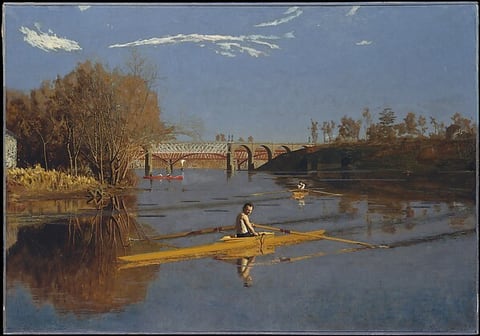
Eakins studied in Paris under Jean-Léon Gérôme and was impressed in Spain by Velázquez and Ribera, then returned to Philadelphia, where he spent his life. He painted rowers, boxers and his city’s doctors and scholars with a frank realism grounded in anatomy, perspective and, later, photography. A demanding teacher at the Pennsylvania Academy of the Fine Arts, he was forced to resign in 1886 over his use of nude models. Max Schmitt in a Single Scull was the first of his rowing pictures.
Written by Ochre Editions.
Rights and the museum’s record
Public domain. The National Gallery of Art has dedicated this image to the public domain under CC0, so anyone may copy, adapt and use it, for any purpose, without asking. Our prints and files are reproductions made from the museum’s image; the museum doesn’t endorse them.
- Object number
- 1991.34.1
- Credit
- Courtesy National Gallery of Art, Washington
- Type
- Painting
- Licence
- CC0 1.0 Universal
- Museum record
- See it on the museum’s site
Report this work
More by Thomas Eakins
All their works