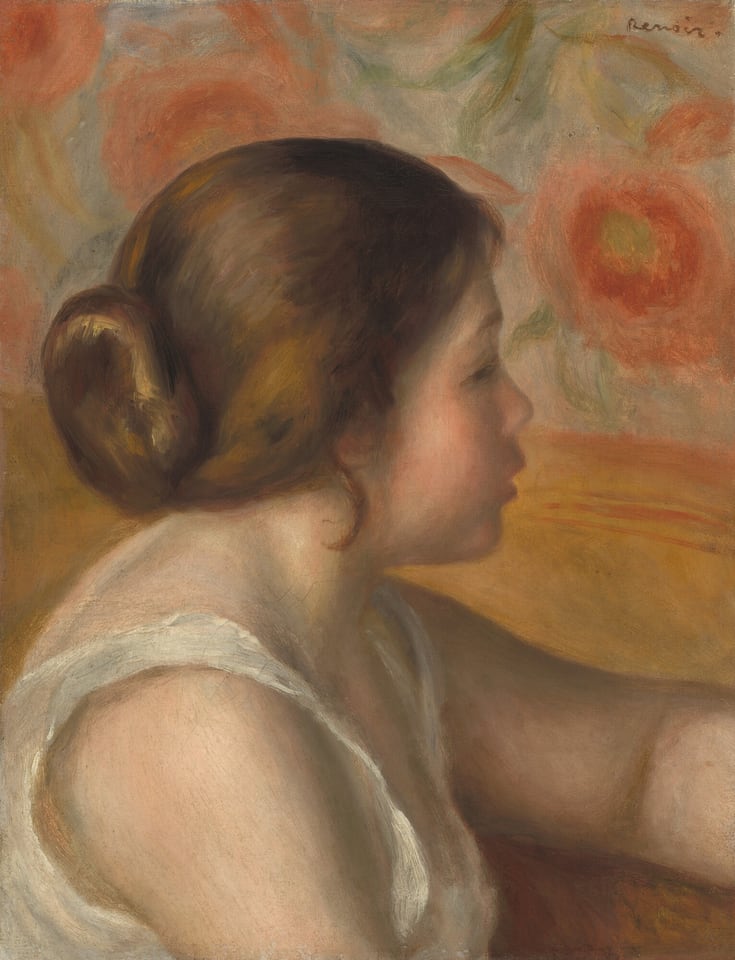
Head of a Young Girlc. 1890
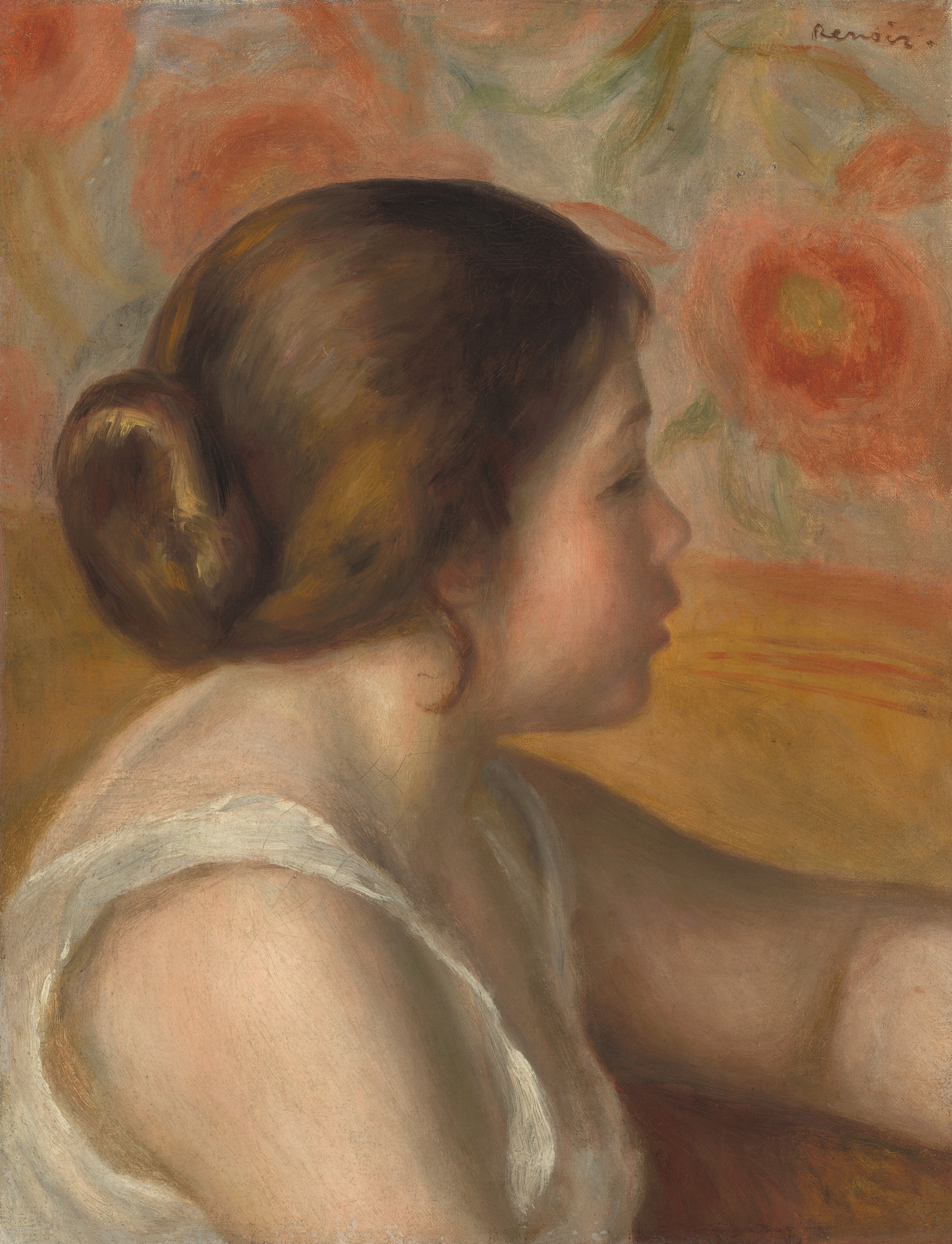
A young woman with glossy brown hair gathered into a bun is seen in profile, her cheeks rosy and her lips slightly parted, one arm resting on a table. More about this work
About this work
A young woman with glossy brown hair gathered into a bun is seen in profile, her cheeks rosy and her lips slightly parted, one arm resting on a table. Behind her, the background breaks into swirling forms of orange, red and blue-grey, perhaps a patterned hanging, treated as pure colour. Renoir painted many such studies of young models around 1890, valuing them less as portraits than as occasions for warm, luminous flesh tones and soft, caressing brushwork.
Written by Ochre Editions.
What you’re looking at
This painting shows a young woman's upper body from the torso up. She is seated and facing the right, with her face seen in profile and one arm bent in front of her, seeming to rest on a brown table or surface. She has pale skin, round, rosy cheeks, a small nose, and pink lips that are slightly parted. Her brown hair is styled into a smooth, glossy bun at the nape of her neck. She is wearing a white garment with thin straps over her shoulders. The background features a yellow section on the bottom half, and on the top half is a colorful, abstract pattern with large, soft, swirling forms in shades of orange and red on a blue-gray background with hints of green.
Description from the National Gallery of Art.
How it was made
- Oil paint
- Pigment ground in a drying oil, usually linseed. It dries slowly, so painters could blend on the canvas, build up thin translucent glazes, and rework a picture over weeks. Canvas replaced wooden panels in the 1500s because it is lighter and can be rolled.
Pierre-Auguste Renoir
French, 1841–1919 · Born in Limoges; died in Cagnes-sur-Mer.
Renoir began as a painter of porcelain in Paris, then studied in Gleyre’s studio, where he met Monet, Sisley and Bazille. In the 1870s he was a central figure of Impressionism, painting Parisians at leisure in dappled light. A journey to Italy in 1881–82 led him towards firmer drawing and more classical compositions. Despite severe rheumatoid arthritis in later life he continued to paint, settling at Cagnes-sur-Mer on the Mediterranean, where he died.
Written by Ochre Editions.
Impressionism
Painters in 1870s Paris who worked quickly, often outdoors, to catch light as it changed.
Rights and the museum’s record
Public domain. The National Gallery of Art has dedicated this image to the public domain under CC0, so anyone may copy, adapt and use it, for any purpose, without asking. Our prints and files are reproductions made from the museum’s image; the museum doesn’t endorse them.
- Object number
- 1948.18.1
- Credit
- Courtesy National Gallery of Art, Washington
- Type
- Painting
- Licence
- CC0 1.0 Universal
- Museum record
- See it on the museum’s site
Report this work
More by Pierre-Auguste Renoir
All their works