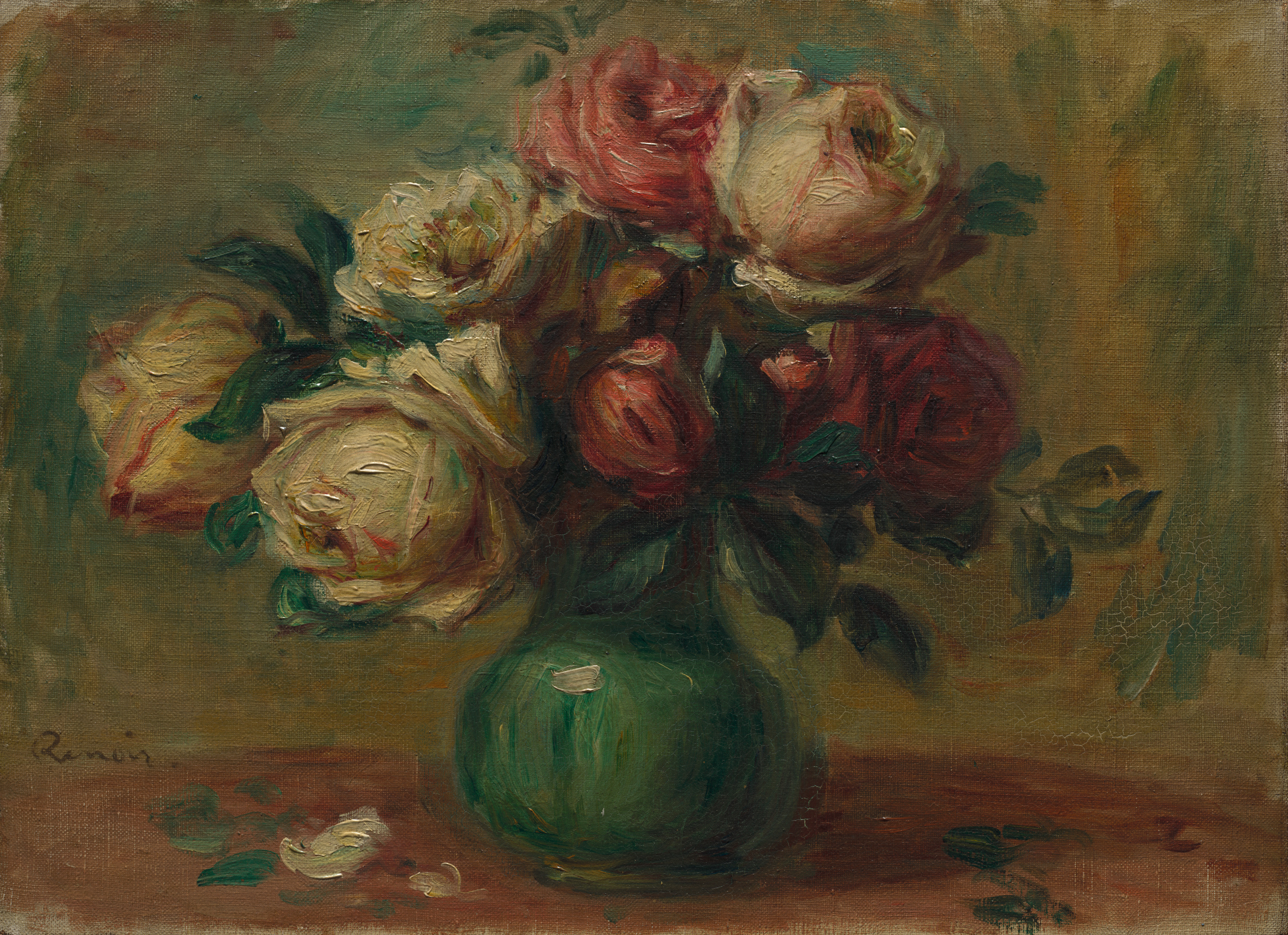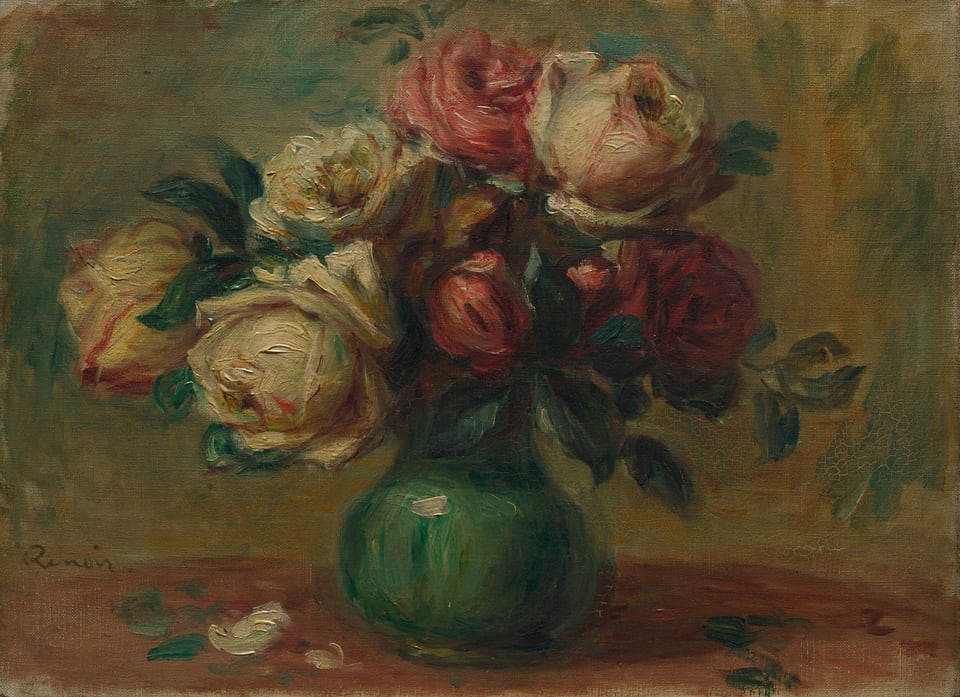
Roses in a Vasec. 1890
The palette Renoir used to depict the seven roses in this still life ranges from various shades of red to warm whites, light yellows, and pinks. More about this work
About this work
The palette Renoir used to depict the seven roses in this still life ranges from various shades of red to warm whites, light yellows, and pinks. The artist declared, "'Painting flowers lets my brain rest. It does not cause the same tension of spirit as when I face a model. When I paint flowers, I put down tones, I boldly try values, without having to worry about losing a canvas.'" He was particularly fond of roses, whose full, rounded shapes he likened to the female body. In 1861, Renoir met Claude Monet (1840–1926) and later shared a studio with him. Monet became an important influence on Renoir's art, as can be seen here in the rapid brush strokes, thinly scuffled background, and buildup of paint (impasto) in the blooms.
Text from the Cleveland Museum of Art.
How it was made
- Oil paint
- Pigment ground in a drying oil, usually linseed. It dries slowly, so painters could blend on the canvas, build up thin translucent glazes, and rework a picture over weeks. Canvas replaced wooden panels in the 1500s because it is lighter and can be rolled.
Pierre-Auguste Renoir
French, 1841–1919 · Born in Limoges; died in Cagnes-sur-Mer.
Renoir began as a painter of porcelain in Paris, then studied in Gleyre’s studio, where he met Monet, Sisley and Bazille. In the 1870s he was a central figure of Impressionism, painting Parisians at leisure in dappled light. A journey to Italy in 1881–82 led him towards firmer drawing and more classical compositions. Despite severe rheumatoid arthritis in later life he continued to paint, settling at Cagnes-sur-Mer on the Mediterranean, where he died.
Written by Ochre Editions.
Impressionism
Painters in 1870s Paris who worked quickly, often outdoors, to catch light as it changed.
Rights and the museum’s record
Public domain. The Cleveland Museum of Art has dedicated this image to the public domain under CC0, so anyone may copy, adapt and use it, for any purpose, without asking. Our prints and files are reproductions made from the museum’s image; the museum doesn’t endorse them.
- Object number
- 1941.14
- Credit
- Courtesy of the Cleveland Museum of Art
- Type
- Painting
- Department
- Modern European Painting and Sculpture
- Licence
- CC0 1.0 Universal
- Museum record
- See it on the museum’s site
Report this work
More by Pierre-Auguste Renoir
All their works