The House of Cardsprobably 1737
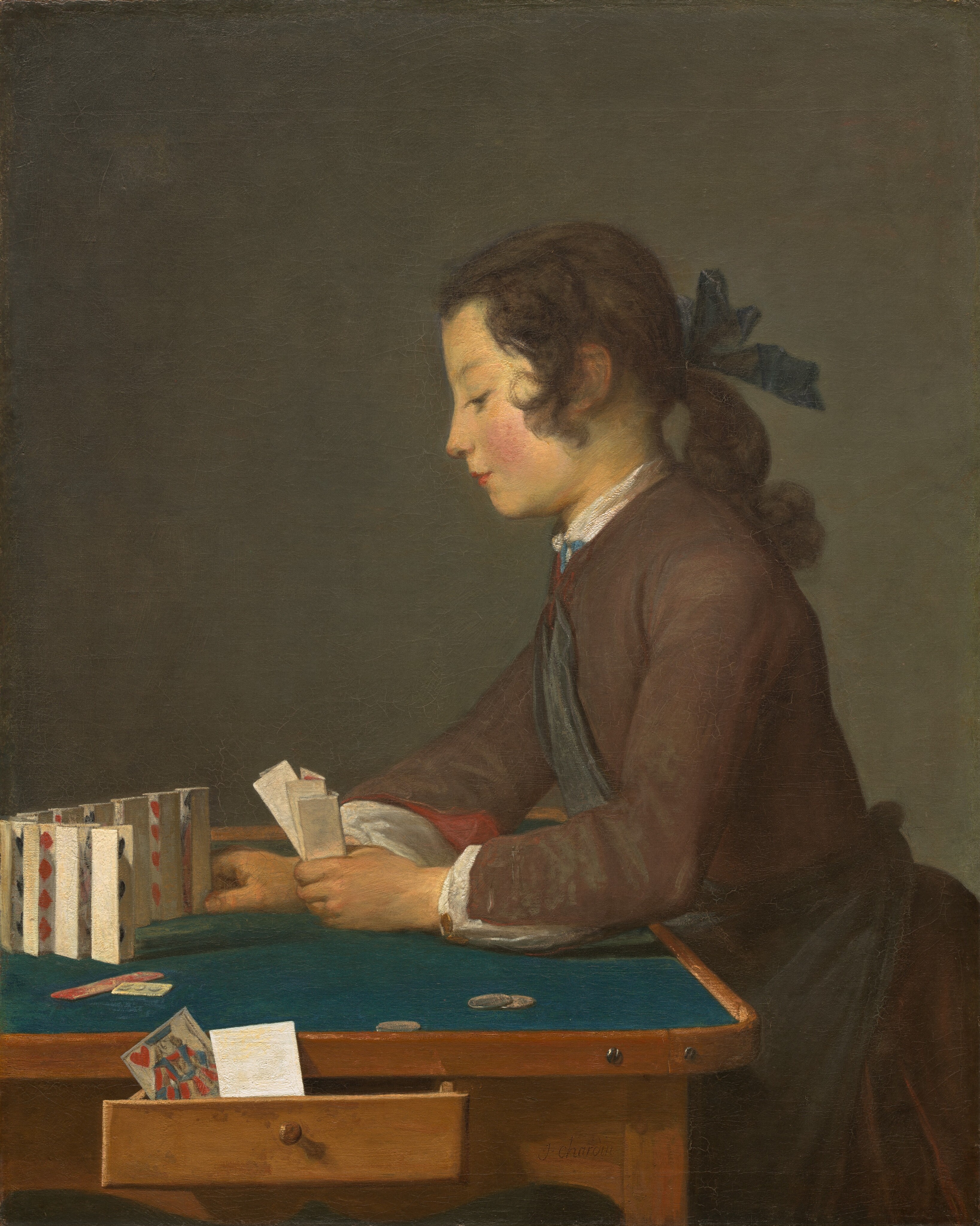
A boy in a brown coat leans on a table covered in teal cloth, carefully standing a row of folded playing cards on end, with a few coins nearby and a jack of hearts showing in the open drawer. More about this work
About this work
A boy in a brown coat leans on a table covered in teal cloth, carefully standing a row of folded playing cards on end, with a few coins nearby and a jack of hearts showing in the open drawer. Chardin painted the subject several times in the 1730s: a house of cards, like a soap bubble, was a familiar emblem of fragility and vain effort, yet he lets the moral hover lightly behind the absorbed calm of a child at play. The soft, granular paint and quiet light against a dark background give the moment a deep stillness.
Written by Ochre Editions.
What you’re looking at
Shown from about the lap up, a young person with brown hair and a peachy complexion faces our left in profile as he leans onto a table and sets folded playing cards up in a row in this vertical painting. Shown against a dark background, his long, brown hair curls by his ears and is pulled back with a navy-blue ribbon at the nape of his neck. He has a delicately sloping nose, his pink lips are closed, the cheek facing us is flushed, and he looks down at the tabletop under lowered lids. He wears a chestnut-brown, long-sleeved coat with a dark blue sash across his chest and tied around his waist. The white of his undershirt peeks out at the high neck and wrists, and the brick-red lining of the sleeve of his jacket rolls back at his right wrist. The wooden table is lined with teal-blue fabric on its surface, and three coins lie near his left hand, closer to us. In that hand he holds three nested, vertically folded playing cards. With his right hand he places the last in a line of ten cards, standing vertically but close together like dominoes, in a curving row in front of him. Scarlet-red diamonds and hearts and the edges of some black shapes are visible within the bent cards. A jack of hearts and a piece of paper or the back of another card sit in a drawer that opens toward us along the side of the table. The artist signed the work in dark brown paint in the lower right corner: “J. Chardin.”
Description from the National Gallery of Art.
How it was made
- Oil paint
- Pigment ground in a drying oil, usually linseed. It dries slowly, so painters could blend on the canvas, build up thin translucent glazes, and rework a picture over weeks. Canvas replaced wooden panels in the 1500s because it is lighter and can be rolled.
Jean Siméon Chardin
French, 1699–1779 · Born and died in Paris.
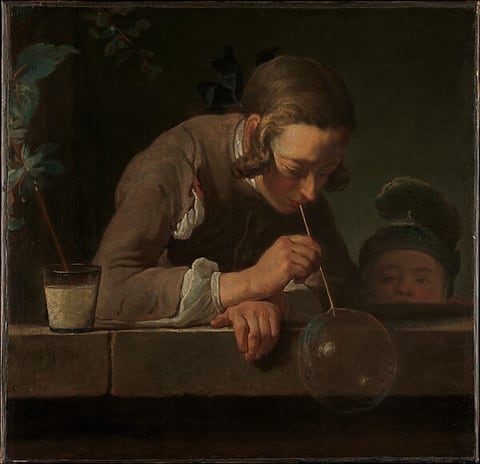
Chardin spent his life in Paris and was received into the Academy in 1728 as a painter of animals and fruit. He found his subjects in modest kitchens and households, painting still lifes and quiet genre scenes such as Soap Bubbles and The House of Cards with grainy, carefully worked paint and an air of calm concentration. In later life, as his eyesight weakened, he turned to pastel, producing searching self-portraits.
Written by Ochre Editions.
Rights and the museum’s record
Public domain. The National Gallery of Art has dedicated this image to the public domain under CC0, so anyone may copy, adapt and use it, for any purpose, without asking. Our prints and files are reproductions made from the museum’s image; the museum doesn’t endorse them.
- Object number
- 1937.1.90
- Credit
- Courtesy National Gallery of Art, Washington
- Type
- Painting
- Licence
- CC0 1.0 Universal
- Museum record
- See it on the museum’s site