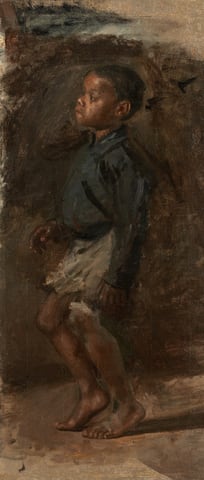
Study for "The Dancing Lesson": The Banjo Playerprobably 1877
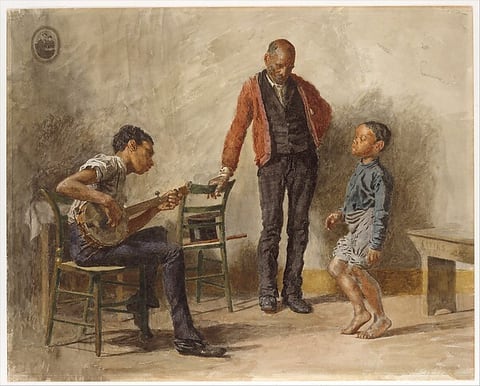
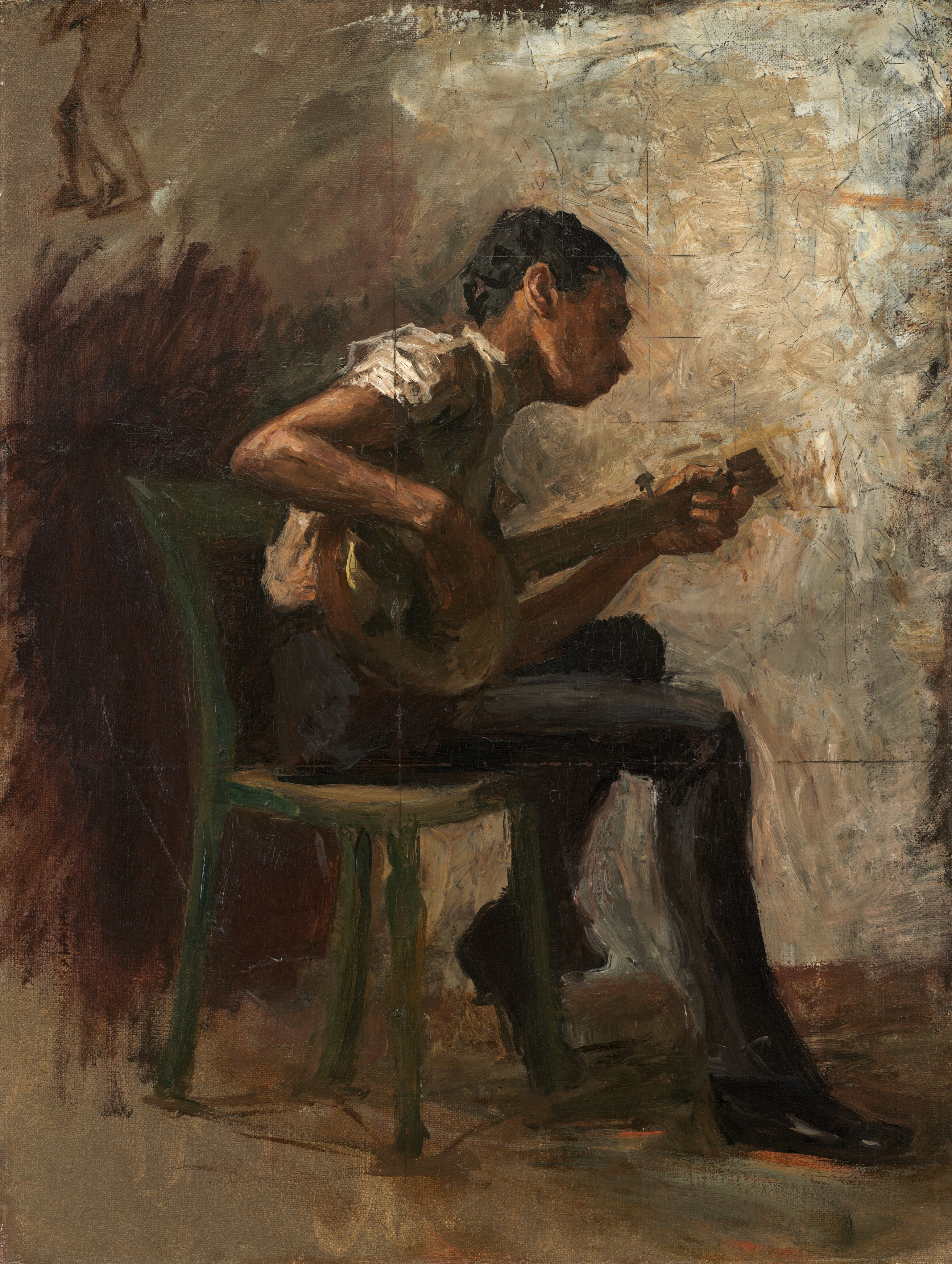
A young banjo player leans over his instrument, lit from the left so that his profile falls into shadow, in an oil study Thomas Eakins made for his watercolour The Dancing Lesson of 1878. More about this work
About this work
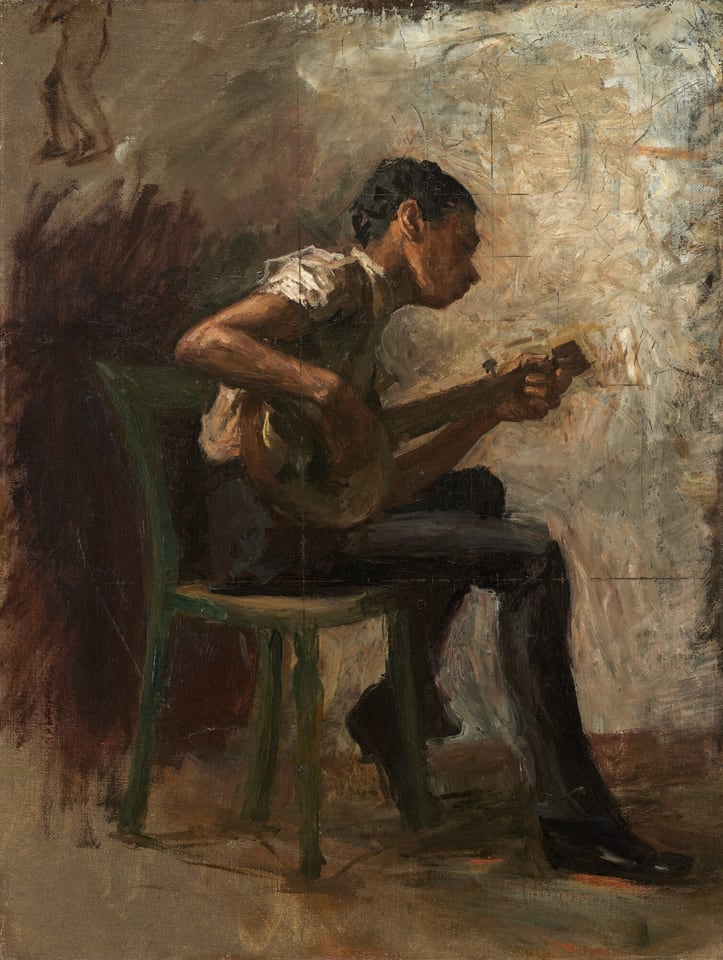
A young banjo player leans over his instrument, lit from the left so that his profile falls into shadow, in an oil study Thomas Eakins made for his watercolour The Dancing Lesson of 1878. The grid drawn across the figure and chair shows how he transferred the pose, precisely scaled, into the final composition, typical of his methodical approach. Eakins prepared his pictures with studies of each figure from life, and this one has a freshness and directness all its own.
Written by Ochre Editions.
What you’re looking at
A young, gangly, brown-skinned boy sits on a green chair and leans over the banjo he plays in this loosely painted, vertical composition. His body faces our right in profile, and his head leans to his left and away from us. Light comes from our left to highlight his ear and the side of his chin, but throws his profile into shadow against the lighter background. The boy has short black hair and wears a white shirt with the sleeves rolled up, black pants, and black shoes. The floor is loosely painted with streaks of earth brown, taupe, and dark moss green. The wall behind the boy is painted with visible strokes of parchment brown, peachy tan, pearl white, and fog gray. The space to our left of the boy is dark brown, and an outline of a standing person is sketched in the top left corner. A grid is overlaid across the boy’s body and the chair.
Description from the National Gallery of Art.
How it was made
- Oil paint
- Pigment ground in a drying oil, usually linseed. It dries slowly, so painters could blend on the canvas, build up thin translucent glazes, and rework a picture over weeks. Canvas replaced wooden panels in the 1500s because it is lighter and can be rolled.
Thomas Eakins
American, 1844–1916 · Born and died in Philadelphia, Pennsylvania.
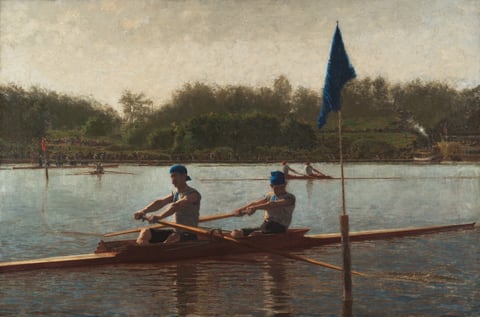
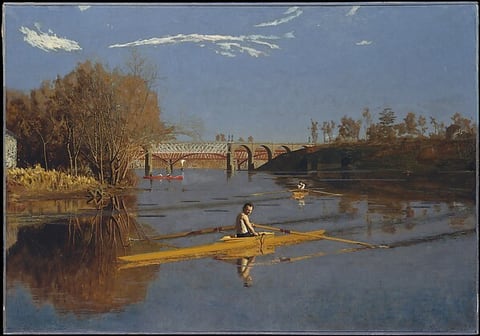
Eakins studied in Paris under Jean-Léon Gérôme and was impressed in Spain by Velázquez and Ribera, then returned to Philadelphia, where he spent his life. He painted rowers, boxers and his city’s doctors and scholars with a frank realism grounded in anatomy, perspective and, later, photography. A demanding teacher at the Pennsylvania Academy of the Fine Arts, he was forced to resign in 1886 over his use of nude models. Max Schmitt in a Single Scull was the first of his rowing pictures.
Written by Ochre Editions.
Rights and the museum’s record
Public domain. The National Gallery of Art has dedicated this image to the public domain under CC0, so anyone may copy, adapt and use it, for any purpose, without asking. Our prints and files are reproductions made from the museum’s image; the museum doesn’t endorse them.
- Object number
- 1985.64.16
- Credit
- Courtesy National Gallery of Art, Washington
- Type
- Painting
- Licence
- CC0 1.0 Universal
- Museum record
- See it on the museum’s site