My Day at Home1906
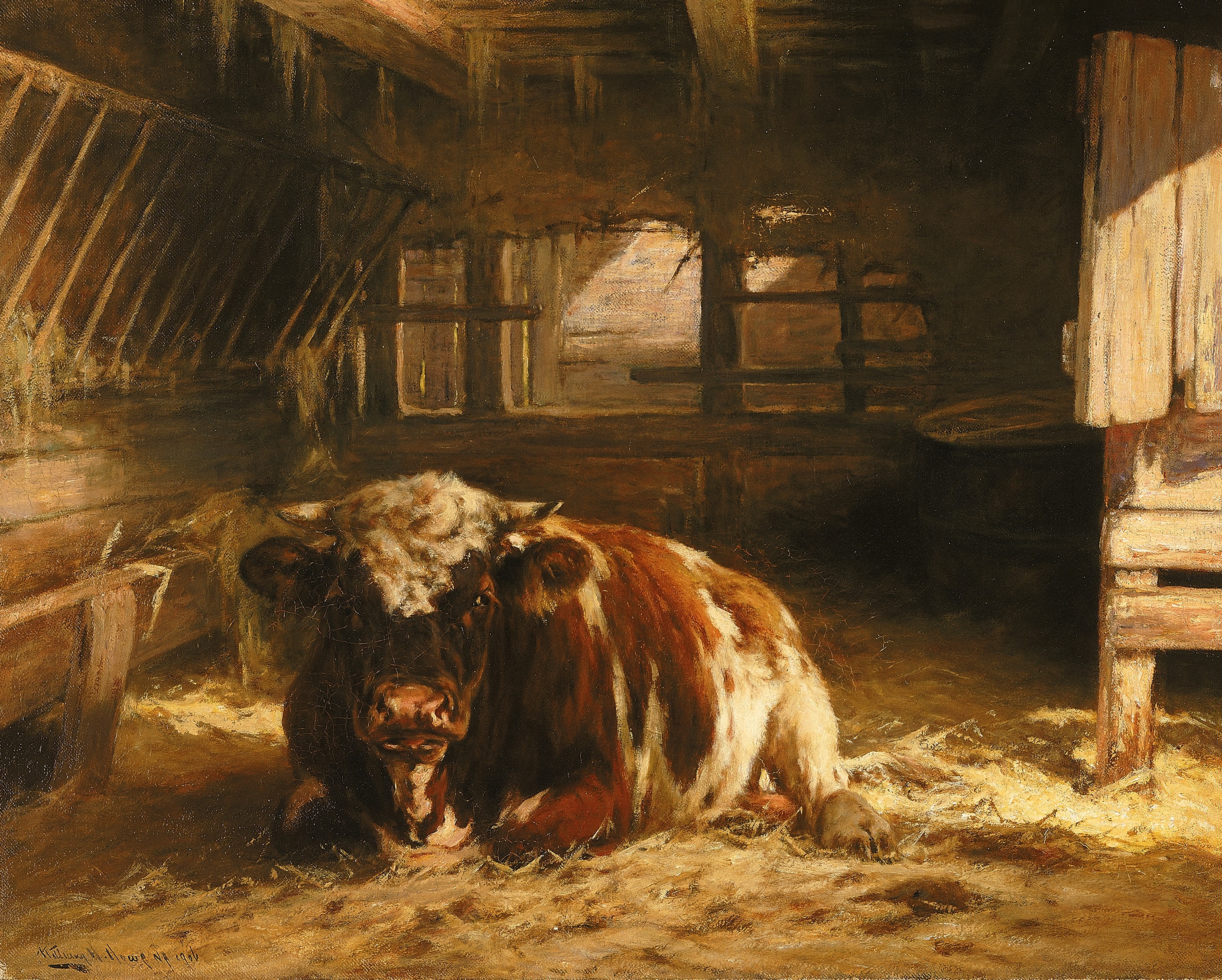
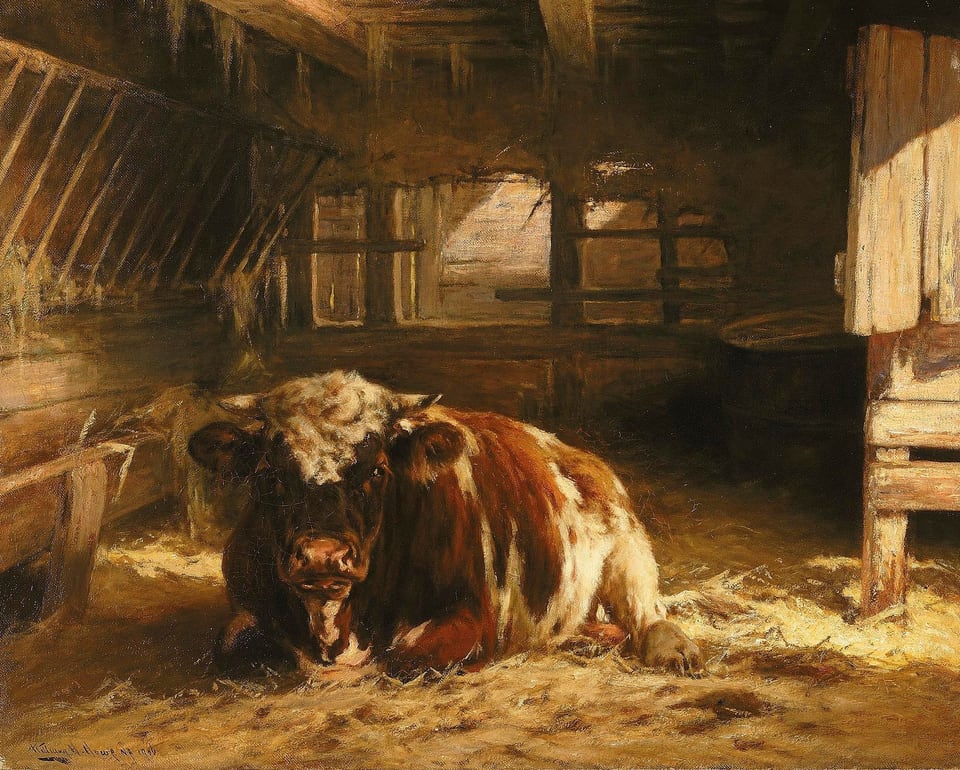
William Henry Howe made a name for himself in France and the United States as a painter of animals. More about this work
About this work
William Henry Howe made a name for himself in France and the United States as a painter of animals. His farm scenes provided patrons with an antidote to the unnerving changes in American society brought about by industrialization. The prize bull and placid cow in these paintings evoke the patriarchal and matriarchal roles of a nineteenth-century household, and hark back to an ideal of agrarian America that seemed distant from the urban bustle of the Gilded Age.
Text from the Smithsonian American Art Museum.
How it was made
- Oil paint
- Pigment ground in a drying oil, usually linseed. It dries slowly, so painters could blend on the canvas, build up thin translucent glazes, and rework a picture over weeks. Canvas replaced wooden panels in the 1500s because it is lighter and can be rolled.
William H. Howe
born Ravenna, OH 1846-died Bronxville, NY 1929
Rights and the museum’s record
Public domain. The Smithsonian American Art Museum has dedicated this image to the public domain under CC0, so anyone may copy, adapt and use it, for any purpose, without asking. Our prints and files are reproductions made from the museum’s image; the museum doesn’t endorse them.
- Object number
- 1909.7.30
- Credit
- Courtesy of the Smithsonian American Art Museum
- Type
- Painting
- Department
- Painting and Sculpture
- Licence
- CC0 1.0 Universal
- Museum record
- See it on the museum’s site