Ange Laurent de La Live de Jullyprobably 1759
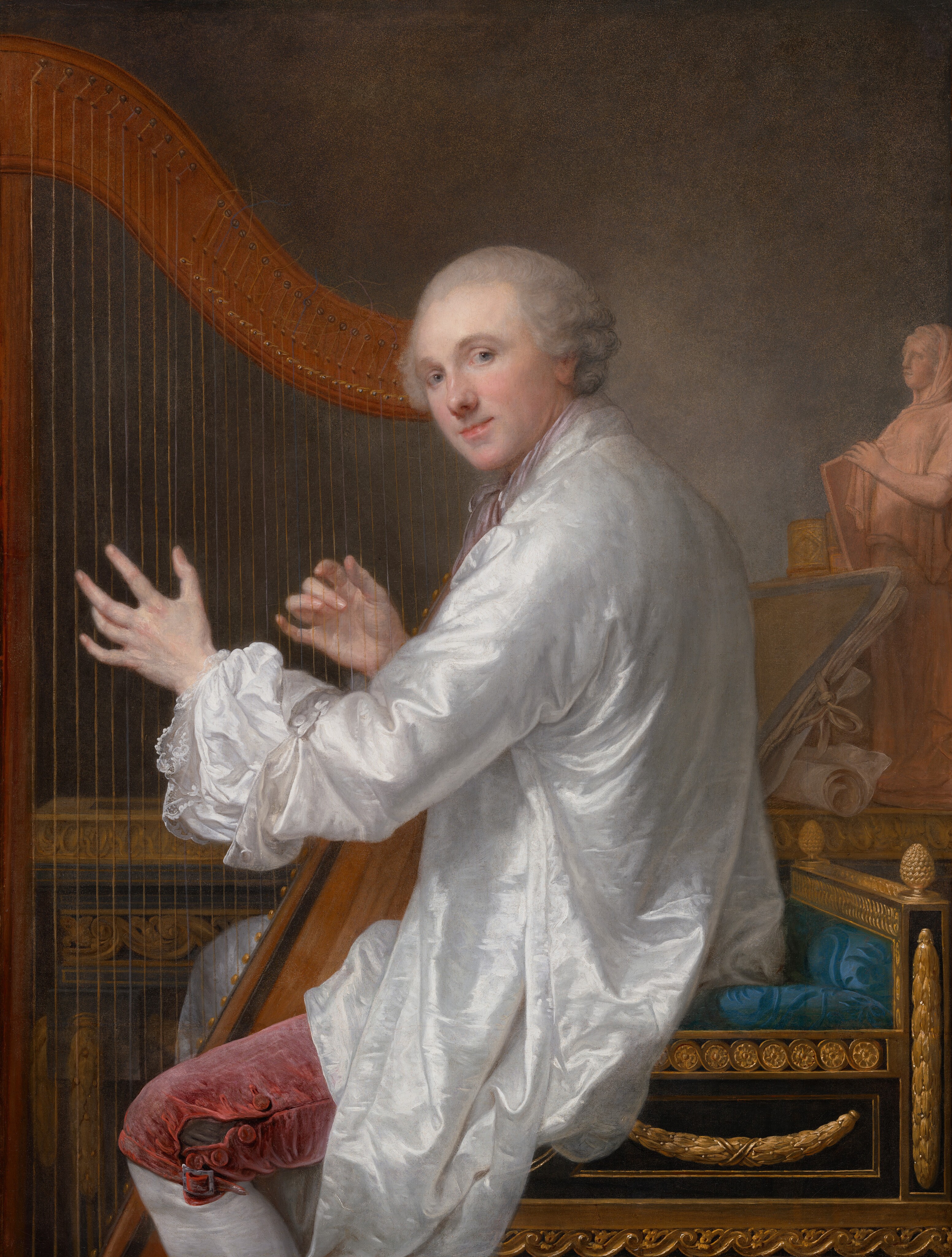
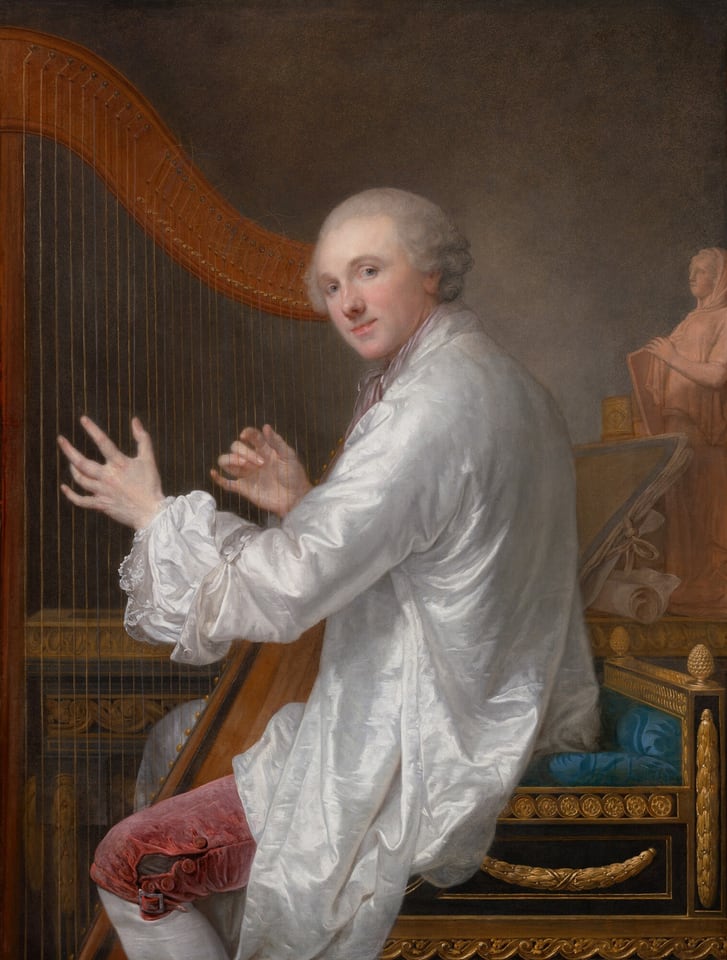
The collector Ange Laurent de La Live de Jully sits at his harp in a loose white shirt and rose-pink breeches, turning from the strings to smile at us, in a room furnished with a gilded chair and a table of books, portfolios and a statuette. More about this work
About this work
The collector Ange Laurent de La Live de Jully sits at his harp in a loose white shirt and rose-pink breeches, turning from the strings to smile at us, in a room furnished with a gilded chair and a table of books, portfolios and a statuette. La Live de Jully was one of the most adventurous collectors in Paris and an early patron of Greuze, who here gives him an informal, intimate air, a man of taste at home among his music and his books.
Written by Ochre Editions.
What you’re looking at
A pale-skinned man sits facing our left as he plays a harp while turning his face to smile at us in this vertical portrait painting. He looks out the corners of his light blue eyes under arched, gray brows. He has a rounded nose, pale pink lips, and a round face. Gray hair is brushed back from his high forehead and curls around his ears. His long fingers rest on the strings of the harp, and the ends of strings curl like wind-loosened strands of hair along the top edge. The man wears a pale mauve-purple cravat, and his snow-white, long-sleeved chemise is untucked and loose around his thighs. The cuff we see is open and folded back over a bright white shirt edged with lace. His dusky rose-pink breeches are unbuttoned at the knee over white stockings. The square-seated chair on which he sits is carved with garlands and floral patterns, which are gilded gold. The seat itself is topaz blue, and it has a low back. A similarly ornamented and gilded table along the back of the room holds a portfolio and roll of papers, the tooled and gilded spines of books, and a statuette to the right. The pale pinkish-orange statuette shows a woman holding a tablet and wearing a long, loose robe and head covering. Her body angles to our left and she looks off in that direction. The wall behind the table is mottled with smoky shades of gray and tan.
Description from the National Gallery of Art.
How it was made
- Oil paint
- Pigment ground in a drying oil, usually linseed. It dries slowly, so painters could blend on the canvas, build up thin translucent glazes, and rework a picture over weeks. Canvas replaced wooden panels in the 1500s because it is lighter and can be rolled.
Jean Baptiste Greuze
French, 1725–1805 · Born in Tournus; died in Paris.
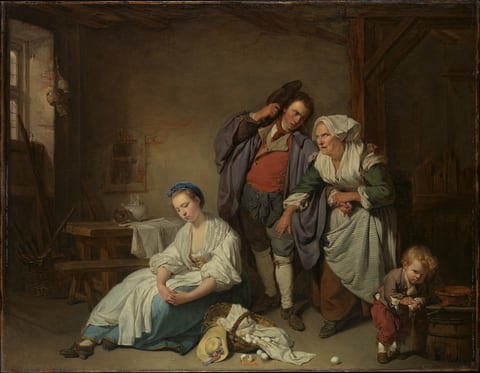
Greuze rose to fame at the Paris Salon in the later 1750s with moralising scenes of family life, sentimental and theatrical, which the critic Denis Diderot championed. Broken Eggs, shown at the Salon of 1757, tells a story of lost innocence through a single domestic incident. When the Academy received him in 1769 as a genre painter rather than a history painter, he withdrew from the Salon for many years.
Written by Ochre Editions.
Rights and the museum’s record
Public domain. The National Gallery of Art has dedicated this image to the public domain under CC0, so anyone may copy, adapt and use it, for any purpose, without asking. Our prints and files are reproductions made from the museum’s image; the museum doesn’t endorse them.
- Object number
- 1946.7.8
- Credit
- Courtesy National Gallery of Art, Washington
- Type
- Painting
- Licence
- CC0 1.0 Universal
- Museum record
- See it on the museum’s site