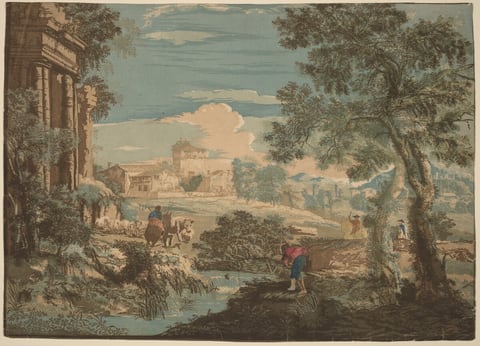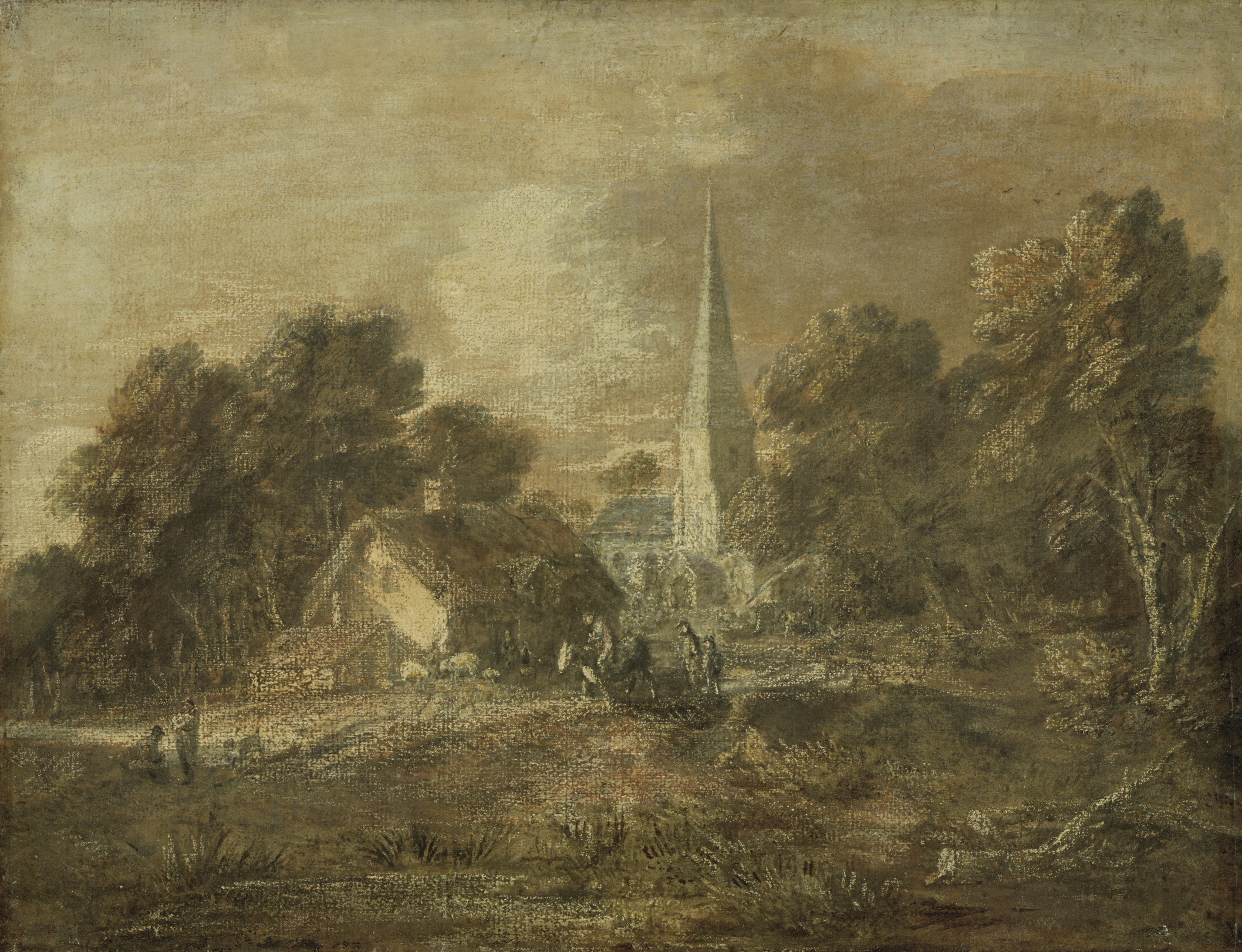
Wooded Landscape with Village Sceneearly 1770s (not later than 1772)
A village nestles among dense woodland in this landscape by Thomas Gainsborough, made not in oil but in gouache over black and red chalk, then varnished and mounted on canvas to give it the depth and glow of a painting. More about this work
About this work
A village nestles among dense woodland in this landscape by Thomas Gainsborough, made not in oil but in gouache over black and red chalk, then varnished and mounted on canvas to give it the depth and glow of a painting. Gainsborough experimented with unusual techniques throughout his career, and in the early 1770s he produced a group of such varnished drawings, some of which he exhibited at the Royal Academy in 1772. Landscape was his private passion, distinct from the portraits that earned his living.
Written by Ochre Editions.
What you’re looking at
A work made of varnished gouache, over black and red chalks, on cream laid paper, laid down on canvas, stretched on a wooden stretcher and varnished again.
Description from the Art Institute of Chicago.
How it was made
- Opaque watercolour
- Watercolour made opaque with white or chalk and laid in flat, even layers. Persian and Indian painters ground their colours from minerals, applied them with the finest brushes and burnished the finished page.
- Chalk
- Natural black, red and white chalks. Used together on toned paper they could give the warmth of flesh with very little effort, and they were favourites for studies from life.
- Laid paper
- Handmade on a mould of close-set wires, which leave fine parallel lines you can see when the sheet is held to the light.
Thomas Gainsborough
English, 1727–1788 · Born in Sudbury; died in London.
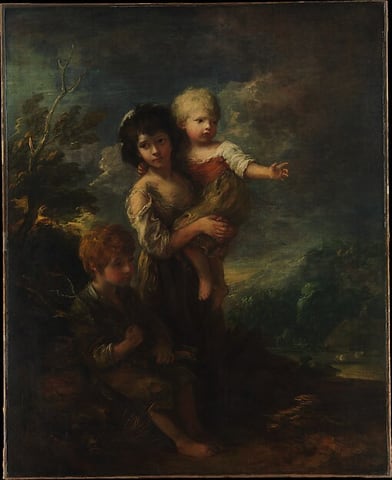
Gainsborough trained in London with the French engraver Hubert Gravelot, then built his career as a portraitist first in Suffolk and later in fashionable Bath before moving to London in 1774. He was a founder member of the Royal Academy and a favourite painter of George III’s family. Although portraits paid his way, his own preference was landscape, and late works such as Cottage Children (The Wood Gatherers) bring the two together in his fluent, feathery brushwork.
Written by Ochre Editions.
Rights and the museum’s record
Public domain. The Art Institute of Chicago has dedicated this image to the public domain under CC0, so anyone may copy, adapt and use it, for any purpose, without asking. Our prints and files are reproductions made from the museum’s image; the museum doesn’t endorse them.
- Object number
- 2012.80
- Credit
- Courtesy of the Art Institute of Chicago
- Type
- Drawing and Watercolor
- Department
- Prints and Drawings
- Licence
- CC0 1.0 Universal
- Museum record
- See it on the museum’s site