Claude Lorrain (Claude Gellée)
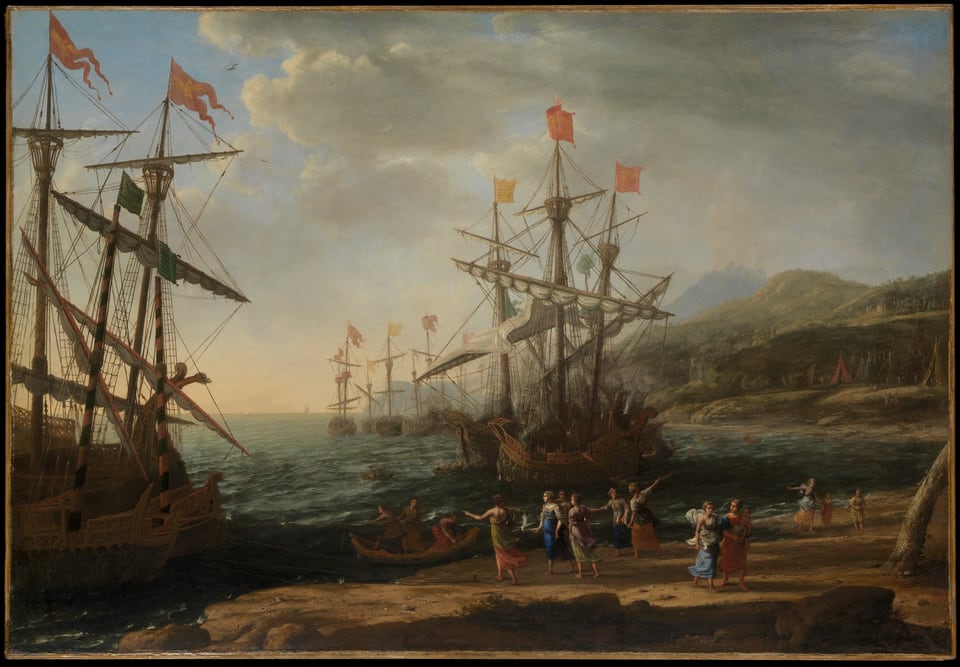
The Trojan Women Setting Fire to Their Fleetca. 1643
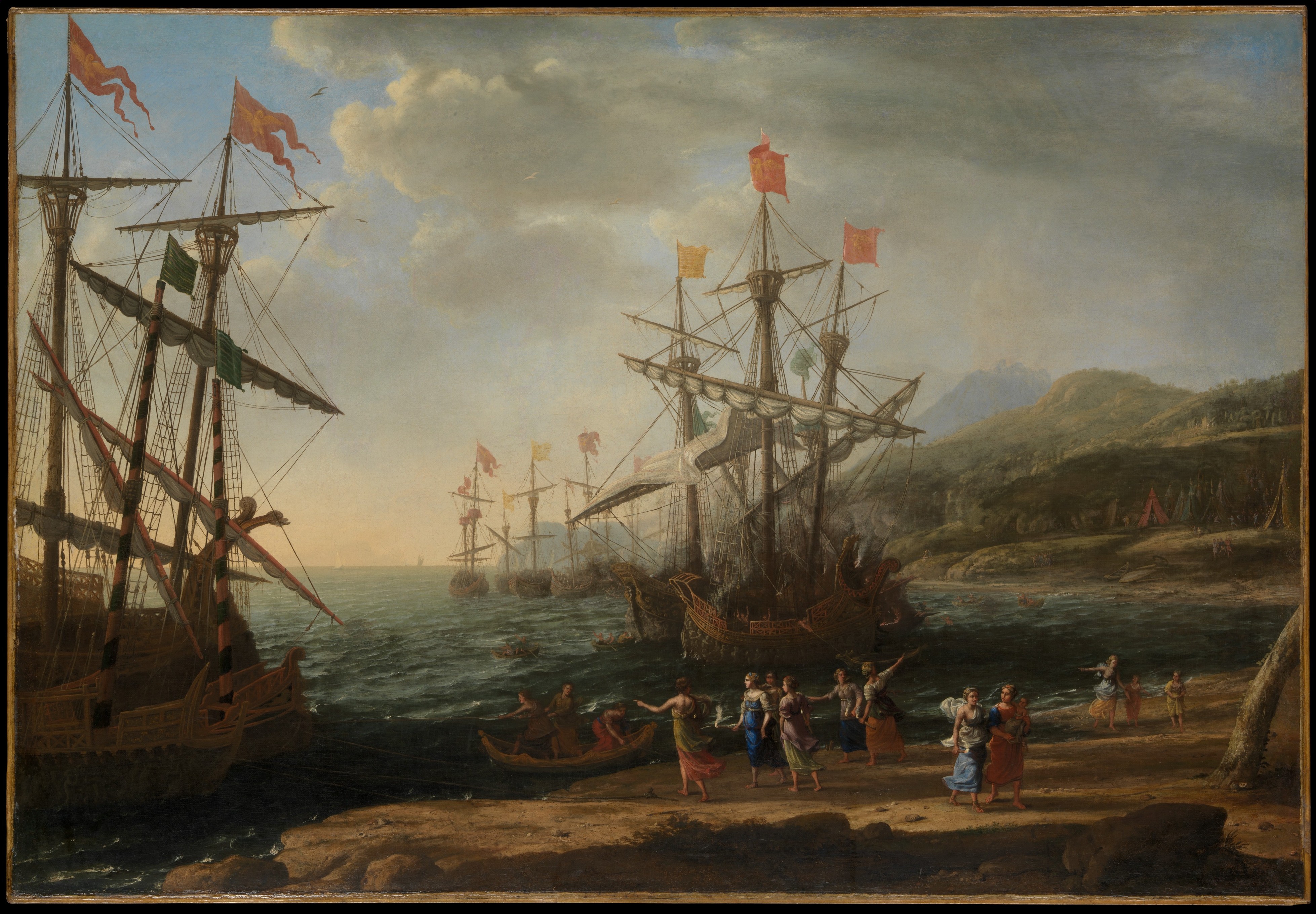
Weary of years of wandering, the Trojan women travelling with Aeneas gather on the shore of Sicily and set fire to their own ships, urged on by the goddess Iris in disguise, so that they need sail no further. More about this work
About this work
Weary of years of wandering, the Trojan women travelling with Aeneas gather on the shore of Sicily and set fire to their own ships, urged on by the goddess Iris in disguise, so that they need sail no further. Claude, the great painter of ideal landscape, sets the episode from Virgil’s Aeneid in a broad harbour, where the drama unfolds on a small scale among the figures and ships. As so often in his work, much of the poetry lies in the luminous sea and sky.
Written by Ochre Editions.
How it was made
- Oil paint
- Pigment ground in a drying oil, usually linseed. It dries slowly, so painters could blend on the canvas, build up thin translucent glazes, and rework a picture over weeks. Canvas replaced wooden panels in the 1500s because it is lighter and can be rolled.
Claude Lorrain (Claude Gellée)
French, 1604–1682 · Born in Chamagne; died in Rome.
Claude Gellée, called Lorrain after his native duchy, went to Rome as a youth and spent almost his whole life there. He became the most admired landscape painter of his century, creating idealised visions of the Roman Campagna and classical harbours bathed in the golden light of morning or evening, peopled with small biblical and mythological figures. He recorded his compositions in drawings bound into a volume, the Liber Veritatis, as a guard against forgers.
Written by Ochre Editions.
Rights and the museum’s record
Public domain. The Met has dedicated this image to the public domain under CC0, so anyone may copy, adapt and use it, for any purpose, without asking. Our prints and files are reproductions made from the museum’s image; the museum doesn’t endorse them.
- Object number
- 55.119
- Credit
- Courtesy of The Metropolitan Museum of Art
- Type
- Paintings
- Department
- European Paintings
- Licence
- CC0 1.0 Universal
- Museum record
- See it on the museum’s site
Report this work
More by Claude Lorrain (Claude Gellée)
All their works
Close in colour