Saint Romanus of Antioch and Saint Barulas1638
Francisco de Zurbarán created this painting for a church in Seville, Spain, dedicated to Saint Romanus of Antioch. More about this work
About this work
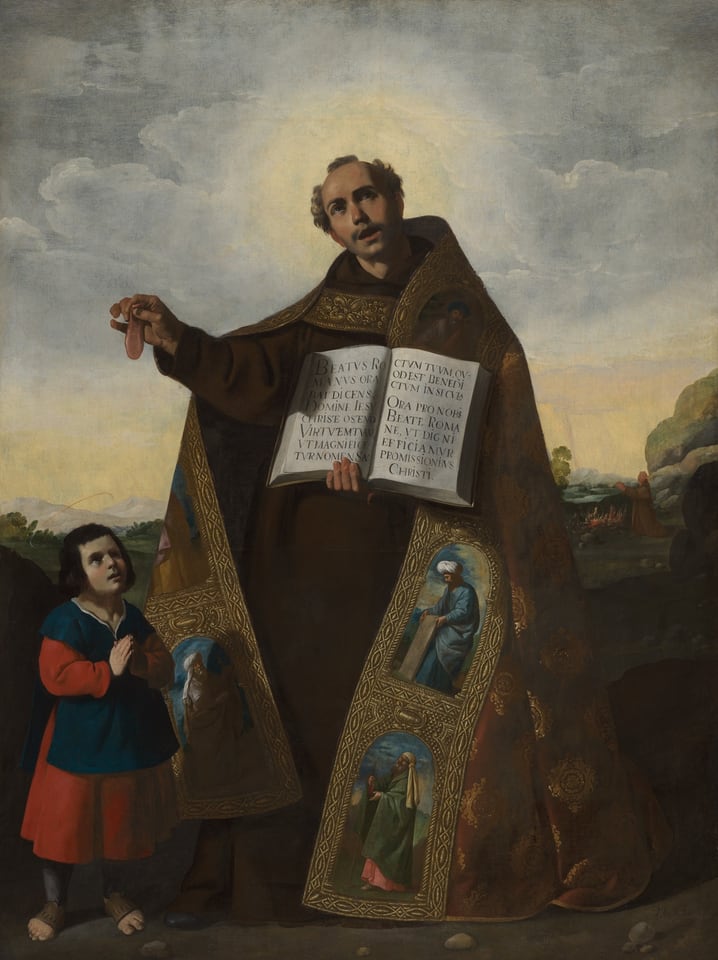
Francisco de Zurbarán created this painting for a church in Seville, Spain, dedicated to Saint Romanus of Antioch. Here, Romanus holds up his own tongue, torn out by his tormentors, and grasps a massive book inscribed with a prayer for the faithful. Painted to support the Counter-Reformation, the Catholic Church’s response to the Protestant movement, Zurbarán aimed to make the saints accessible to everyday people.
Text from the Art Institute of Chicago.
What you’re looking at
A work made of oil on canvas.
Description from the Art Institute of Chicago.
How it was made
- Oil paint
- Pigment ground in a drying oil, usually linseed. It dries slowly, so painters could blend on the canvas, build up thin translucent glazes, and rework a picture over weeks. Canvas replaced wooden panels in the 1500s because it is lighter and can be rolled.
Francisco de Zurbarán
Spanish, 1598–1664 · Born in Fuente de Cantos; died in Madrid.
Zurbarán worked chiefly in Seville, where religious orders commissioned him to paint cycles for their monasteries. His saints and monks, set against dark grounds and modelled with strong, sculptural light, combine austerity with close attention to the textures of cloth and wood. He also painted a handful of austere still lifes. As taste in Seville shifted towards Murillo’s softer style, he moved to Madrid in 1658, where he died.
Written by Ochre Editions.
Rights and the museum’s record
Public domain. The Art Institute of Chicago has dedicated this image to the public domain under CC0, so anyone may copy, adapt and use it, for any purpose, without asking. Our prints and files are reproductions made from the museum’s image; the museum doesn’t endorse them.
- Object number
- 1947.793
- Credit
- Courtesy of the Art Institute of Chicago
- Type
- Painting
- Department
- Painting and Sculpture of Europe
- Licence
- CC0 1.0 Universal
- Museum record
- See it on the museum’s site