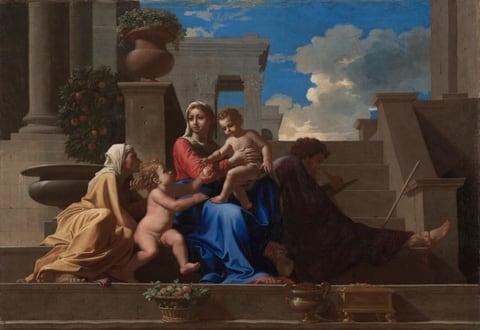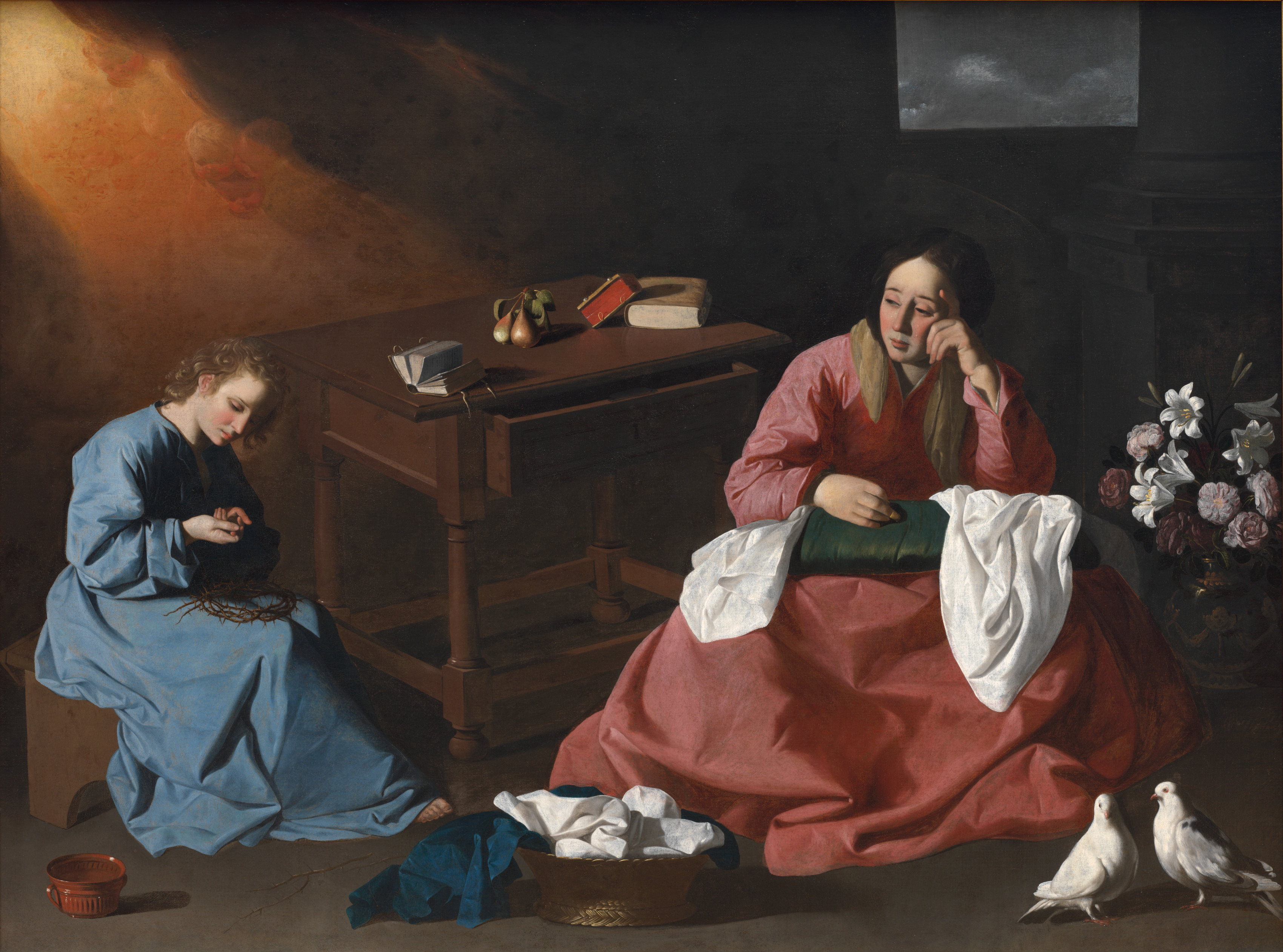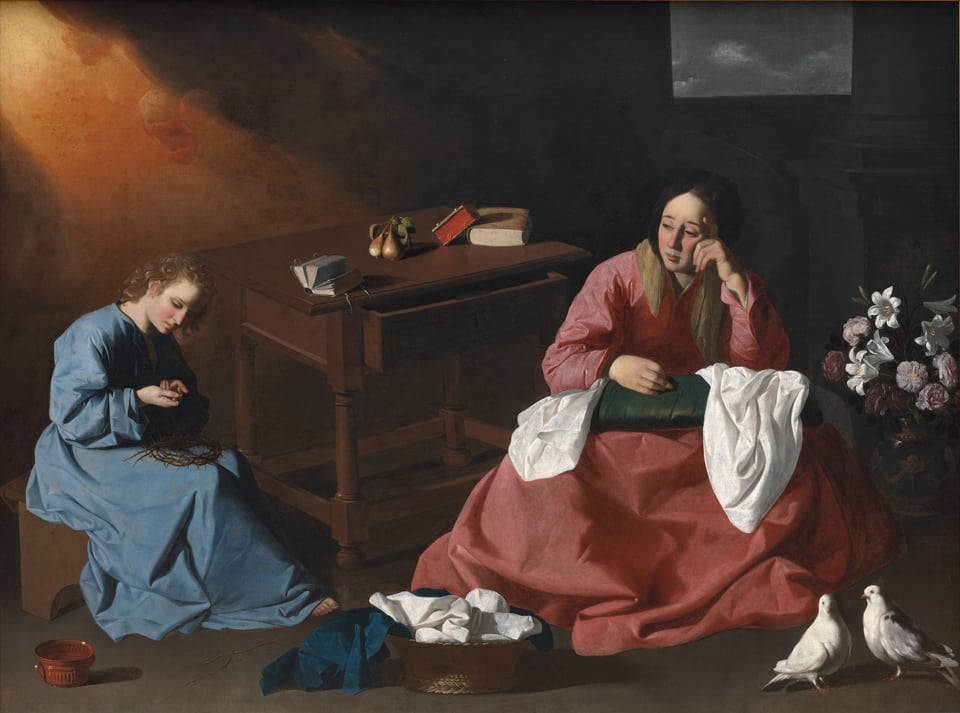
Christ and the Virgin in the House at Nazarethc. 1640
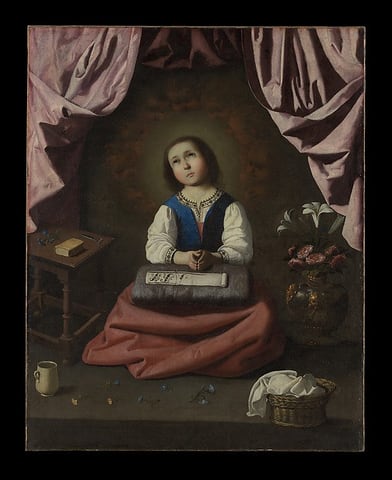
Stories of Christ’s childhood and adolescence became increasingly popular during the Counter-Reformation because they were easily understood by a broad public. More about this work
About this work
Stories of Christ’s childhood and adolescence became increasingly popular during the Counter-Reformation because they were easily understood by a broad public. Rather than taking a story from the Bible, Zurbarán appears to have invented this subject, in which Jesus pricks himself on a crown of thorns he is weaving, foretelling his later torment at the Crucifixion. Despite the grand scale and monumental figures, the work has remarkable intimacy and quietness, emphasizing such details as the Virgin’s tears.
Text from the Cleveland Museum of Art.
How it was made
- Oil paint
- Pigment ground in a drying oil, usually linseed. It dries slowly, so painters could blend on the canvas, build up thin translucent glazes, and rework a picture over weeks. Canvas replaced wooden panels in the 1500s because it is lighter and can be rolled.
Francisco de Zurbarán
Spanish, 1598–1664 · Born in Fuente de Cantos; died in Madrid.
Zurbarán worked chiefly in Seville, where religious orders commissioned him to paint cycles for their monasteries. His saints and monks, set against dark grounds and modelled with strong, sculptural light, combine austerity with close attention to the textures of cloth and wood. He also painted a handful of austere still lifes. As taste in Seville shifted towards Murillo’s softer style, he moved to Madrid in 1658, where he died.
Written by Ochre Editions.
Rights and the museum’s record
Public domain. The Cleveland Museum of Art has dedicated this image to the public domain under CC0, so anyone may copy, adapt and use it, for any purpose, without asking. Our prints and files are reproductions made from the museum’s image; the museum doesn’t endorse them.
- Object number
- 1960.117
- Credit
- Courtesy of the Cleveland Museum of Art
- Type
- Painting
- Department
- European Painting and Sculpture
- Licence
- CC0 1.0 Universal
- Museum record
- See it on the museum’s site