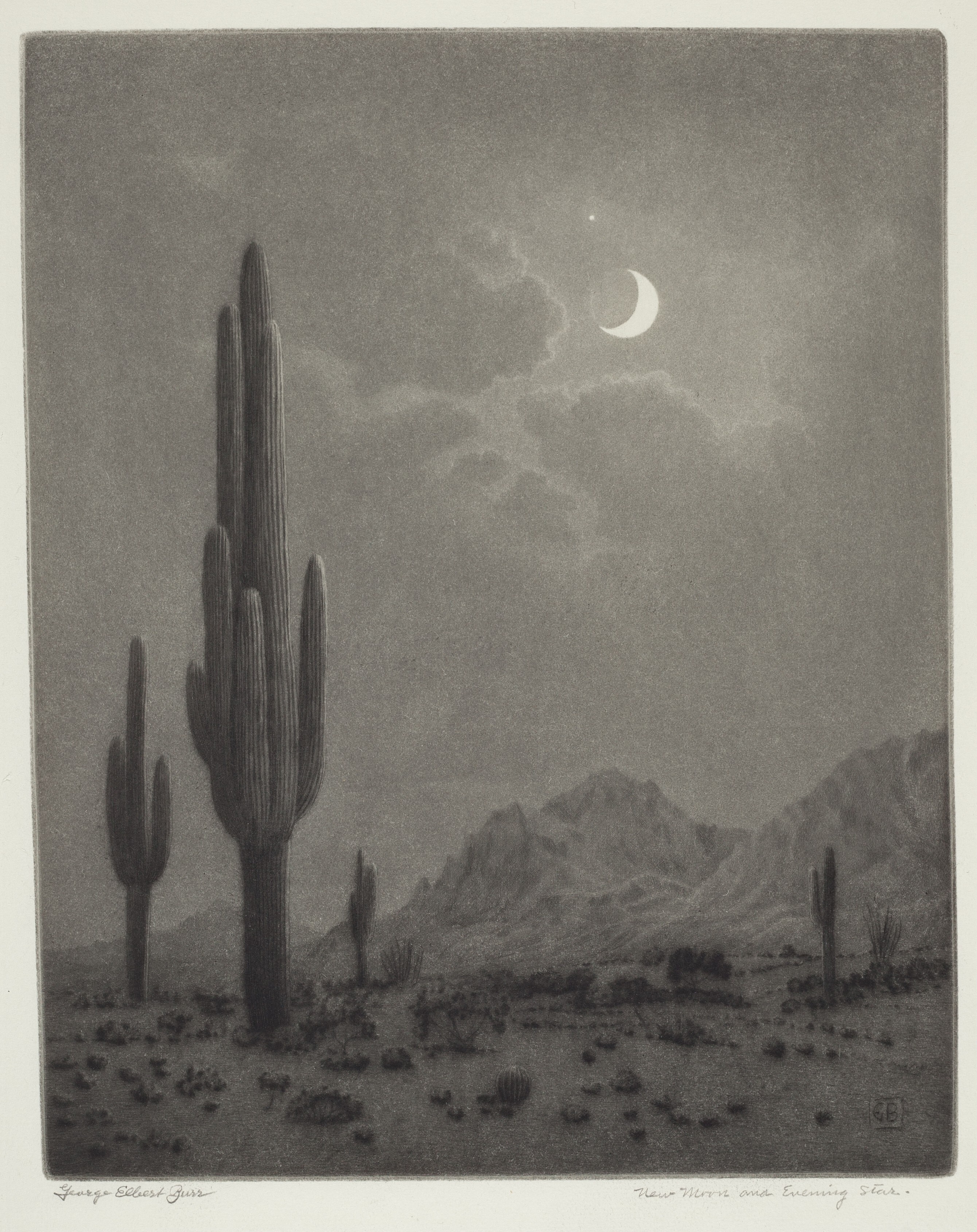
New Moon and Evening Starc. 1932
A saguaro cactus stands silhouetted at the left of a darkening desert, while a crescent moon and a bright evening star shine through a break in soft grey clouds above rocky mountains. More about this work
About this work
A saguaro cactus stands silhouetted at the left of a darkening desert, while a crescent moon and a bright evening star shine through a break in soft grey clouds above rocky mountains. George Elbert Burr settled in Arizona in the 1920s and made the desert his great subject, producing many etchings of its plants, mountains and changing skies. Here he combines etching, drypoint and aquatint to build the velvety tones of dusk, when the desert’s forms dissolve into shadow.
Written by Ochre Editions.
What you’re looking at
This print depicts a grayscale desert landscape with a prominent saguaro cactus to the left. In the background, rocky mountains are visible in the darkness. The sky shows a crescent moon and a bright star through an opening in the soft gray clouds. Sparse desert vegetation is faintly visible on the ground, and more cacti can be seen in the distance.
Description from the National Gallery of Art.
How it was made
- Aquatint
- Resin dust is fused to the plate and bitten with acid, so the plate prints areas of tone, like a wash, rather than lines.
- Drypoint
- Lines scratched straight into the plate with a needle throw up a ridge of metal, the burr, which holds ink and prints a soft, furred line. The burr wears down, so early impressions are the richest.
- Etching
- The artist draws with a needle through a waxy coating on a copper plate, and acid bites the exposed lines. The plate is then inked, wiped and printed under pressure, so the line keeps the freedom of drawing.
George Elbert Burr
American, 1859–1939
Burr worked as an illustrator in New York before spending several years travelling and sketching in Europe around 1900. Moving west for his health, he settled in Denver and later in Phoenix, and became best known for etchings of the deserts and mountains of the American Southwest, many worked with drypoint and aquatint and some inked in colour to suggest the light of dawn and dusk.
Written by Ochre Editions.
Rights and the museum’s record
Public domain. The National Gallery of Art has dedicated this image to the public domain under CC0, so anyone may copy, adapt and use it, for any purpose, without asking. Our prints and files are reproductions made from the museum’s image; the museum doesn’t endorse them.
- Object number
- 2008.115.1124
- Credit
- Courtesy National Gallery of Art, Washington
- Type
- Licence
- CC0 1.0 Universal
- Museum record
- See it on the museum’s site