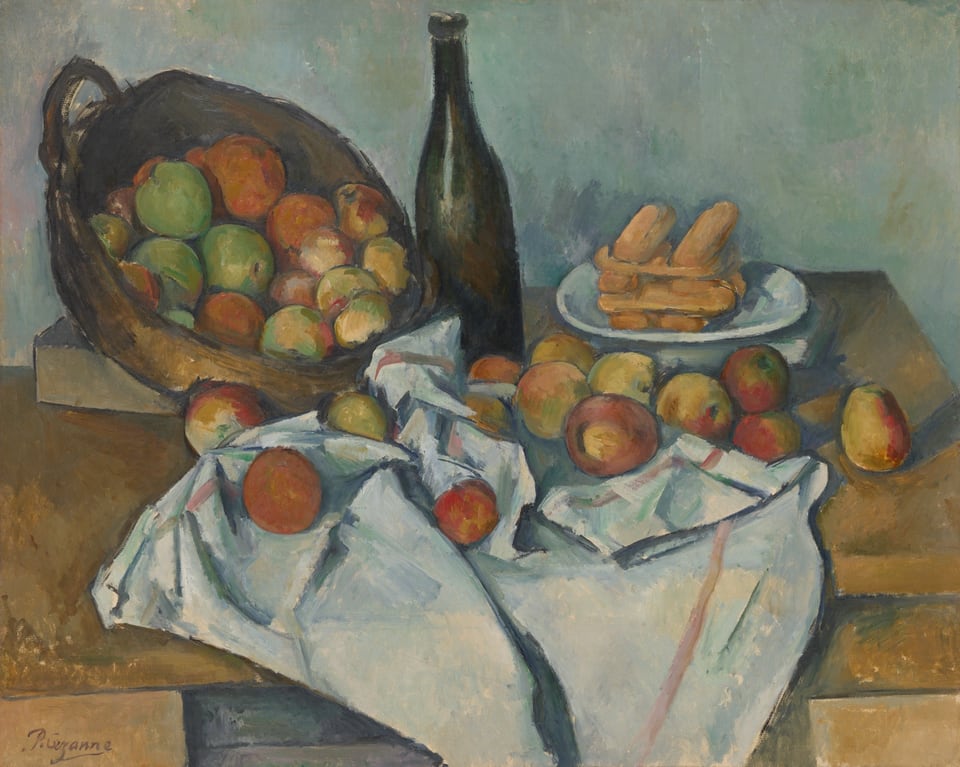
The Basket of Applesc. 1893
A basket of green and red-yellow apples tips forward onto a rumpled white cloth, beside a leaning dark green bottle and a plate of stacked biscuits. More about this work
About this work
A basket of green and red-yellow apples tips forward onto a rumpled white cloth, beside a leaning dark green bottle and a plate of stacked biscuits. Look at the table: its front edge does not line up from one side of the cloth to the other, and the bottle and basket seem to be seen from different angles. Cézanne deliberately combined viewpoints and adjusted forms to balance the whole composition, setting aside the single fixed perspective that had governed painting since the Renaissance. This quietly radical approach to still life became a starting point for the Cubists.
Written by Ochre Editions.
What you’re looking at
Painting of a basket of green and red-yellow apples spilling over into a white cloth placed on a wooden table, with a dark green bottle and a plate of pale biscuits behind.
Description from the Art Institute of Chicago.
How it was made
- Oil paint
- Pigment ground in a drying oil, usually linseed. It dries slowly, so painters could blend on the canvas, build up thin translucent glazes, and rework a picture over weeks. Canvas replaced wooden panels in the 1500s because it is lighter and can be rolled.
Paul Cézanne
French, 1839–1906 · Born and died in Aix-en-Provence.
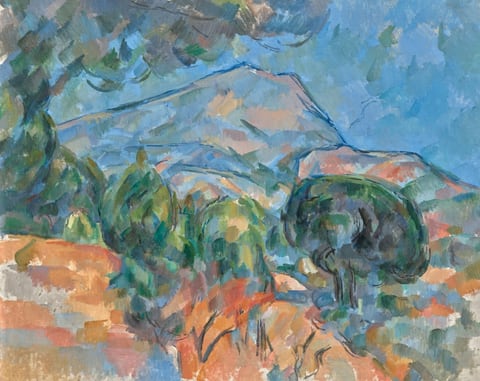
Cézanne divided his life between Paris and his native Aix-en-Provence. Encouraged by his schoolfriend Émile Zola and later by Pissarro, with whom he painted at Pontoise and Auvers in the 1870s, he showed at the first and third Impressionist exhibitions. He then withdrew to Provence and worked towards a more structured art, building form from patches of colour in still lifes, bathers and repeated views of Mont Sainte-Victoire. Younger painters, Picasso and Braque among them, saw him as a founder of modern painting.
Written by Ochre Editions.
Post-Impressionism
Artists who kept Impressionism's colour but pushed towards structure, symbol and feeling.
Rights and the museum’s record
Public domain. The Art Institute of Chicago has dedicated this image to the public domain under CC0, so anyone may copy, adapt and use it, for any purpose, without asking. Our prints and files are reproductions made from the museum’s image; the museum doesn’t endorse them.
- Object number
- 1926.252
- Credit
- Courtesy of the Art Institute of Chicago
- Type
- Painting
- Department
- Painting and Sculpture of Europe
- Licence
- CC0 1.0 Universal
- Museum record
- See it on the museum’s site