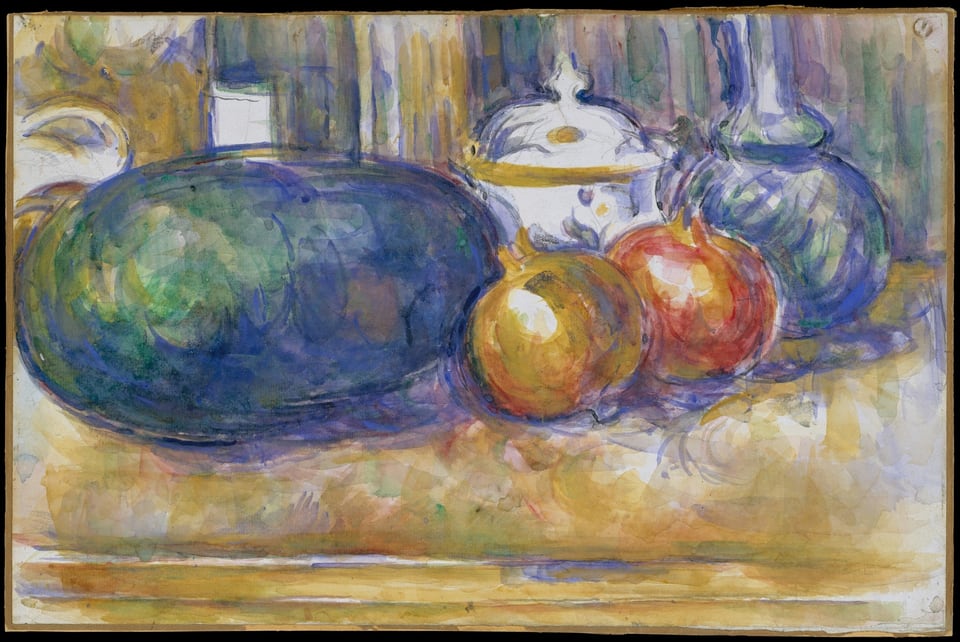
Still-Life with a Watermelon and Pomegranates1900–1906
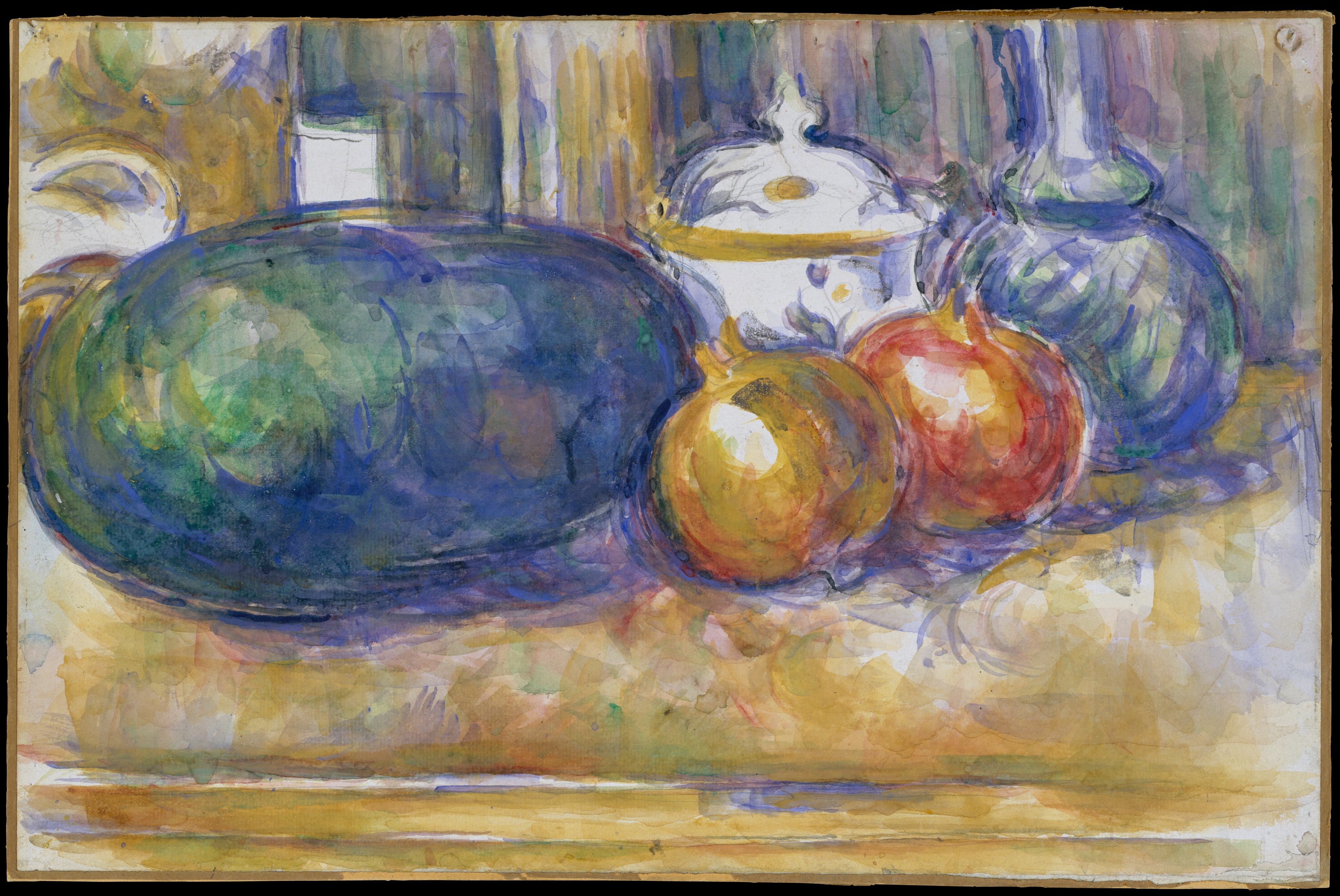
A watermelon, pomegranates and other objects are suggested rather than described in overlapping, translucent washes of watercolour over light pencil, with much of the white paper left bare. More about this work
About this work
A watermelon, pomegranates and other objects are suggested rather than described in overlapping, translucent washes of watercolour over light pencil, with much of the white paper left bare. In his last years Cézanne made many still life watercolours like this, building form from patches of colour that seem to vibrate against one another. The empty spaces are as important as the painted ones, letting light flow through the composition.
Written by Ochre Editions.
How it was made
- Watercolour
- Pigment in gum arabic, thinned with water and laid in transparent washes. Nothing white is painted: the light is the paper showing through.
- Graphite
- Pencil. Graphite has been used for drawing since the 1500s; in 1795 Nicolas-Jacques Conté mixed it with clay, so its hardness could be graded.
- Laid paper
- Handmade on a mould of close-set wires, which leave fine parallel lines you can see when the sheet is held to the light.
Paul Cézanne
French, 1839–1906 · Born and died in Aix-en-Provence.
Cézanne divided his life between Paris and his native Aix-en-Provence. Encouraged by his schoolfriend Émile Zola and later by Pissarro, with whom he painted at Pontoise and Auvers in the 1870s, he showed at the first and third Impressionist exhibitions. He then withdrew to Provence and worked towards a more structured art, building form from patches of colour in still lifes, bathers and repeated views of Mont Sainte-Victoire. Younger painters, Picasso and Braque among them, saw him as a founder of modern painting.
Written by Ochre Editions.
Post-Impressionism
Artists who kept Impressionism's colour but pushed towards structure, symbol and feeling.
Rights and the museum’s record
Public domain. The Met has dedicated this image to the public domain under CC0, so anyone may copy, adapt and use it, for any purpose, without asking. Our prints and files are reproductions made from the museum’s image; the museum doesn’t endorse them.
- Object number
- 2001.202.1
- Credit
- Courtesy of The Metropolitan Museum of Art
- Type
- Drawings
- Department
- Drawings and Prints
- Licence
- CC0 1.0 Universal
- Museum record
- See it on the museum’s site
Report this work
More by Paul Cézanne
All their works
Close in colour